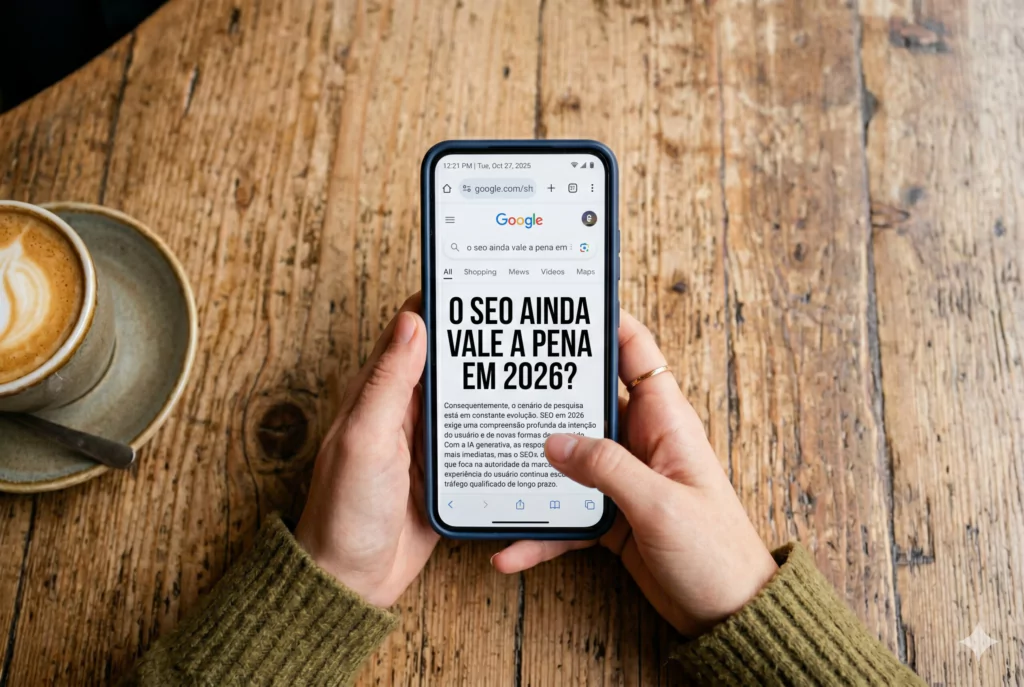
Second to BrightEdge Research, 53% of all traceable traffic on the Internet comes from organic searches. No announcements. No social networks. See from SEO.
If you are still wondering if it is worth investing in optimization for search mechanisms, that number should set off an important alert. But I understand that, in the end, in recent months, the digital market has practically seen one thing: “artificial intelligence is going to kill SEO.” ChatGPT, Gemini, Google’s AI Overview… many people seem convinced that the game is over for the organic.
Spoiler: it’s not over. In truth, SEO was never as strategic as it is now.
In this article, I will show you why this “SEO narrative” is wrong, as these data help us prove that, in fact, in the way of doing SEO in 2026. If you have an online business that wants to grow sustainably, without depending 100% on paid media (which, according to market analysis, is close to 20% more expensive in Brazil in 2026, pressing the electoral fund and the adjustments of the Meta Ads), continue reading.
SEO in the current scenario: AI, you’re looking for what’s really dumb
There is no time to ignore the elephant in the room. Google AI Overview, ChatGPT Search, Perplexity and others Artificial intelligence tools are changing how people seek information. Isso é real. Or that it is not real is a conclusion pressed that many people have said: the idea that SEO is dead.
This discussion must be held on large media. Em uma report published by UOL Economia in May 2026sector specialists discussed the topic and the consensus was very clear: SEO remains essential for companies that want to maintain digital relevance.
Nadjine Terhoch, Client Success Manager here at Agência Mestre, was one of the voices in the matter. Secondly, “SEO is not just appearing on Google: it is building digital authority and being recognized as a reliable source of artificial intelligence.”
O que mudou, de facto, foi o jogo. SEO is no longer just a race for positions in Google and has led to a dispute over authority, both in traditional search engines and in AIs. Plain, generic content and product only to preencher lost calendar. As artificial intelligences tend to prioritize deeper materials, trust and assassination by brands that demonstrate real authority over the subject.
And more: The future is not “AI replacing Google”. You find yourself coexisting. As Nadjine summarized in the report: “The future of search will be hybrid: Google and AI coexisting. The companies that will understand this are the first to be advanced.” Ou seja, quem investe em SEO de qualidade noje is constructing exactly the asset that can guarantee presence in both worlds.
Is it worth investing in SEO? Check the numbers that answer that question
Chega de achismo. Let’s go to the dice, in the end, when the matter is invested, the number is higher than you think.
The global market for SEO services is estimated at US$ 83.98 billion in 2026, second to aioSEO, and is projected to reach US$ 148.86 billion by 2030. This is not a declining market. It is a market in accelerated expansion. Companies that are still “questioning SEO makes sense” are, in practice, looking to the opposite side of an industry that continues to grow.
The ROI also helps explain this movement. Second data from HubSpot (2025), for every dollar invested in SEO, the average return is US$7.65. Em payment trafficthat number fell to US$ 1.80, second to SeoProfy.
- I also read: How to increase the ROI of marketing campaigns: know 8 strategies
In other words, or SEO delivers more than 4 times or returns half of the pay per invested amount. And this is a scenario in which Google Ads and Meta Ads costs in Brazil will rise approximately 20% in 2026, making organic traffic even more valuable as a long-term asset.
When the matter is B2B lead generationor argument fica ainda mais forte. Second Conversion Research, 61% of marketing professionals focus on SEO and organic traffic as the main source of qualified leads, above any other strategy. Makes sense, right? Or let us know that you are looking for organic products that you are actively looking for or that you offer. The purchase intention is new.
And there is a data that summarizes everything: 53% of all traceable traffic on the Internet comes from organic searches, second to BrightEdge Research. More da metade. Opening SEO is opening more of the largest amount of traffic available on the internet.
The numbers do not give much space for doubt: SEO is not expensive. The investment with two best returns from digital marketing.
Is AI killing or SEO?
Essa é, provavelmente, a pergunta que mas tenho ouvido heje. I understand where she sees you. When you see Google answering directly on the results page, without requiring you to click on a specific site, it is natural to think: “what is the meaning of fighting for appear on the first page of Google “Isn’t there going to click?”
But there is a fundamental detail that this narrative usually ignores: AI requires content to exist.
Google’s AI Overview does not create responses from anything. It searches, crawls and synthesizes information from sites that have demonstrated authority and are positioned organically. In other words: to be summoned by AI, you first need to be found, understood and recognized. SEO continues to be fundamental. However, your company simply does not enter into the conversation of artificial intelligence.
The data confirms this point. Second Semrush study released in November 2025, Google’s AI Overview already charges 15.69% of searches. When it appears, the organic CTR of position 1 is almost 61%. It is real and cannot be ignored. But another important side of the fashion: brands mentioned within the AI Overview we receive 35% more clicks than we receive without them. The problem is not with AI. The problem is not being present there.
Topics: A large majority of people using continuous generative AI tools also use traditional search engines. AI, therefore, works as a complement, not as a substitute. Likewise, ChatGPT Search, which already has about 9% of the search market second to First Page Sage, operates with a similar logic: it prioritizes content with authority, depth and credibility. This is exactly what a good SEO strategy should be built.
As Nadjine Terhoch said in the UOL report, the future of the search will be hybrid. Google and AI coexisting. Thus, strong SEO today is building a presence in our environments at the same time, without paying more per isso.
AI does not affect SEO. The elevated level. Quem face SEO de qualidade saiu in front. Quem fazia SEO de volume, sin critério e sin stratégia, ficou para tras. Simple assim.
The SEO leaf is different and, therefore, more important
If you are also associated with SEO to enter keyword text, buy mass links and try to trick Google’s algorithm, you need to update this concept. This type of SEO was late (and it was late). Or that there is a much more sophisticated and, therefore, much more strategic discipline.
O Google deixou clear or path with the reinforcement of the concept of EEAT do Google: Experience, Expertise, Authority and Reliability. The algorithm wants to deliver to the user the best possible content, produced by those who really understand the matter. The December 2025 Core Update harshly penalized generic content, including those generated in mass by AI without editorial criteria. The Quality Rater Guidelines updated in September 2025 will explicitly identify and punish false authority sinais.
In practice, this means that SEO now involves at least four simultaneous fronts:
- Technical SEO: loading speed, data structure, mobile-first, Core Web Vitals. Sites that are technically structured are processed more easily both by Google and by AIs. Isso was never so critical as now;
- content of authority: it is not enough to publish, it is necessary to publish well. Content with real depth, original data, confirmed authorship and constant updating. AI is strongly affected by recent data: content with more than three months without updating tends to lose citations in responses generated by artificial intelligence;
- link building of quality: backlinks continue to be one of two main ranking sinais. More than 65% of the pages on the internet do not have a single backlink, second market data. That the construction of domain authorities with consistency is expressively differentiated from consistency;
- GEO (Generative Engine Optimization): the newest frontier of SEO. It is a specific optimization to appear in the responses of generative AIs. Isso means structuring information so that ChatGPT, Gemini and AI Overview can interpret and use its content in the responses. According to Saeva, based on conversion research, 63.6% of Brazilian companies have invested in SEO, but only 24.3% have adopted GEO. The difference is open, but it is not going to be open forever.
SEO and branding will also go hand in hand. Digital reputation, presence on multiple channels and original content directly influence organic visibility. A strong brand ranqueia melhor. A site that ranks well strengthens the brand. It’s a cycle. And it begins with strategy.
The SEO of 2026 is more complex, sim. But it is precisely for this reason that it delivers more results for you to do directly. And it is also because the distance between investing in strategy and treating SEO as an operational task only increases.
What happens when you stop investing in SEO?
There is a fundamental difference between SEO and paid media that many people only understand when they stop investing in two dollars.
When you pause a Google Ads or Meta Ads campaign, or traffic will begin on the same day. Literally. Or click some along with the investment. It is a model of aluguel: as soon as you pay, you appear. Deixou to pay, sumiu.
Or SEO works in an opposite way. It is an accumulated asset. Every article published, every backlink conquered, every technical marvel implemented, everything is so successful. The domain gains authority progressively, and that authority continues generating traffic, leads and sales even in the months in which the investment is lower. It is a digital heritage construction model.
More or the other way around is also true: when you stop investing in SEO, you don’t lose everything once and for all. I lose a few years and, many times, I don’t notice. Concorrência continues publishing, conquering links and gaining authority. The Google algorithm values freshness and constant updating. In six, twelve months, you are looking for Analytics and you notice that the numbers are falling. Thus, the work to recover positions is much more than it would have been to maintain them.
The market does not understand this cliff. According to Conversion data, 44.6% of Brazilian companies claim to want to increase their investment in SEO in 2025. There is no coincidence. It is reconfirmation that what is happening is that recovering lost ground costs much more than maintaining construction in progress.
In a scenario where the average payer is 20% more expensive, stopping SEO is, in practice, dependency on the most expensive channel and abandoning the channel that delivers the highest ROI. This is one of the less strategic decisions a marketing manager can make today.
The time to invest in SEO is not when you have lost positions. He said before. And now.
If you find yourself here and reconnoiter your company in some point in this text, it may be because you are too dependent on my pay, because your organic traffic is stagnant or because you simply never have a real SEO strategy, or Mestre I can help you change isso.
For more than 20 years doing SEO work for companies of all sizes and segments in Brazil. We do not sell magic formula without a promise of results in 30 days. That we deliver real strategy, consistent execution and sustainable organic growth. Exactly what the 2026 market demands.
Get in touch now and fill out the form below!