
The National Markets and Competition Commission (CNMC) has announced a public tender to hire analysts specialized in the scrutiny of content generated by influencers on platforms such as Instagram, YouTube and TikTok, with the specific objective of detecting possible unidentified commercial communications, that is, covert advertising. The contract, published on February 2, has an estimated value of €179,000 and an initial duration of 12 months with the option of two additional extensions of 12 months each. 
This action is part of the regulatory supervision exercise that the CNMC is carrying out after the entry into force of Royal Decree 444/2024, which develops article 94 of the General Law of Audiovisual Communication on the so-called “Users of Special Relevance” in video exchange services through digital platforms. 
Who are the Specially Relevant Users?
According to the Royal Decree, in force since May 2, 2024, a content creator is considered a User of Special Relevance (UER) when, simultaneously:
- Obtains gross income equal to or greater than €300,000 per year derived from its activity on video platforms
- Has at least 1,000,000 followers on a single platform or 2,000,000 combined on several
- Has published or shared at least 24 videos in the previous calendar year
The EBUs, as they are equivalent to audiovisual communication service providers, must register in the State Registry of Audiovisual Communication Service Providers and comply with clear obligations regarding advertising transparency, protection of minors and labeling of content by age, among other requirements derived from audiovisual regulations. 
Why monitor influencers?
The CNMC tender specifies three services that the companies or professionals that are awarded must provide:
- A consultation service on influencers and their content published on Instagram, YouTube and TikTok
- The delivery of monthly lists of the main influencers and their publications on these platforms
- The analysis of specific content to detect possible unidentified commercial communications.
The CNMC indicates that, since the entry into force of the EBU regime, it has identified approximately more than 1,600 influencers with significant impact who could be subject to supervision on social networks. Given this volume and the limited technical resources available internally, the regulator considers it necessary to use external experts to carry out a systematic analysis of the emissions of these agents. 
EBUs are not simply “big influencers” from a media perspective; By complying with the income and audience requirements provided for in audiovisual legislation, they are considered providers of audiovisual communication services for all legal purposes. This implies that the rules of Title VI of the General Law of Audiovisual Communication must apply, particularly those related to commercial communications, which require that all advertising be clearly differentiated from editorial content through optical, acoustic or spatial elements.
And practices such as making publications on social networks where products are promoted without clear identification as advertising content, are precisely at the origin of regulatory tightening. The obligation to unambiguously label commercial communications seeks to avoid the ambiguity that, for years, has characterized part of influencer marketing.
Examples of covert advertising pointed out by the Instagram account @hazmeunafotoasi
The regulations that the CNMC is now exploiting to extend surveillance responds to a modification of the Spanish audiovisual framework, promoted by the European Union, which seeks to adapt the traditional regulation of radio and television stations to a digital ecosystem where large content creators compete for attention and generate income comparable to traditional media. 
In practice, formulas persist that dilute this identification of “advertising” or “paid collaboration.”
The CNMC’s supervision of the EBU is contemporary with other regulatory actions that try to balance transparency, protection of minors and truthfulness in digital advertising. In addition to Royal Decree 444/2024, there is a Code of Conduct for Advertising through Influencers that complements legal regulation, aimed at promoting the best practices in the sector and clarifying how advertising on social networks should be identified. 
But since the entry into force of the Royal Decree, the regulator has detected that, although many creators have begun to incorporate labels such as “advertising” or “paid collaboration”, in practice formulas that dilute that identification persist. In some cases, the commercial mention appears in tiny fonts, colors that blend into the background, or for just a few seconds in stories and ephemeral videos, making it difficult for the user to truly perceive. These types of strategies formally comply, but materially they can be unclear.
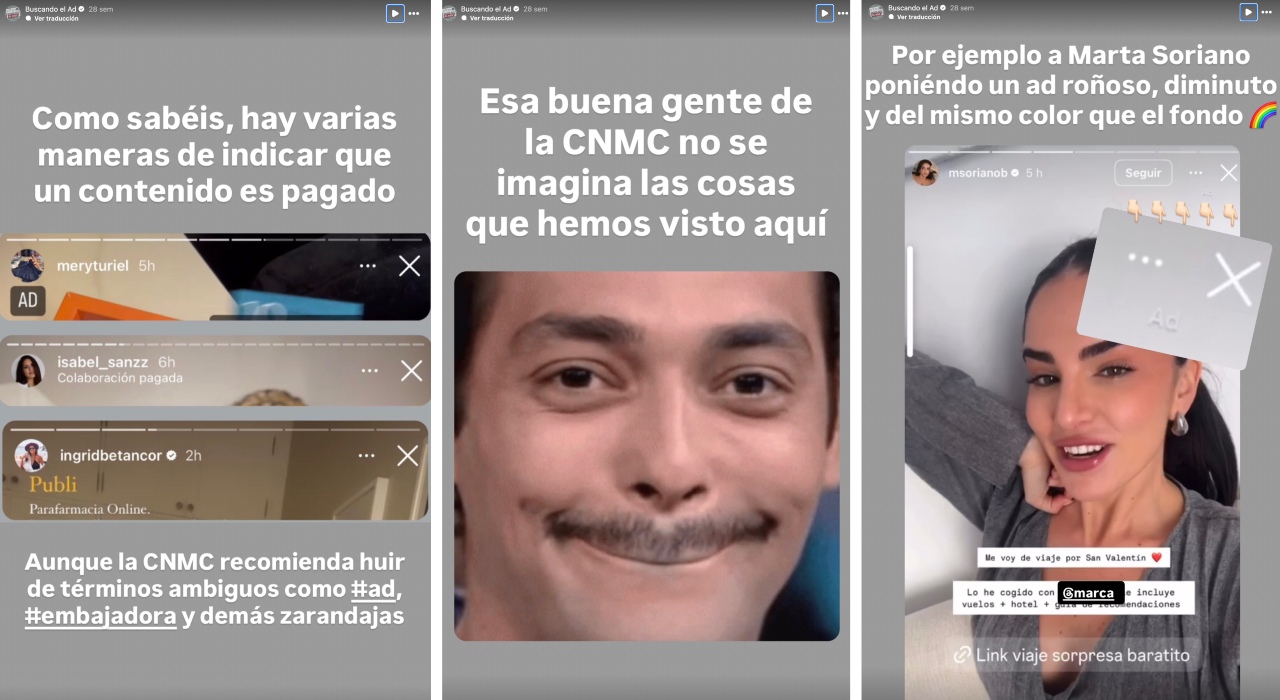
The Instagram account @hazmeunafotoasi has a section titled “Looking for the Ad”
The deadline to submit offers for these analysis and detection services ends on February 23, 2026, with the opening of technical and economic proposals scheduled for the end of February and the beginning of March. 
Taken together, this tender reflects a growing trend among European regulators to treat large content creators not only as “influencers”, but as agents with responsibilities comparable to traditional media outlets, especially when their economic activities, reach and business practices can impact massive and vulnerable audiences.