OpenAI continues to expand the commercial functions of ChatGPT and has taken a step that brings its operation closer to that of Google. The company has presented Businesses in ChatGPT, a new proposal that allows companies to claim and manage their presence in the artificial intelligence assistant, update information about their products and services and learn how users interact with their brands.
The launch introduces a model that is directly reminiscent of Google Business Profile, the system with which companies manage the information that appears about them in the Google search engine and on Maps. The difference is the environment in which discovery occurs, because instead of consulting a list of results, consumers use conversations with artificial intelligence to explore alternatives, compare products and make decisions.
Begins to provide tools to manage information and measure presence
The initiative comes at a time when brands’ visibility in AI-generated responses becomes increasingly important for digital marketing strategies. Until now, much of that conversation has focused on how to get attendees to mention or recommend a company. With this launch, OpenAI begins to provide companies themselves with tools to directly manage their information and measure part of that presence.
The service is in beta phase and is articulated through a new management platform called Business Hub. OpenAI presents it as a way to connect companies with the 1.2 billion people who, according to their figures, use ChatGPT every week.
The main novelty is the possibility of claiming a business profile within ChatGPT. Through Business Hub, eligible organizations will be able to verify their identity and manage relevant information about their activity, their products and their services. Once the verification process is completed, they will be able to update commercial data and directly incorporate product catalogs with information on prices and availability.
The stated goal is for ChatGPT to provide more accurate and up-to-date business information when users view products, compare alternatives, or search for information about a company.
The verification mechanism will vary depending on the type of business and the market. Benji Shomair, Vice President of Monetization at OpenAI, explained that the company contemplates different procedures to prove the ownership of profiles, although he has not detailed all the requirements.
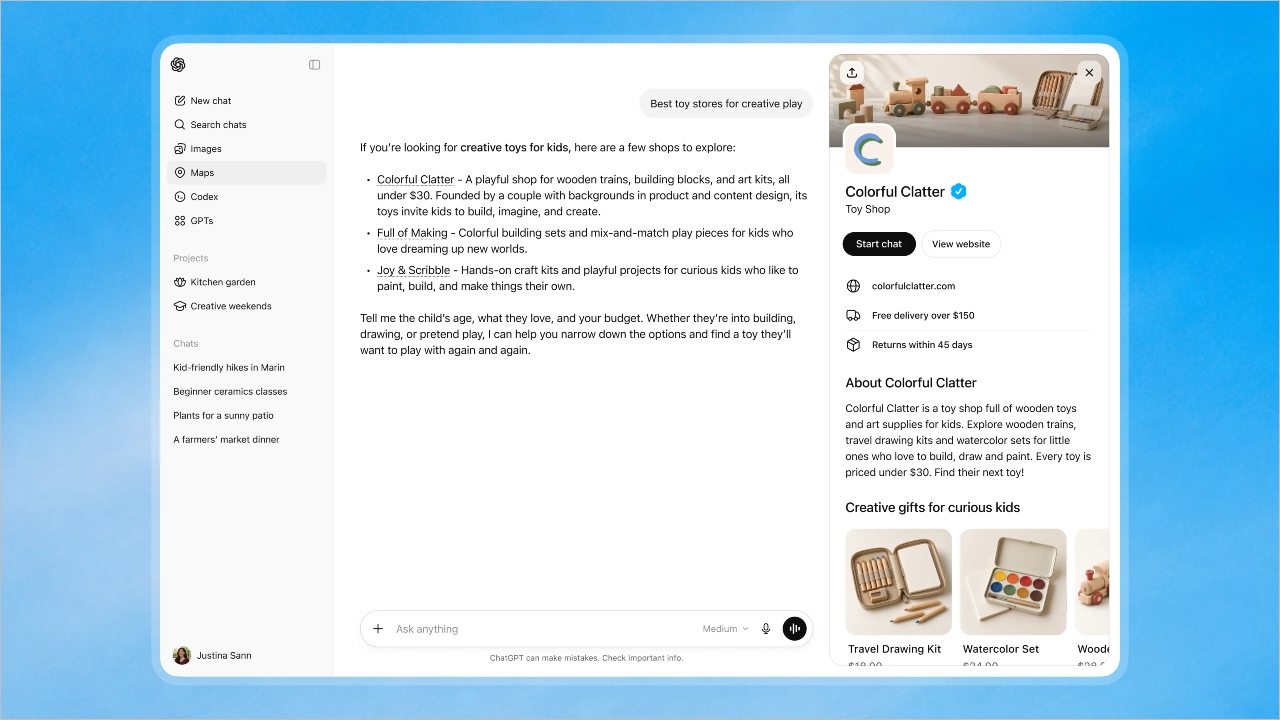
Eligible businesses located in markets where ChatGPT is available will be able to request your profile. OpenAI Enterprise customers and advertisers will be able to manage the process with their merchant representatives, while Shopify merchants will have specific mechanisms to connect their stores and simplify verification. The integration with Shopify thus makes it possible to link this new profile infrastructure with the product catalogs that are already present in ChatGPT.
A dashboard to see how a brand appears in conversations
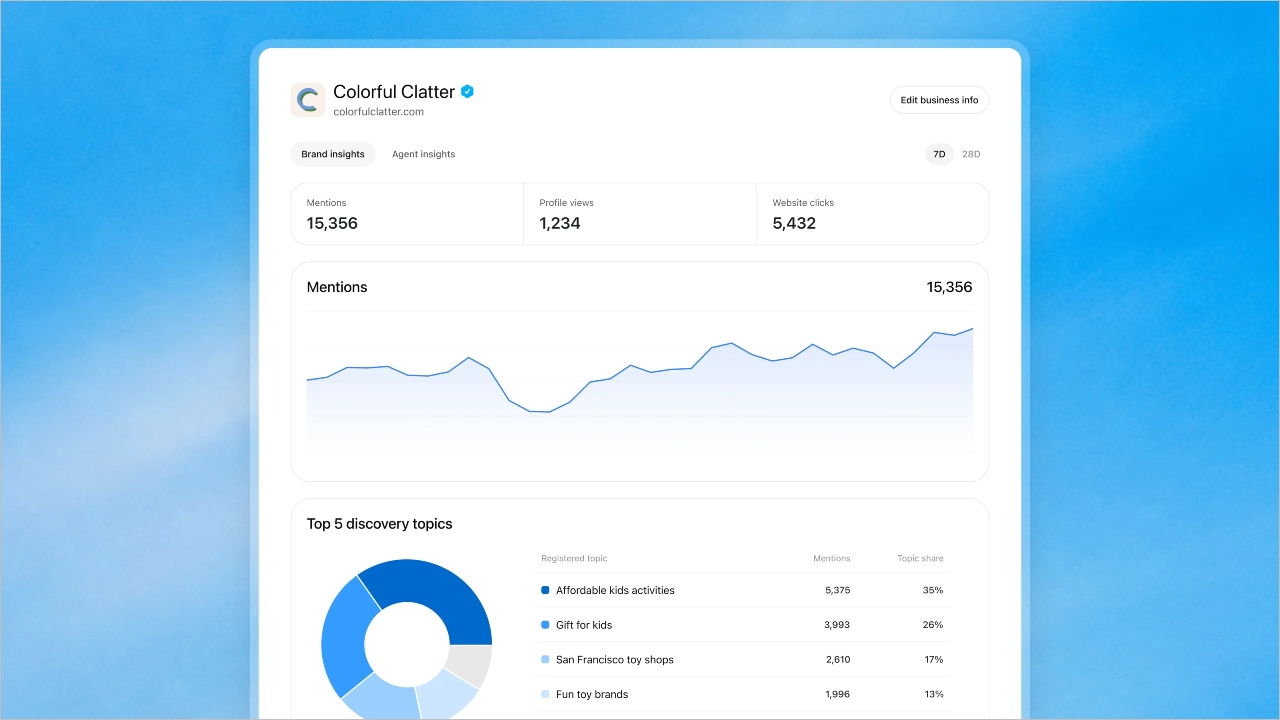
The second novelty announced by OpenAI is the incorporation of measurement tools that will allow companies to know how their discovery occurs within ChatGPT. Business Hub will offer aggregated indicators on user interaction with businesses, including:
- Company mentions on ChatGPT
- Business profile views
- Clicks to your website
- Discovery topics, that is, recurring topics in conversations in which the company’s website is cited.
These functionalities are reminiscent of the analytics systems that Google offers companies to understand their visibility and the interaction of users with their results. However, they introduce a difference and that is that the unit of analysis is no longer only a search or a click, but also the presence of the company within conversations that can be part of a decision process.
For marketing departments, this information can provide new signals about the contexts in which a brand appears, the interests associated with it, and the opportunities to improve the information it makes available to attendees.
OpenAI notes that the indicators will be offered on an aggregate basis and will be subject to minimum activity thresholds to preserve privacy. The company ensures that it will not share with companies the individual conversations of users or those held with their commercial agents.
It should be noted that the announced tools constitute a first set of metrics and are not yet equivalent to a complete commercial attribution or conversion measurement solution.
Business agents to accompany purchasing decisions
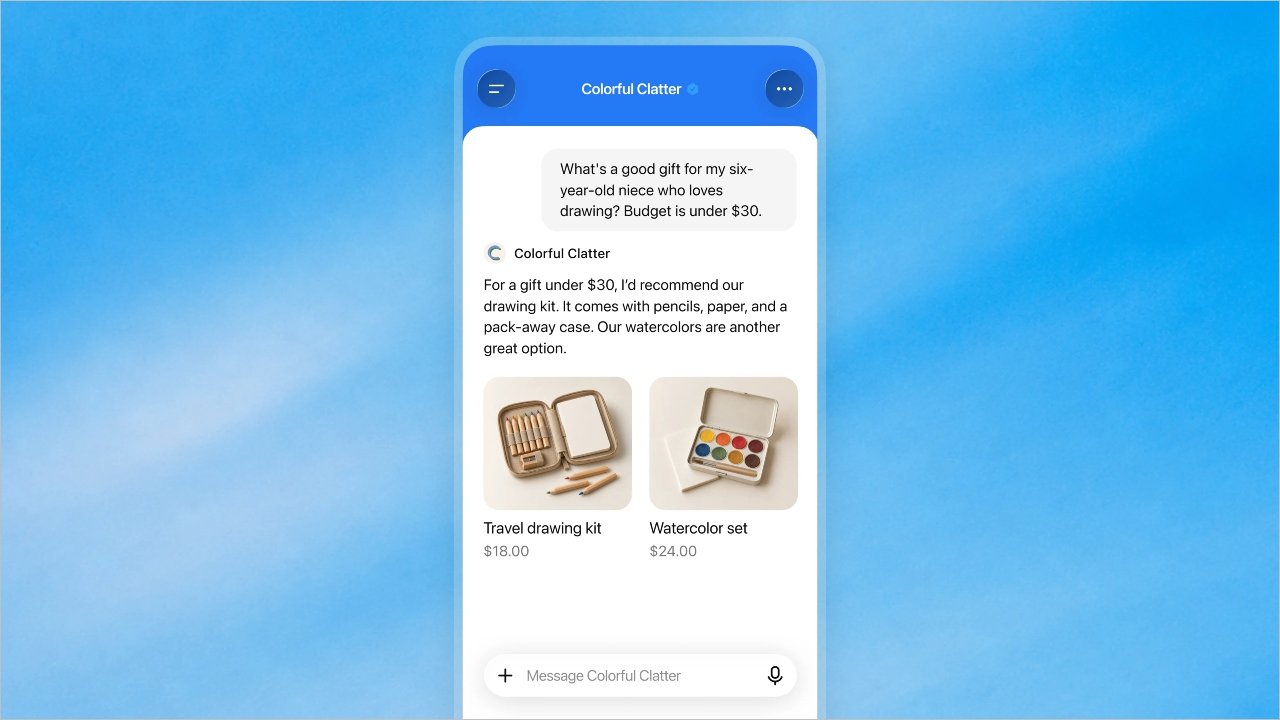
The launch also incorporates Business Agents, artificial intelligence agents that eligible companies can configure to answer questions about their products and services. When a company is mentioned in a ChatGPT response, the user will be able to access their profile. If you have a business agent, you will have the option to start a specific conversation to resolve doubts, compare alternatives or delve deeper into the characteristics of your offer. For example, a consumer interested in two products may ask about their differences and the features that best fit their needs.
OpenAI separates these interactions from general ChatGPT responses. Conversations with a Business Agent will be expressly identified as such and will take place in a space separate from the original conversation with the assistant.
This distinction is important because it allows us to recognize when the user is querying information through an agent linked to a company, rather than receiving an independent response from ChatGPT.
Business Agents are currently available for select e-commerce businesses and online services in the United States. OpenAI plans to progressively expand its availability to other markets and business categories.
The proposal also contemplates the possibility for companies to sponsor their agents and use them as an ad destination within ChatGPT. In this way, an ad can direct the user to a conversation with the brand agent, where they can ask questions about their products or services.
OpenAI ensures that these sponsored placements will be identified and separated from the attendee’s responses.
Claiming a profile will not guarantee appearing in recommendations or controlling responses
In short, ChatGPT is getting closer and closer to Google and opens a new stage for brand visibility. The parallels with Google Business Profile are evident in the management of verified profiles, updating business information and discovery metrics. But OpenAI’s move also reflects a broader evolution of artificial intelligence assistants.
Until now, brands could work to improve their presence in ChatGPT responses through content, positioning, and generative engine optimization strategies, known as GEO. With Business Hub, an additional way appears that allows the direct management of structured information and the possibility of consulting indicators about its appearance in the conversational environment.
However, this does not mean that claiming a profile guarantees appearing in the assistant’s recommendations, nor that companies can control ChatGPT’s independent responses. OpenAI has not announced in this sense that the verification will give priority to the results. It does mean, however, that companies begin to have their own space within a platform that increasingly intervenes in the discovery of products and services.
OpenAI has indicated that the launch is a first phase and that it will develop new tools for companies with more complex needs.