3 in every 10 Brazilians use artificial intelligence to understand politics, economics and sciences. O dice e da Nexus, Data Research and Intelligencein a survey carried out with more than 2,000 people throughout the country. And he says much more than it seems like a first read.
We are not just talking about technology enthusiasts or Silicon Valley executives. We are talking about the Brazilian media, those people who remember, hit the cell phone and, before forming an opinion about what they saw in the feed, use an AI tool to better understand the issue. This behavior is no longer a reality and is growing at an accelerated pace, mainly among young people and people with higher education and education.
To work with marketing, this fact raises an alert and, at the same time, opens up a huge opportunity. If the consumer already uses AI to learn, research and make decisions, the question that every brand needs to answer is simple and direct: does your company have these answers?
In this article, let’s understand what this change in behavior means, in practice, for digital marketing, because the traditional content production model is not enough and what it really means to build a strategy AI First before concorrência advance first. Let’s go la?
The Brazilian EA: what the dice reveal
According to the Nexus investigation, 2,012 Brazilians over 18 years of age lived throughout the country. The numbers should be careful with the scale. Total number of interviewees, 10% say they use AI tools frequently to understand complex topicswhile 20% will never use them some times. Somados, These groups practically represent one third of the adult population of Brazil. Ou seja, we are falsifying tens of thousands of people who will be incorporated into AI in the form of a combined and information process.
The cut by geração is even more revealing. Among young people from 18 to 30 years old, at age Z, 4 in every 10 will visit IA to learn about political, economic or scientific issues considered more complex. This is precisely the public that is now entering the labor market, building purchasing power and forming consumer habits that can last for decades. Ignoring how this group seeks to process information is a strategic error that brands tend to feel in the medium term.
Schooling and income also directly influence this behavior. Among people with complete higher education, 39% use AI to understand complex topics, a rate that fell to 32% among those with intermediate education and to 20% among those with fundamental education. Do not cut for income, or the pattern is repeated: 39% of those who earn more than five minimum wages use IA for this purpose, against 22% between those who receive at the minimum wage.
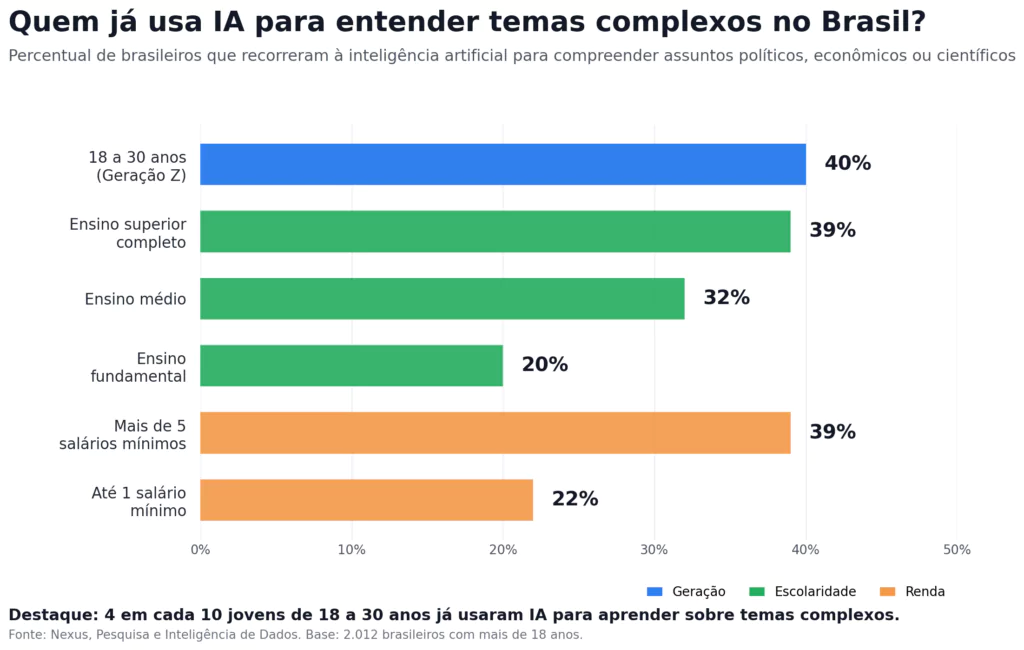
What do these numbers show, in practice, for marketing? That publics with greater purchasing power and greater influence over corporate decisions are, at this moment, being informed and shaped by responses generated by artificial intelligence. The truth is that, if the content of your brand is not present in this ecosystem, it simply does not exist in the journey of learning and making decisions for people.
It makes you curious to decide: does AI come into the consumer’s everyday life?
Understanding complex topics is just at the beginning. Nexus research shows that The use of artificial intelligence in Brazil has passed by intellectual curiosity and is migrating to a very strategic territory for brands: the moment of decision.
29% of Brazilians would feel comfortable using AI as support for decisions related to health and well-being. Another 28% affirm that these tools can be used to automate work or study tasks, and 23% see technology as an ally to increase productivity.
There are three uses for something in common: We all happen in moments of high intention. Health, productivity and work are not included in the categories of passive entertainment. Only in contexts where the consumer is actively searching for a solution, comparing alternatives and preparing to move forward. This is precisely where brands need to be present.
The use turned to work and productivity is more common among people with higher education and income above five minimum wages, reaching 35%. The application of AI in health and well-being appears more among individuals with minimum wage income, women and people between 45 and 60 years old. Ou seja, There is no single consumer profile that uses AI to decide. This behavior crosses age groups, genders and social classes, even with different intensities.
Isso profoundly changes the logic of the marketing funil. For years, the dominant model separated the clarity or moment of learning from the moment of conversation. The consumer searches on Google, reads articles, watches videos and, only after walking this path, checks the brand.
Well, a growing part of this day is happening within generative AI tools, such as ChatGPT, Gemini and Perplexity, which deliver consolidated responses without necessarily directing the user to a specific site.

The Brazilian consumer has taken this step. Now we know which brands are ready to appear in a new contact point or whether they will continue to be optimized only for a search behavior that, in a few years, will no longer be the only way..
How content marketing needs to reinvent itself in the age of AI
For a long time, logically content marketing It was relatively simple: produce relevant material, optimize for certain key words and ensure that Google understands and ranks those pages. That formula worked for years and still has value. But it is not enough.
The reason is direct: a growing plot of the consumer’s search journey no longer ends in a click for a site. It ends in a response generated by an AI tool. Or ChatGPT, or Gemini, or Perplexity is Google’s own Search Generative Experience that consolidates information from multiple sources and delivers to the user a prompt response, without needing to visit the page. For brands, this means that appearing on the first page of Google continues to be important, but it is not the only game in the field.
The question that content marketing needs to answer now and later: How to ensure that your brand is cited, referenced and recommended for AI tools?
The answer passes through some fundamental pillars. The first is in depth. Basic content, which only lists superficial information about a topic, tends to be ignored by language models in favor of materials that really deepen a topic, draw its own perspective and demonstrate real mastery over the topic. Isso is directly linked to the concept of EEATacronym in English for Experience, Specialty, Authority and Reliability, which Google already uses to evaluate the quality of content and that generative AI models replicate in similar ways.
The second pillar is the use of primary data. Proprietary research, exclusive studies and analyzes based on original sources are only specific to the type of content that AI tools tend to reference, because they represent information that is not available anywhere. It is for this reason that given how Nexus researches it, it has so much strategic value: it creates a content that is, by definition, unique.
The third pillar is consistency of voice and authority. Brands that publish regularly on a specific topic, maintaining a clear and well-founded point of view, build over time the type of reputation that the algorithms, whether traditional search or generative AI, reconhecem and valorize.
Reinventing content marketing in the age of AI does not mean abandoning what works. It means adding a strategic layer that many companies still ignore: producing content that is not only found by the consumer, but also recognized as a reference for the tools that this consumer already uses to decide.

The role of agencies in need of transition: conheça a Mestre
Most companies already understand that they need to incorporate artificial intelligence into their marketing strategy. The problem is to understand the needs and know how to execute some very different things. There is no space between the intention and practice of the role of an agency AI First it becomes essential.
here na Mestrethis is exactly the work we do. We do not sell technology for technology. We help companies transform artificial intelligence into real strategy, with measurable and long-term results..
In practice, this work happens on three main fronts.
At first it is content and SEO. We do not produce volume content just to feed an editorial calendar. We map the topics so that your brand needs the authority, we identify how these topics are being processed by generative AI tools and we build a strategy that guarantees presence and relevance both in traditional search engines and in responses generated by language models, combining classic SEO with AEO, and engine optimization. of response.
Second front payment traffic and personalization. With AI, it is possible to segment, test and adjust campaigns at a pace that would be impossible manually. This process does not only reduce or cost by acquisition, as it also identifies patterns of behavior that inform decisions very much apart from the media pay, impacting or positioning, to offer and communicate your brand as a whole.
A third versus data and intelligence. Most companies collect data, but we rarely manage to transform them into age-old decisions. We act as partners in the construction of a data-driven operation, in which each campaign, each content and each interaction generates learning that feeds back to the strategy.
The Brazilian consumer is already using AI to learn, compare and decide. If your company wants to be present on that day, or moment of today. Learn about Agência Mestre’s services and discover how our strategy can transform your results.. Just get in touch and fill out the form below!