
The European labor market is going through a turning point as different countries transpose the European Salary Transparency Directive into their respective regulatory frameworks. Beyond a legal issue, the situation opens an opportunity for companies to improve their employer brand, team management or selection processes.
And knowing the salary of colleagues or the criteria that the company applies to establish remuneration can improve the trust of professionals in organizations, according to research by Infojobs. In June, the platform surveyed 4,660 people from the active population, between 18 and 65 years old, to analyze the perception of the impact of the future standard, still pending approval.
The new law aims to reduce and eliminate wage gaps and expand workers’ rights
The law seeks to reduce and eliminate the wage gap and, to this end, establishes new obligations for companies in terms of information, justification of remuneration differences and worker rights. The measures were approved by the Council of Ministers on September 8, after exceeding the deadline for transposition set for June 7.
As explained by the Ministry of Labor and Social Economy, the standard aims to combat precariousness by guaranteeing adequate access from the first moment to the essential characteristics of the employment relationship. In this sense, it stipulates the essential elements that must appear in the employment contract, including the start date and end date if applicable; the content of the labor provision; professional category or group; the applicable labor agreement; working time and distribution of the day, overtime, vacations; duration and conditions of the trial period. With regard to remuneration, the base salary, supplements, method of calculating variable concepts and perception criteria must be specified.
In addition, one of the main measures is that employers will have 30 days to provide people with a current contract with the information they request about their working conditions. Another novelty is the incorporation of the technological vision, since access must be provided to the criteria and algorithmic rules that determine the working conditions, that is, to provide information related to the existence of algorithmic or automated systems applied to decision-making related to the determination, fixing, variation or modification of working conditions.
The perception of transparency
One of the main findings of the Infojobs analysis has to do with the obligations related to the selection processes. The European directive establishes that candidates must know the starting salary or remuneration band before the job interview or by publishing the offer. The intention would be to guarantee more balanced negotiations and reduce possible remuneration inequalities.
These measures have the support of workers: 62% believe that publishing the salary range will improve trust in the company, 60% believe that it favors equal pay and 59% that it contributes to greater pay equity. Furthermore, more than half (54%) understand that it would strengthen their negotiating power with the contracting company.
From the employment platform they indicate that these perceptions find certain differences by gender. Women attribute a greater positive impact to the publication of salary ranges: 67% consider that including salary in offers would contribute to reinforcing pay equality and trust in organizations, compared to 53% of men.
Lack of knowledge about salaries
According to Infojobs, this perception may be related to a lower availability of salary information. They point out that lack of knowledge about remuneration especially affects women, workers in micro-businesses and professionals with salaries of less than 1,000 euros per month; all of them groups with a less favorable position when negotiating their working conditions.
However, ignorance is still a widespread issue. 44% of workers admit that they do not know what the salary range is for a professional with a similar profile in their sector of activity, and 22% say they do not have any reference as to what their salary should be. And the situation is similar if we focus on the context of the company: 41% of workers say they do not know how much colleagues with equivalent responsibilities earn and only 20% could make an estimate.
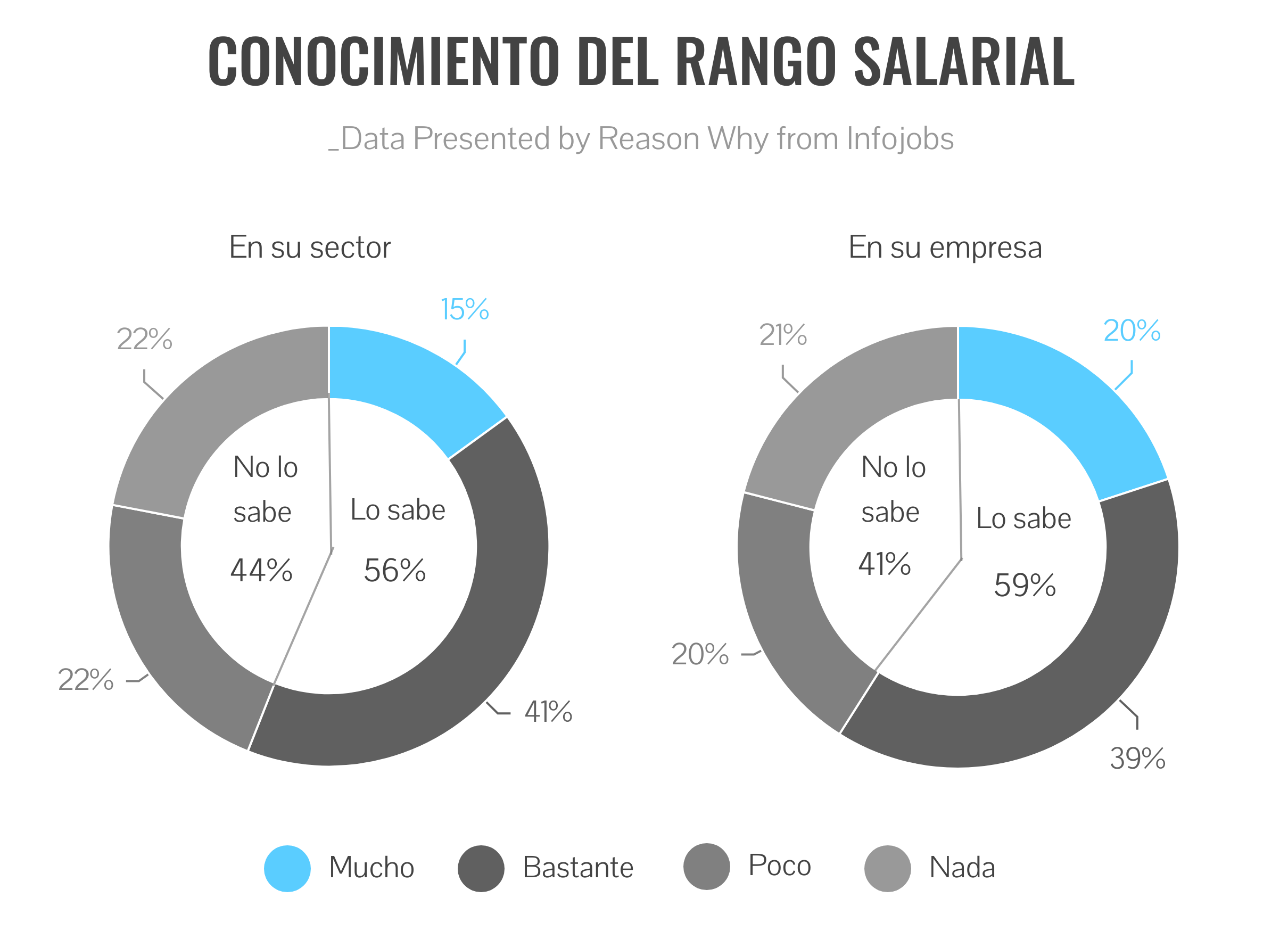
Differences are also observed by autonomous communities. Madrid and the Valencian Community register the highest levels of knowledge about salary ranges: in both communities, 57% of workers say they know how much a professional with a similar profile earns in their sector. The figure rises to 60% when it comes to professionals within the same company.
Ignorance also affects the way the organization sets salaries. Almost half of the workers (47%) say they do not know or partially know the criteria their company uses to establish remuneration and salary reviews. Furthermore, among professionals who say they know them, only 23% consider these criteria to be truly fair and transparent, while 30% believe that they are neither sufficient nor equitable.
Tips for salary transparency
From Infojobs they understand that the data is a reflection that salary transparency responds to regulatory requirements, but also to a growing expectation on the part of professionals. In this regard, it offers a series of recommendations both to adapt to the regulations and to turn the new law into an opportunity with regard to selection and talent management processes.
Thus, he advises:
- Carry out internal audits: it is advisable to carry out remuneration audits to identify and correct possible unjustified salary gaps within the team
- Design structured salary bands: job offers must be based on objective, neutral criteria linked to the value of the position, skills and experience, not to the negotiation capacity of the candidates
- Training and reskilling for selection teams and managers: they must leave behind comparisons with previous salaries and focus on the ranges communicated for the offer; and they must evaluate talent based purely on competencies.
- Internal communication: transparency generates trust, so companies should not wait for employees to demand the data; They must integrate them into the communication of their remuneration policies as part of their talent loyalty strategy.