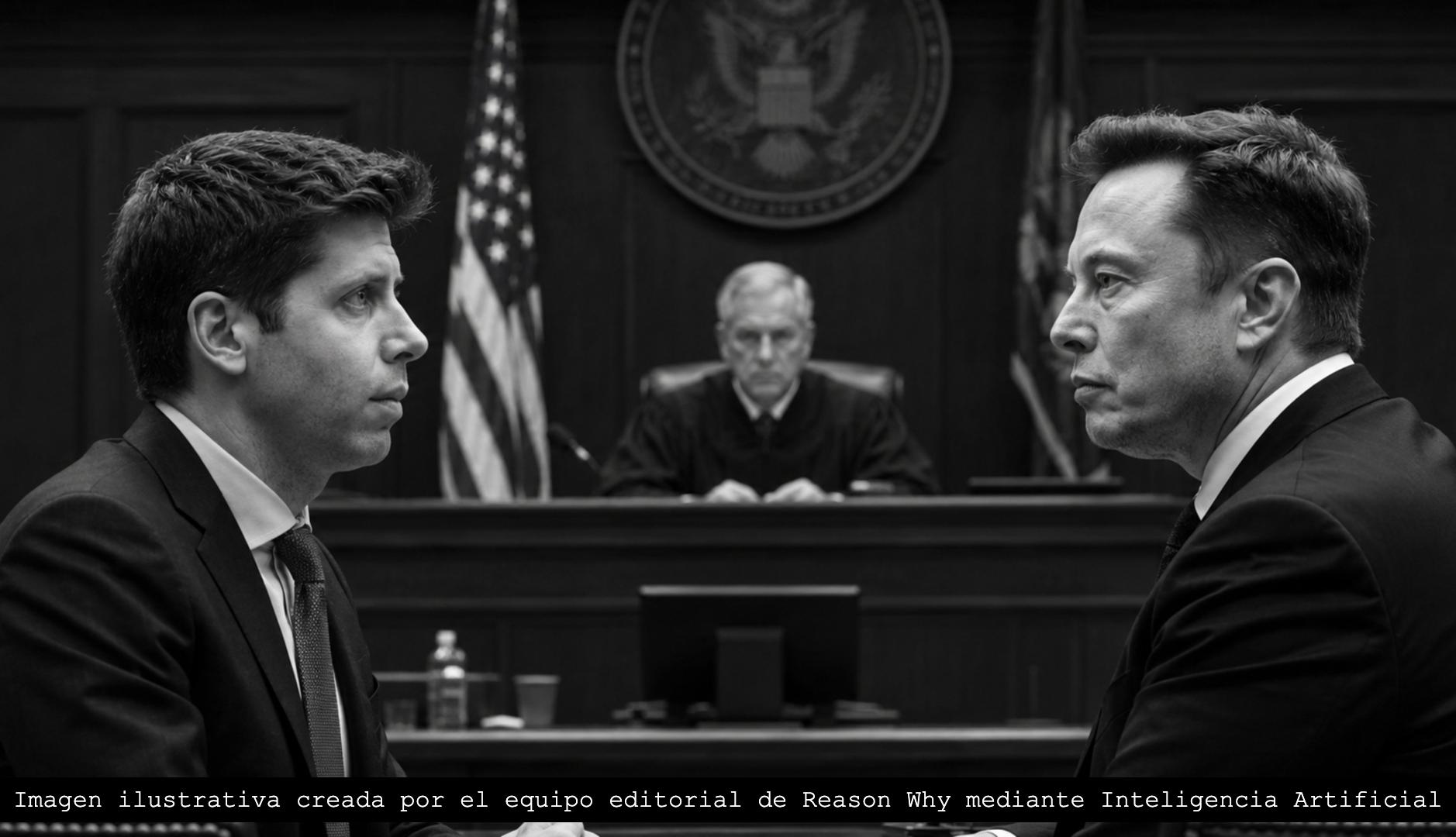
The open war between Elon Musk and Sam Altman for narrative, philosophical and business control of artificial intelligence has ended, for now, with a clear judicial victory for OpenAI. A federal jury in California has unanimously rejected Musk’s claims against the company, its CEO Sam Altman, President Greg Brockman and Microsoft, considering that the businessman presented his accusations about the alleged betrayal of OpenAI’s founding mission too late.
The verdict puts an end to one of the most watched processes in the recent technology industry and clears up one of the main legal threats to OpenAI just as the company moves towards a potential IPO that could become one of the largest in the history of Wall Street.
The dispute went back to the very origin of OpenAI. Musk, Altman and Brockman participated in the creation of the laboratory in 2015 as a non-profit organization aimed, at least on paper, at developing artificial intelligence. “for the benefit of humanity.” However, Musk accused the company of having abandoned that original purpose by progressively transforming into a for-profit business structure and closing multi-million dollar deals, especially with Microsoft.
Musk accused the company of abandoning its purpose by becoming a for-profit company
The Tesla founder maintained that he had contributed about $38 million under the premise that OpenAI would continue to operate as a non-profit organization. Their lawyers have even stated during the trial that Altman and Brockman had “robbed from a charity” by turning it into one of the most valuable private businesses in the technological world.
But the court has never really ruled on that underlying debate. The decisive question has ended up being procedural. The jury first had to determine whether Musk had filed the lawsuit within the time limits established by law. And he has concluded that no. Musk left the OpenAI board in 2018 and did not file the lawsuit until February 2024, a six-year interval that has been decisive for the outcome.
Judge Yvonne González Rogers immediately endorsed the jury’s recommendation and dismissed the claims. The ruling thus blocks all the measures that Musk intended to achieve, including the dismissal of Altman, the reversal of OpenAI’s corporate structure or an economic claim that could reach $134 billion.
For almost three weeks, the trial has offered an unprecedented image of the internal tensions, rivalries and transformations that have marked the rise of OpenAI from a small experimental laboratory to a global artificial intelligence giant.
Some of the most influential names in the technology sector have been taking the stand, including Sam Altman, Greg Brockman, Microsoft CEO Satya Nadella, the former scientific director of OpenAI, Ilya Sutskever, and Elon Musk himself. Hundreds of private messages, internal diaries and corporate documents were also presented that showed the discussions surrounding the company’s business evolution.
Musk’s defense attempted to erode Altman’s credibility by even recovering the episode of his brief dismissal as CEO in November 2023. Sutskever claimed to have collected evidence for months about what he described as a pattern of deception on Altman’s part, although he later admitted regretting having promoted that temporary departure. Altman himself admitted during the interrogation that he had said “some occasional lie.”
OpenAI, for its part, has presented Musk as a resentful competitor who left the organization when it failed to control its course and who years later created xAI to compete directly in the same market. Greg Brockman even publicly questioned Musk’s technical knowledge of artificial intelligence. “He knows about rockets, he knows about electric cars. He didn’t know, and I think he doesn’t know, about AI”he declared during the trial.
OpenAI has portrayed Musk as a resentful competitor who left the organization when it failed to control its course.
The company has also defended that the transition to a business model had been publicly known for years. OpenAI created a limited for-profit subsidiary in 2019 to raise capital, and in 2025 it completed a new reorganization as a public benefit corporation under the control of its original foundation.
The ruling strengthens OpenAI’s strategic position
Beyond the personal dimension of the confrontation between Musk and Altman, the trial had become a real threat to the financial and corporate stability of OpenAI. An eventual victory for Musk would have introduced enormous uncertainties about the shareholding structure, the ability to raise financing or even the viability of a future IPO.
Currently, OpenAI is valued at around $500 billion and some analysts consider that it could star in one of the most important IPOs ever seen in the technology market. Microsoft maintains approximately a 27% stake in the company, while the original foundation retains about 26%.
The financial context makes the judicial outcome even more relevant. While OpenAI has been working for months on a potential IPO, SpaceX – which recently absorbed xAI, the artificial intelligence company founded by Musk – is also preparing its own landing on the public markets. The trial has thus ended up becoming, indirectly, a clash between two future listed giants of artificial intelligence.
The ruling now removes one of the biggest legal obstacles in that path. And the resolution also prevents the case from setting legal precedents on one of the great emerging debates in artificial intelligence: the extent to which donors or founders of nonprofit laboratories can later challenge their transformation into multibillion-dollar commercial companies. That question, considered by many experts to be the philosophical and regulatory core of the conflict, has remained unresolved.
For Musk, the blow is important both at a reputational and strategic level. The businessman spent three days testifying before the jury and presented the case as a defense of charities against their corporate exploitation. However, the jury did not even assess the merits of those accusations.
However, Musk has already announced that the court battle will continue. Through “There is no doubt to anyone following the case in detail that Altman and Brockman enriched themselves by robbing a charity. The only question is when they did it.”the businessman has written. Musk also defends that allowing this type of corporate transformations would set a precedent “incredibly destructive” for charitable giving in the United States and recalls that, in his opinion, “OpenAI was founded to benefit all humanity.”
Meanwhile, the competition between OpenAI and xAI continues to intensify. Musk’s company, founded in 2023 and recently integrated into SpaceX, maintains other legal fronts open against OpenAI related to competition and trade secrets. But, at least for now, the most important battle in contemporary artificial intelligence has ended with Sam Altman consolidating his position at the helm of OpenAI.