Adobe has presented ten experimental artificial intelligence and creative technology projects during the Adobe Max 2026 Sneaks session, hosted by actor Terry Crews. The demonstrations, developed by its research and innovation teams, offer a preview of the tools with which the company is exploring new possibilities for audiovisual production, photography, design and digital content creation.
Proposals include systems capable of coherently applying modifications to different shots of a sequence, altering a scene while it is played, isolating sounds through text descriptions or transforming a photograph into a navigable environment. All of them share the same orientation to transfer complex technical operations to more intuitive forms of interaction, without giving up the creator’s ability to intervene in the result.
They are research projects in the development phase that allow Adobe to show where its investment is directed.
Sneaks demos are not necessarily announcements of features that will be immediately incorporated into Photoshop, Premiere Pro or other commercial applications; They are research projects in different phases of development, which allow Adobe to show where it is directing its technological investment and collect the impressions of the creative community.
Editing using natural language, understanding visual content and direct manipulation of elements are some of the lines of work that articulate this edition.
Edit an entire sequence without repeating each modification
One of the most representative projects is Project Scene Sweep, conceived to solve a common difficulty in audiovisual post-production such as maintaining the continuity of an edition across different planes.
The system recognizes characters, locations and scenes within a sequence and allows the same modification to be applied consistently, even if the camera angles change or cuts occur. Thus, a creative decision can be extended to an entire scene without having to manually reproduce the process in each take.
Project Scene Sweep allows you to transfer the same editing decision to different shots of a sequence
In a different vein, Project Live Set explores the possibility of directing a scene as it continues to unfold. The tool allows you to change a subject, transform the environment or modify the camera direction during playback, bringing video editing closer to a real-time intervention experience.
For its part, Project On Cue focuses on the temporal control of actions in video generated by artificial intelligence. Instead of just describing what should happen, it allows you to determine when a specific event occurs, such as a flash of light or movement. To do this, it uses editable time signals, which can be drawn manually or extracted from videos and musical compositions.
The fourth audiovisual project, Project Screen Test, addresses narrative development. It allows you to define the appearance, voice and personality of a fictional character and then converse with them using natural language. The proposal seeks to facilitate the exploration of their motivations and possible reactions to different situations before transferring it to a production.
From the description of sounds to the exploration of images from within
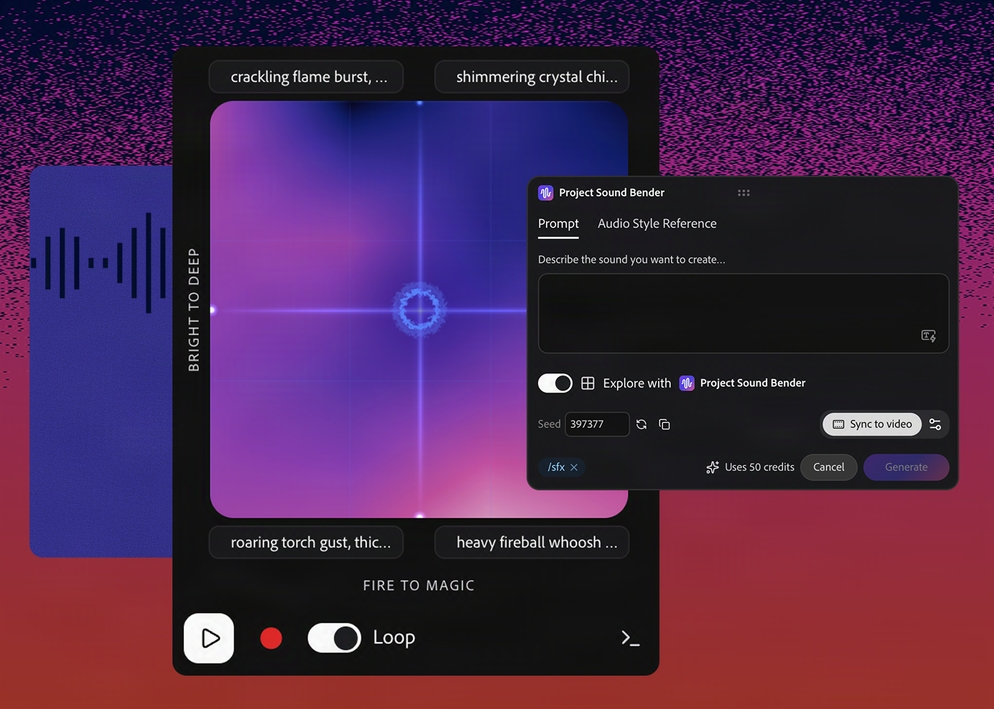
In the audio field, Adobe has introduced Project Sound Bender, an experimental tool that allows you to identify and isolate a specific sound within a finished mix from a textual description.
Once separated, the user can explore variations on an interactive canvas, modify its characteristics in real time and adapt its evolution to the movement of a scene. The project also includes the generation of new sounds based on instructions.
The proposal responds to a need in audiovisual production which is to be able to work on specific components of a sound track without necessarily having their original recordings separately.
In the field of image, Project Sight Span proposes a deeper transformation of the relationship between photography and visual composition. Starting from a static image, it generates a navigable environment that the creator can explore from within, discovering perspectives and framing that were not present in the original photograph.
The project points towards a closer integration between two-dimensional creation and three-dimensional environments, by allowing an image to stop functioning solely as a closed surface and begin to serve as a starting point for new compositions.
Smart brushes, gesture editing, and reusable edits
An important part of the projects presented focuses on the evolution of image editing tools.
Project Deep Brush uses artificial intelligence to interpret the shapes, colors and lighting conditions of a photo. In this way, brush strokes can adapt to the contours of objects, modify tones while preserving natural shadows or introduce light changes directly on the image.
The innovation lies in making the painting tool respond to the visual content it is working on, so that user intervention is more precise.
A similar approach inspires Project Hands On, which combines object segmentation and vision and language models to generate manipulation controls directly on the elements of an image. Instead of resorting exclusively to menus or parameters, the creator can intervene on the components of a scene using gestures.
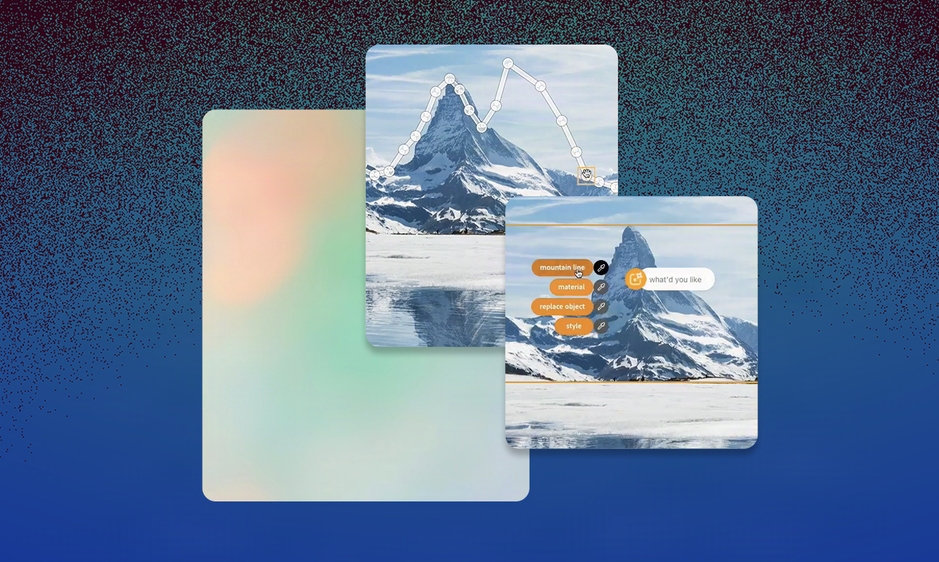
Project Rinse Repeat, for its part, allows you to transfer a modification made in one area of an image to other areas, adapting it to the characteristics of each one. One of its peculiarities is that it reproduces the operations using native Photoshop tools, so the results remain editable.
The tenth project, Project Link Up, investigates how to interpret creative intent from simple drag-and-drop actions. For example, when introducing an illustration of a car in a parking space, the system can automatically adjust its perspective, scale and style to integrate it into the composition. The result also retains its editable vector nature.
These demonstrations outline an evolution of creative interfaces towards systems capable of interpreting not only explicit instructions, but also the context of an image and the intention that the user expresses through their actions.
Adobe opens its Sneaks projects to public testing for the first time
One of the new features of this edition is that Adobe has decided to take part of the Sneaks experience beyond the demonstrations carried out on stage.
Through the new Adobe Labs Playground, the company offers access to experimental versions of Project Deep Brush and Project Hands On, which can be tested to learn about their capabilities and provide feedback to development teams.
The environment also includes a preview of Project Custom Filters, another line of research related to Photoshop’s editing capabilities.
The initiative expands the role of Adobe Labs as a meeting space between technological research and creative professionals. In addition to showing progress, the company seeks to obtain information about its practical usefulness, its limitations and the needs that could guide its evolution.
Its definitive incorporation into commercial products will depend on the evolution of each project. For now, Adobe Max 2026 has served to show what creative problems the company intends to solve and what role it attributes to artificial intelligence in the tools of the future.