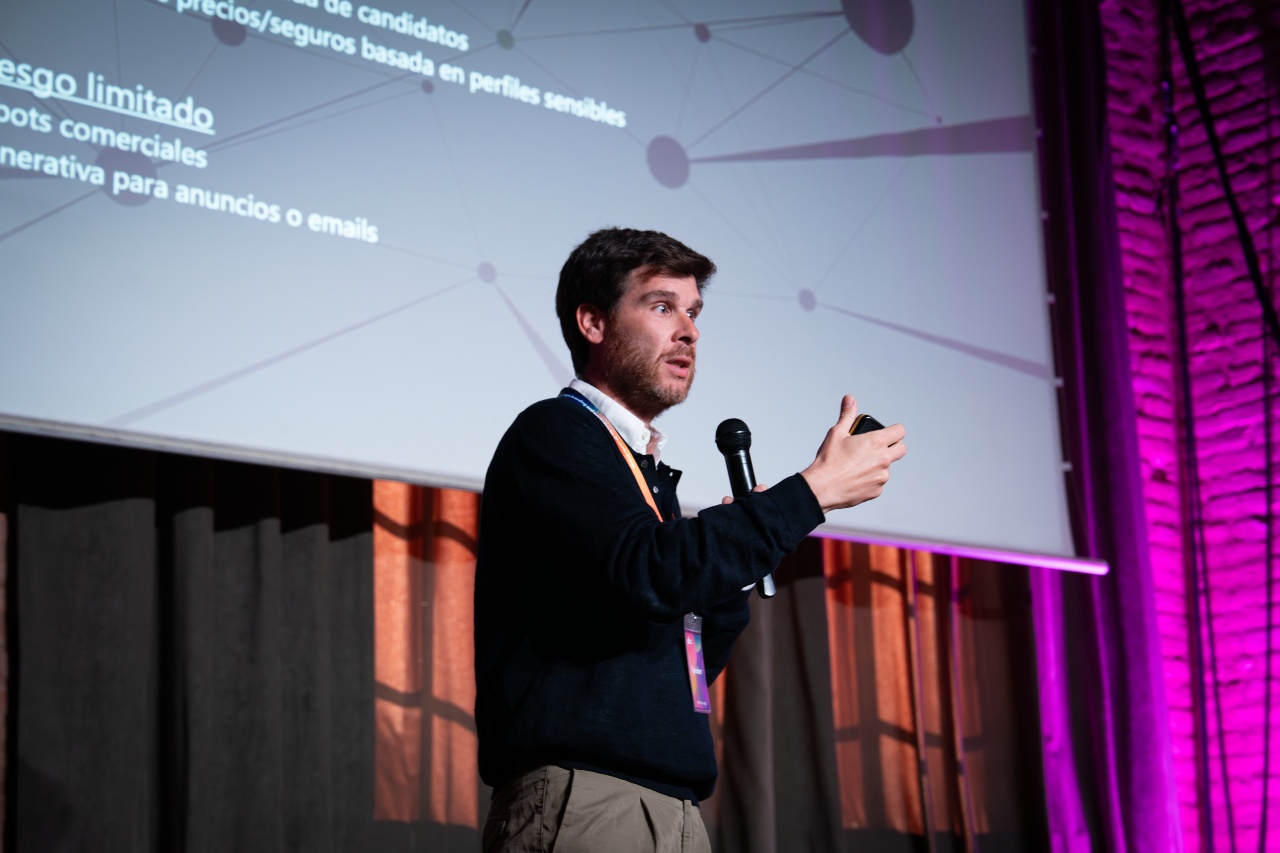
“We are going to try to explain the legal issue related to marketing and AI in a dynamic way, without going into many technical topics, to help you identify those red lines in your daily life.” This is how Sergio de Juan-Creix, Partner at Croma Legal, began his intervention at the AIBC 2026 meeting.
After a day dedicated to analyzing the creative, productive and strategic capabilities of artificial intelligence, AIBC 2026 closed with an inevitable question: under what conditions brands should use these tools and what responsibilities they assume when AI enters their marketing, communication and content production processes.
The conversation brought together Sergio de Juan-Creix, Partner at Croma Legal, and Helena Grau, Go to Market at Krea, in a session aimed at translating the legal framework into a practical language for companies, agencies and marketing teams. The reflection was part of the first edition of AIBC, the meeting promoted by the Buzz team – with Krea as creative partner and Linkvids as audiovisual production partner – to analyze the impact of artificial intelligence on business from an applied perspective.
The main thesis of his intervention was clear: the regulatory framework matters, but the first protective barrier remains common sense.
AI does not eliminate laws that already existed
One of the central ideas of the session was that artificial intelligence does not open an area exempt from responsibility. The rules on intellectual property, image rights, data protection, advertising, unfair competition or electronic commerce continue to apply, even if the tool used is new.
Helena Grau summarized it with a very direct formulation: “It seems that, because you can use artificial intelligence, they will stop applying many laws that they have applied for years”. And he added: “You can cut off someone’s head, hook it up with a collage and show it naked to everyone? No. So, you can’t do it with AI either, even though it’s easier.”
From the presentation made by both professionals, the following legal and ethical keys can be extracted for using AI in marketing without losing control
1. Classify risk before activating a use case
Sergio de Juan-Creix explained that the European Union’s Artificial Intelligence Regulation establishes different levels of risk: unacceptable, high, limited and minimal. In marketing, he noted, many uses are between limited and minimal risk, such as product recommendations, newsletter optimization or content generation for social networks. But that doesn’t mean everything is harmless.
Among the prohibited or especially sensitive uses, it mentioned subliminal techniques, the exploitation of vulnerabilities, social scoring, remote biometric identification or the generation of non-consensual sexual or intimate content. It also focused on high-risk uses that can affect companies and marketing departments, such as automated candidate selection or certain pricing systems based on sensitive profiles.
2. Require platforms not to train with company data
From Krea’s perspective, Helena Grau raised a first basic clause for any company that contracts an AI platform: ensure that the inputs introduced by the company are not used to train the model. “On our platform, nothing that you put as input is being used to train the model behind it”he pointed out.
For marketing teams, this affects briefs, images, client data, creative concepts, internal materials, strategies or confidential documents. The recommendation was clear: it is not enough to use a tool, you have to understand what happens to the information entered into it.
3. Check who is the owner of the generated output
The second contractual point highlighted by Grau was the ownership of the generated content. “Everything you produce with our platform is yours”explained about Krea’s approach, before recommending that any company ask and negotiate with its suppliers.
The issue is especially relevant for campaigns, visuals, audiovisual pieces, digital assets or materials that will later be used for commercial purposes. The fact that a platform allows content to be generated does not automatically mean that the brand can exploit it without reviewing its conditions.
4. Do not confuse compensation with carte blanche
Grau also addressed the compensation clauses that some platforms may offer. He explained that these can cover certain risks linked to the use of the system, but not improper uses made by the user. “What doesn’t cover you? Well, you should go and copy the Nike ad from 2003 and say: now you adapt it for me.”he pointed out.
The idea connects with a transversal warning: AI can be a means of production, but it does not legitimize copying campaigns, using protected references without permission or transforming other people’s materials to exploit them commercially.
5. Be careful with Pinterest, image banks and protected references
One of the clearest examples came when talking about intellectual property. Sergio de Juan-Creix presented a common situation: taking an image from Pinterest, passing it through an AI and using the result in a campaign. His response was blunt: if the original image is copyrighted and there is no license that allows such use, the process can still be problematic.
The AI does not erase the origin of the materials used. Transforming a protected image does not automatically make the result risk-free content.
6. Authorship of outputs remains a gray area
The session also addressed one of the big open questions: whether content generated with AI can be copyrighted. Grau recalled that, especially in the United States, it has been discussed that content generated entirely by AI lacks protection due to the lack of a human component. “In our case, we transfer absolute ownership of each creation to the user.”
De Juan-Creix defended a more nuanced reading. For him, asking for a generic image and accepting the first result is not the same as intervening for hours in the process, directing the composition, adjusting the style, modifying elements and building a piece with creative intent. “In the end Photoshop is a tool, so is AI”he stated.
7. Image rights require consent
The use of faces, clones, digital doubles or deepfakes was another of the great blocks of the session. De Juan-Creix recalled that the right to one’s own image is a fundamental right and that the general rule is consent. This applies to both living people and, in many cases, deceased people, whose rights may correspond to their heirs.
The lawyer recalled that a person’s image cannot be used for a campaign without permission, even if it is done using AI. And here come the cases of deepfakes, generated images or unauthorized uses that can cause reputational, legal or deontological conflicts.
8. Inform when AI is used so as not to mislead
Transparency was another central point. De Juan-Creix recalled that the AI Regulation includes identification obligations in certain cases and linked this requirement with unfair competition: if the content generated can be misleading, it must be warned.
The debate became especially interesting when addressing hybrid works, in which AI is part of a broader creative process. In those cases, he defended a prudent solution: not necessarily labeling each element, but reporting when AI has played a relevant role. “I put it to be transparent, which in the end is that exercise that the norm requires”he explained.
9. Protect personal data, even when it seems irrelevant
Data protection occupied another relevant block. De Juan-Creix recalled that today almost everything can be personal data: an IP, a cookie, an identifier, a pixel, a link with tracking or apparently anonymized data if it can be reversed and identify a person.
In the case of chatbots, automations or AI systems applied to marketing, he recommended clearly informing that the user is interacting with an AI, explaining the data processing in the privacy policy and evaluating whether this data will be used for profiling, advertising or subsequent communications.
10. Audit tools and avoid disorderly use within the company
The practical conclusion of the session was that AI cannot be adopted as a sum of individual decisions within each team. De Juan-Creix defended that companies must audit tools, decide which ones can be used, under what conditions and with what access.
The risk increases especially with agentic AI, because these systems can execute actions, access documents, manage information or integrate into corporate environments. “We must be careful with the access we provide”he warned. The recommendation was to work with corporate tools, review security conditions and prevent each employee from using free or uncontrolled solutions to process sensitive information.
The presentation ended with a simple idea, but difficult to apply in high-pressure productive environments: AI is not the dark side, but it can cause problems if used without control.
Ultimately, the AIBC 2026 legal session left a useful takeaway for marketing teams: responsible AI adoption doesn’t just depend on the legal department. It is a transversal issue that affects marketing, legal, IT, data, creativity, purchasing and management. And its guiding principle should be the combination of judgment, transparency, human oversight and common sense.
Here you can see the full presentation by Sergio de Juan-Creix and Helena Grau: