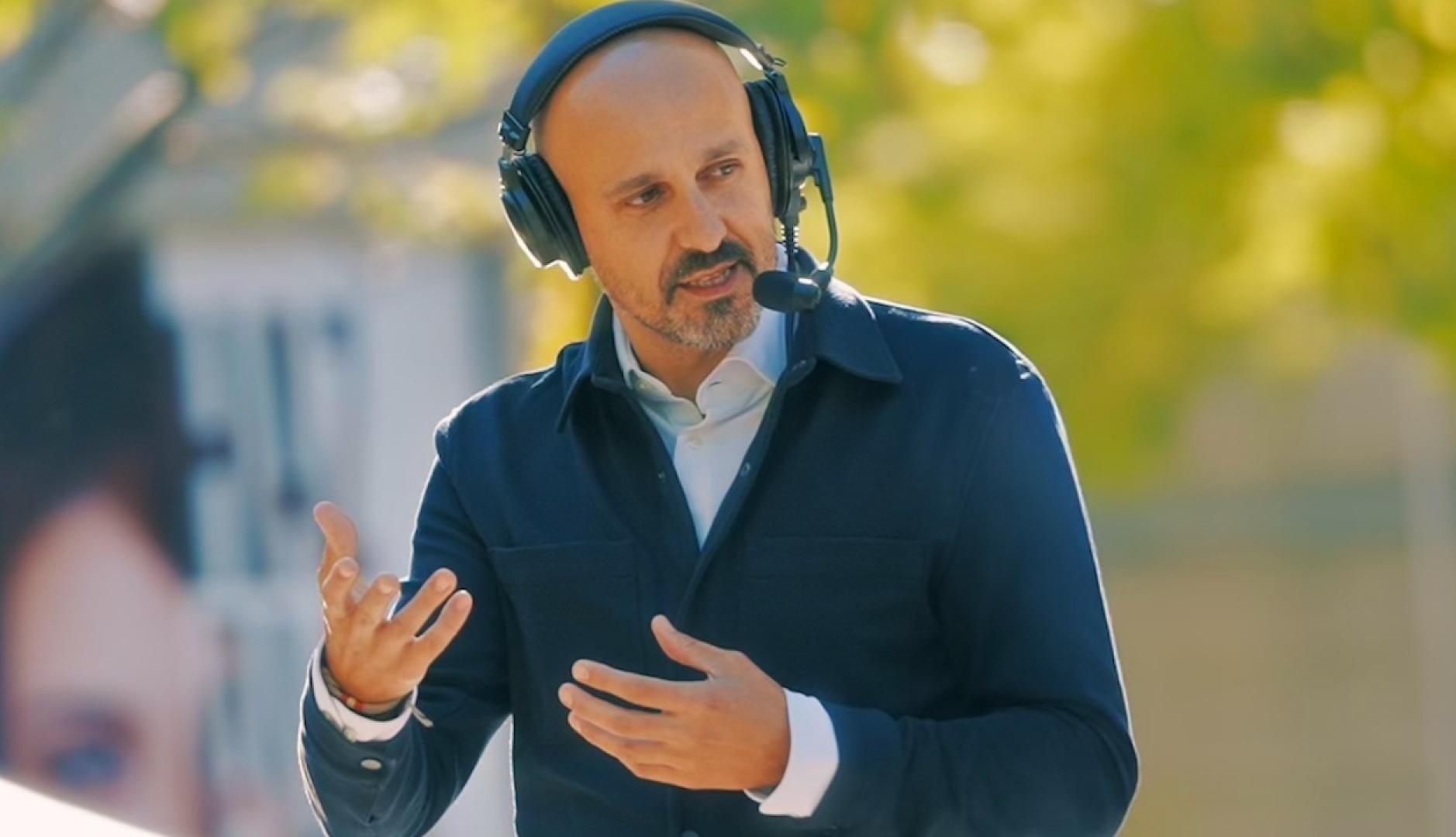
We met with Alberto Merino, Client Managing Director at WPP Media, to walk around Madrid and talk about the evolution of agencies and the challenges that marketing departments face. During his meeting with Javier Guadiana in Light & LightsAlberto warns that the pressure to achieve immediate results is limiting the strategic capacity of marketing, a situation that he considers closely related to the difficulty of demonstrating its contribution to the growth of companies.
And Merino observes that some large IBEX 35 companies are growing double digits, while their marketing budgets do not necessarily increase at the same rate. In his opinion, this difference shows that the industry still has work to do to ensure that marketing is recognized as a source of growth and not only as an expense. A responsibility that many professionals have been pointing out for some time but that Alberto Merino also attributes to media agencies, due to their ability to provide data and arguments that help marketing managers defend the value of their decisions within organizations.
The problem is accentuated when marketing departments must respond to objectives established for six months or one year. Alberto considers that this pressure is moving planning to three, four or five years, and questions whether the agencies themselves concentrate a good part of their strategic work on the following year. Faced with this dynamic, it claims the need to achieve short-term results without giving up a sustainable growth strategy, taking advantage of the business knowledge and measurement capabilities of agencies to identify decisions that generate value beyond a specific campaign.
This evolution also requires expanding the services offered by media agencies. Merino points out that the volume of data and market intelligence currently available allows them to accompany advertisers in the launch of products, the identification of new commercial opportunities and other decisions that transcend advertising activation. As an example, he explains that WPP has replaced the traditional concept of New Business with that of Growth, a way of understanding growth that is not limited to attracting new accounts, but seeks to develop new capabilities and services to grow alongside current clients. But it is a change that also poses a challenge for agencies, which must demonstrate that their evolution consists of providing business knowledge that is truly useful for their clients.
However, having more information does not always mean measuring better. Alberto believes that the industry has so sophisticated its analysis systems that, at times, it has lost sight of important indicators such as the evolution of brands and business results. That is why he defends a measurement that includes all the variables that influence the consumer, even those that depend on other departments, such as distribution. In this sense, it could be suggested that marketing also participate in the decisions that determine these variables, and not limit itself to measuring their consequences. Measurement allows for a better understanding of the business, but this understanding should also serve to expand the influence capacity of marketing departments, and not only to evaluate the consequences of other people’s decisions.
Taken together, Merino’s reflections point to an issue that transcends the sophistication of the tools. Marketing’s strategic influence depends on both what it achieves and its ability to demonstrate it and participate in the decisions that determine business growth. If investments are judged exclusively by their immediate effects or by partial indicators, it is more difficult to defend those whose benefits require continuity. Hence the importance of advertisers and agencies sharing a broader perspective of the business.
The conversation with Alberto Merino also allows us to know how he is experiencing his incorporation to WPP Media and what objectives he has set for this new stage of transformation of the group. The manager also remembers an opportunity to live abroad that he rejected during his adolescence and which he still regrets, and reflects on the management of egos in agencies and its influence on collaboration between professionals.