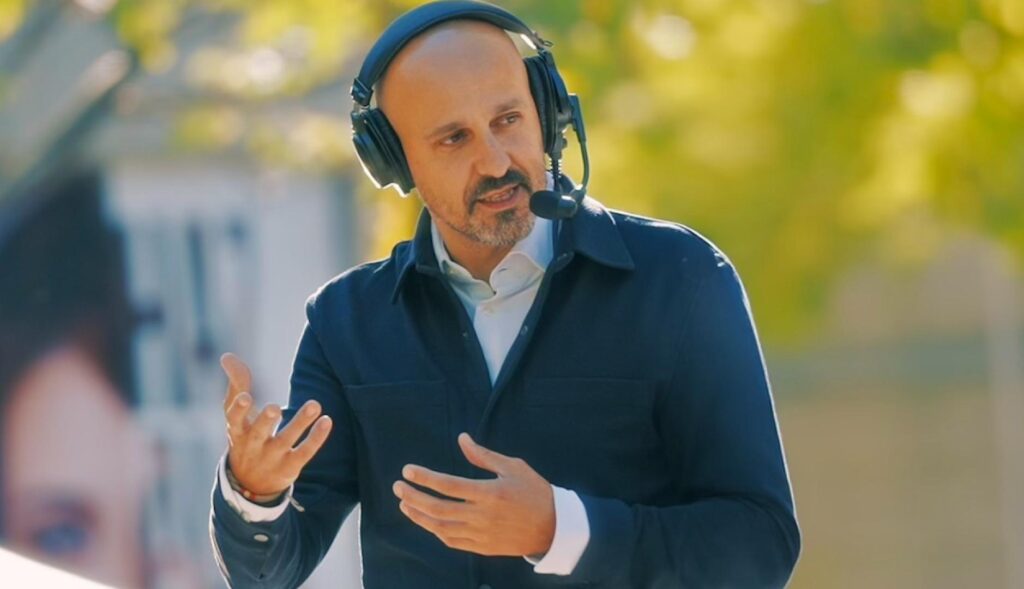
We met with Alberto Merino, Client Managing Director at WPP Media, to walk around Madrid and talk about the evolution of agencies and the challenges that marketing departments face. During his meeting with Javier Guadiana in Light & LightsAlberto reflects on the role of outdoor advertising in an increasingly fragmented audiovisual consumption environment and on how context, proximity and local culture can contribute to making communication more relevant.
The fragmentation of audiences has complicated the ability of brands to achieve great coverage through audiovisual media. Given this scenario, Merino considers that outdoor advertising maintains an important value as a means of outreach, but points out that its contribution goes beyond achieving visibility. Its presence in consumers’ everyday spaces also allows working on proximity and relevance, two especially interesting qualities for brands that need to find ways to distinguish themselves in markets where many compete for the same audiences.
For Alberto, one of the opportunities of outdoor advertising lies in its ability to adapt to the context in which the consumer finds himself. A campaign does not have to be communicated in the same way in Seville, Asturias or Galicia, because each territory has cultural particularities, references and ways of relating to brands. Differentiation, beyond the message, would involve having the ability to acquire meaning in the place where it is presented. And that requires knowing the audiences beyond their demographic characteristics or consumption habits.
This perspective also invites us to review media planning traditionally supported by large circuits and coverage criteria. Merino points out that the new measurement capabilities allow us to move towards a more precise knowledge of advertising exposure and the value of each placement, both in digital and conventional media. The challenge, therefore, lies in taking advantage of this information to make better decisions and not simply reproduce, with more sophisticated tools, the same strategies from fifteen years ago. Because greater precision in planning should also translate into greater relevance of communication.
Innovation is another possibility for the evolution of the medium, especially through activations capable of connecting the physical experience with the digital conversation. However, Alberto warns that innovation should not be an objective in itself. And this applies to any aspect of marketing, which must understand innovation as a tool to establish more relevant relationships with consumers. An eye-catching execution can get attention, but its value for the brand will also depend on what it manages to communicate and its connection with the people it aims to reach. It is an important distinction at a time when the spectacular nature of some actions can be confused with their effectiveness.
The conversation with Alberto Merino also addresses the challenges of the transformation of WPP Media and the objectives that he has set after joining the group. In addition, the manager reflects on the value of discrepancy in teams, the need to coordinate professionals with different abilities and the importance of managing egos to promote collaboration that allows for better results.