The Revolutionary Guards constitute an essential military, political and economic force in Iran. The European Union has classified the Revolutionary Guards as a terrorist organization.
An army created to protect the Islamic revolution
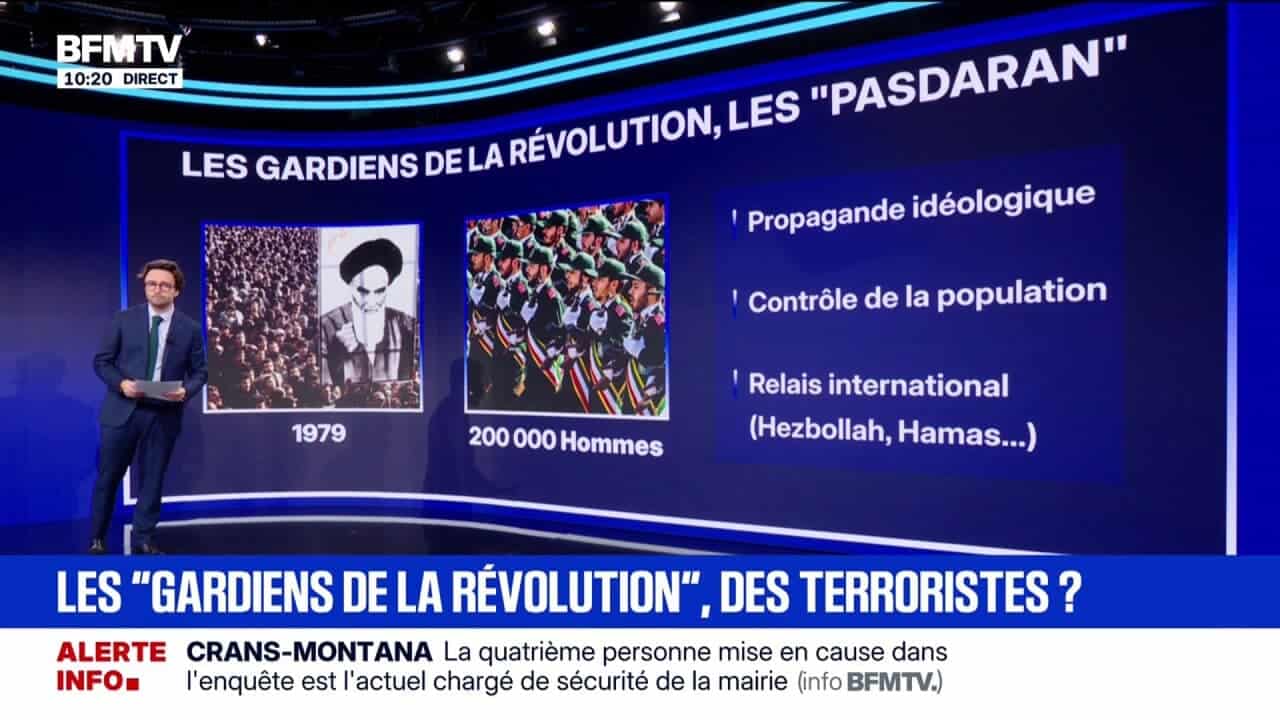
The Revolutionary Guards officially called Islamic Revolutionary Guard Corps (IRGC) were born in 1979, shortly after the Iranian revolution led by Ayatollah Rouhollah Khomeini. Their initial mission is clear: defend the new Islamic regime and prevent any attempt at overthrow, internal or external.
Directly attached to the Supreme Guidethe Guardians are not a simple military force. With approximately 125,000 members and their own land, naval and air forces, they constitute a security pillar of the theocratic regime in Tehran. Their role was tested from the earliest years, notably during the Iran-Iraq war (1980-1988), a founding conflict which shaped an entire generation of Iranian leaders.
An organization that has become a pillar of Iranian power
Over the decades, the Revolutionary Guards have greatly expanded their influence. They are now present in many sectors: internal security, intelligence, politics and even economy. Some analyzes describe the organization as a veritable “industrial empire” with strong political influence.
Their elite unit, the Quds Force, leads external operations and supports armed groups allied to Iran in the Middle East. This clandestine structure is notably responsible for organizing and supporting partner forces in the region in order to defend Tehran’s strategic interests.
This regional presence makes the Revolutionary Guards a central player in tensions in the Middle East.
The question of succession to Ali Khamenei
Since the start of the conflict between Iran and Israel and the United States, the Guardians have been involved in all major strategic decisions.
The death of Ali Khamenei opens a period of uncertainty. According to several analysts, the choice of his successor could further strengthen the influence of the Garders of the revolution.
The name of Mojtaba Khameneison of the late Supreme Leader, returns with insistence. He would maintain close ties with the Guardians and benefit from their support. In the event of a sudden end to the conflict and the survival of the regime, the Revolutionary Guards should see their influence further strengthened.
An organization under pressure?
Since the start of the Israeli and American strikes, the Guardians have strengthened their security postureincreasing protection measures around sensitive sites and command centers.
This culture of cohesion in times of crisis is at the heart of their doctrine : faced with a perceived threat against the Islamic Republic, divisions fade away in favor of a common objective, the survival of the regime.
More involved than ever in military, diplomatic and security decisions, the Guardians now find themselves at the center of the state apparatus. Their influence goes far beyond the military field: they participate in major strategic choices, control entire sections of the economy and establish themselves as the ultimate guarantors of the stability of the Iranian political system.