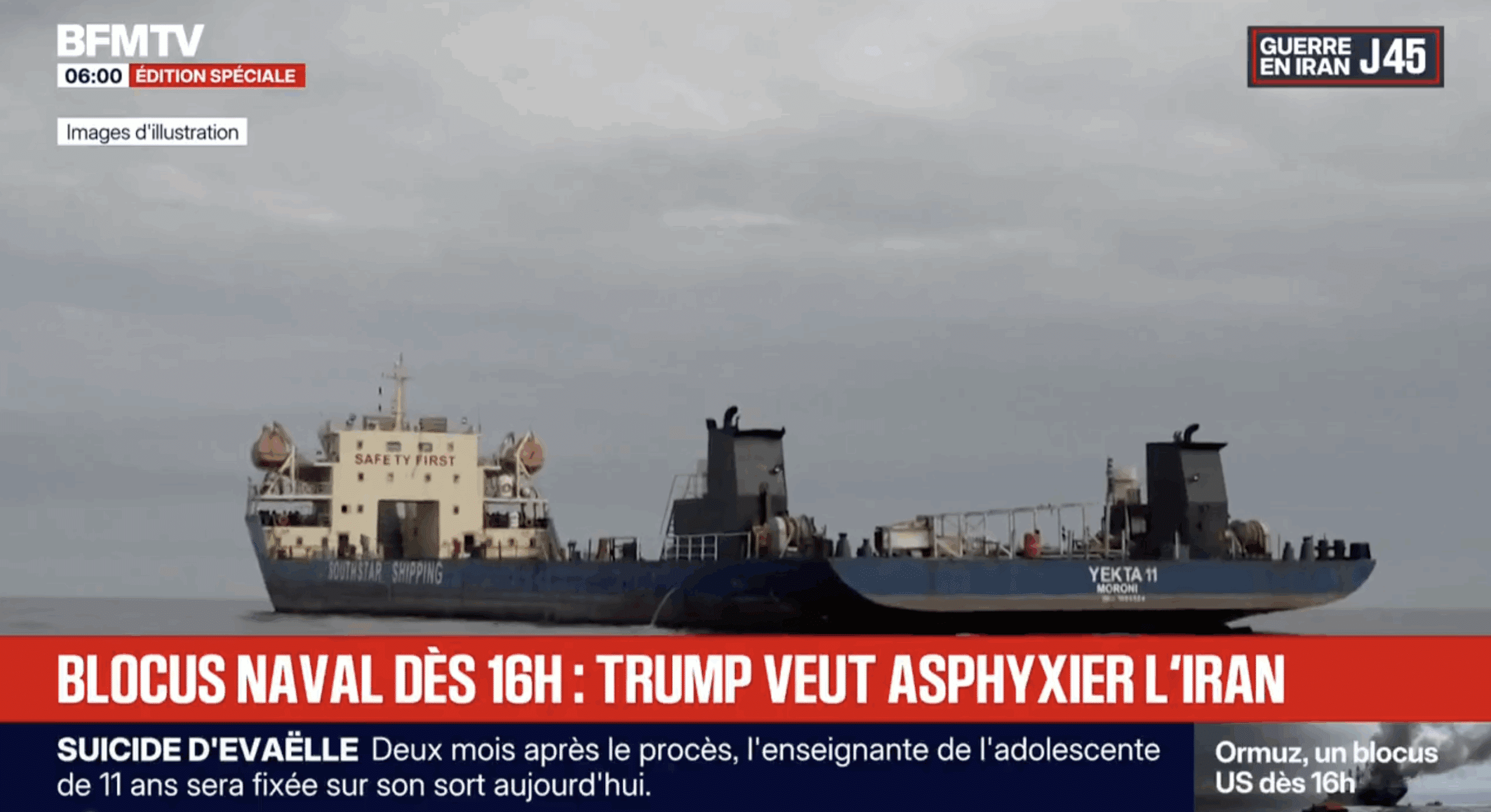
After failed negotiations between the United States and Iran in Pakistan over the weekend, the US military announced a naval blockade of the Strait of Hormuz.
After the calm, the storm has swept across the Strait of Hormuz since Sunday April 12. Following failed negotiations between J.D. Vance and Tehran, the Americans announced a naval blockade in the Strait of Hormuz. A naval blockadeit is a military operation by which a maritime power encircles the coasts, ports or sea lanes of an enemy country in order to prevent all maritime traffic from entering or leaving. In fact, setting up a naval blockade is simple. Warships patrol strategic areas and any third-party vessel may be diverted or sunk. The goal is often to put pressure on a country and its economy.
The establishment of this naval blockade
The Americans plan an uncompromising naval blockade. The peace was short-lived, the reason? For the American representative, it was Iran’s refusal to accept its American conditions which derailed the deal. THE Iranian Foreign Ministry spokesperson he points to “differences on two or three important issues” which would have undermined the negotiations.
The American news site Axios claims that Iran has requested to maintain control over the Strait of Hormuz and his stock of uranium. which the Americans could not accept. As a reminder, the question of the stock of Iranian uranium was an important question at the opening of these negotiations. The latter is a major tool of power since it allows the Iranians to develop a nuclear bomb. The United States also planned mine clearance operations. THE The deployment of destroyers and smaller, faster boats was also put in place to control traffic.
American forces blockade the entire region of Persian Gulf to Gulf of Oman. This naval blockade will apply to all ships wishing to pass through the region regardless of nationality. This allows Uncle Sam’s country to economically asphyxiate Iran by controlling its import and export routes. No duration has been indicated by the American forces. This measure remains a result of the failure of negotiations between Iran and the USA. The fate of the Strait of Hormuz then seems closely linked to the evolution of the negotiations. The Americans do not seem willing to make concessions; for Iran, giving up its stock of uranium and the development of a nuclear bomb seems to be the only possibility of regaining a stable economic space.
Global consequences
The consequences already seem visible. This naval blockade caused oil prices to rise again since the barrel rose above the 100 dollars. 20% of the world’s oil passes through this region its blocking causes a rise in prices that could exceed 120 dollars per barrel. Never has the world seen a greater threat to global energy supplies since the 1970s.
A new rebound of almost 9%: the naval blockade announced by Trump in the Strait of Hormuz once again sends oil prices soaring above $100https://t.co/A9JYVYe1O1
— BFM (@BFMTV) April 13, 2026
Gas is also an important resource that passes through the Strait of Hormuz. 20% of the world’s liquefied natural gas (LNG) passes through the Strait of Hormuz. The latter is a rudimentary gas, used for the proper functioning of a home. Few routes represent a viable alternative to the Strait of Hormuz. There is indeed the “Abqaiq-Yanbu” pipeline which crosses Saudi Arabia to the Red Sea in particular but the latter is hard to protect. The length of the latter and the costt its maintenance are limits to its use.
An illegal naval blockade?
After the announcement of this naval blockade, the command of the Iranian armed forces, Khatam Al-Anbiya announced in a statement read on state television that “ Criminal America’s restrictions on maritime navigation and transit in international waters are illegal and an example of piracy “. In many scenarios the latter would be since this decision is unilateral. No international agreement was signed beforehand. Furthermore, an act of maritime blockade is legally considered an act of war, but no act of war has been internationally recognized. This act then represents a violation of additional international law orchestrated during the tenure of the 47th President of the United States.
However, Western countries have a card to play in this conflict, Emmanuel Macron announced this Monday morning a conference » between Paris and London for a peaceful multinational mission » aimed at restoring freedom of navigation in the strait.