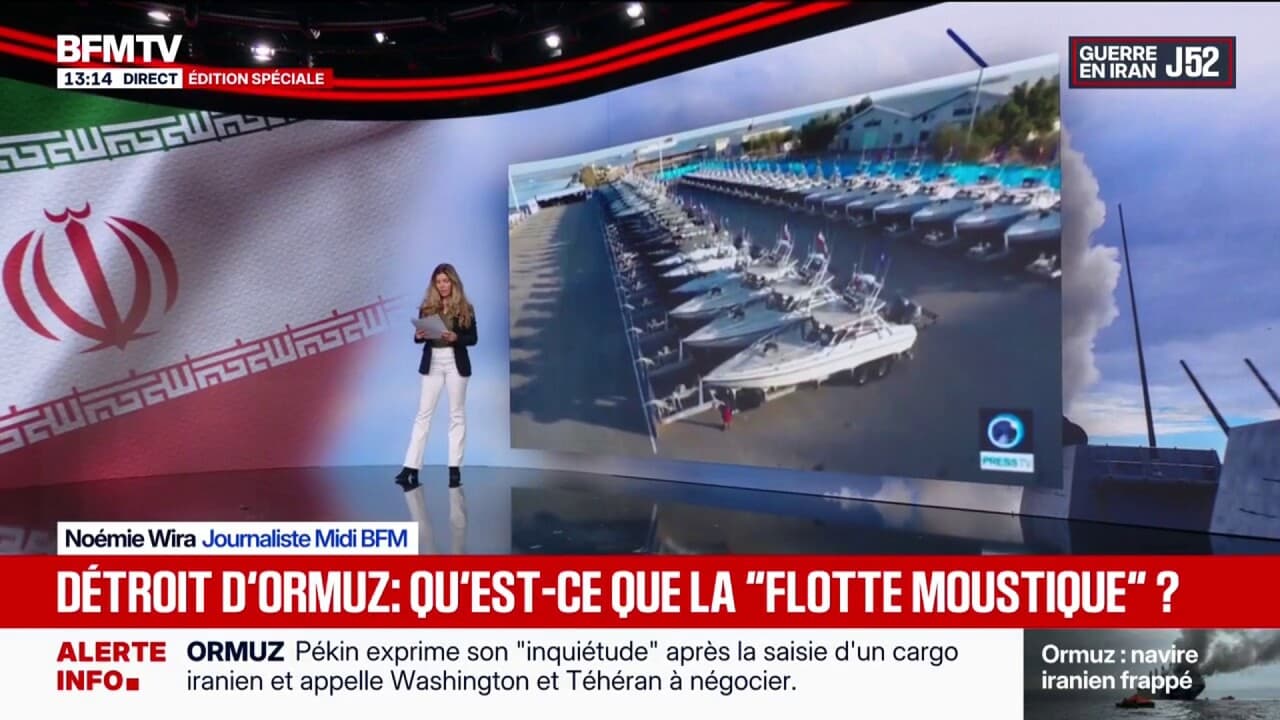
Joint US-Israeli strikes on February 28 sank most of Iran’s conventional navy ships, which now lie at the bottom of Gulf military ports. But Iran is not giving up the waters of the Strait of Hormuz. Hidden in the caves and coves of Iran’s coast, a ghost armada continues to spread fear across the Strait of Hormuz, one of the world’s most important maritime passages. These ships are called: mosquito fleet.”
Small, fast and almost invisible boats
The nickname says it all, or almost. Like the insect, the ship stings quickly, the ship disappears even faster, the ship returns without warning. They are not frigates or destroyers. There are hundreds, perhaps thousands, of small boats less than twenty meters long. Boats designed to blend into the surroundings. Some look like simple fishing boats. Others hide in tunnels or natural shelters dug into the rock. Along the hundreds of kilometers of coastline that Iran controls in the region.
The speed makes these boats particularly formidable. Some exceed 180 km/h, which allows them to escape conventional military radars and appear near a cargo ship before the crew can react. On board, the armament remains light and efficient. Heavy machine guns, rocket launchers and kamikaze drones can threaten any tanker that ventures into the area. If one boat is not enough, they attack together. Forming a real coordinated swarm which makes any attempt at retaliation very difficult.
Also read: Ceasefire in Iran: will the Strait of Hormuz reopen?
A doctrine born from the lessons of the Iran-Iraq war
This naval force did not appear out of thin air. It is the result of a painful lesson learned over decades. During the Iran-Iraq War of the 1980s, the regular Iranian navy was reluctant to strike the tankers of countries financing Baghdad. The Islamic Revolutionary Guard Corps (IRGC) then decided to create its own naval force, based on a different philosophy.
The doctrine is clear. As it is impossible to directly compete with American military superiority, the adversary must be worn down through permanent harassment. The general Dominique Trinquandformer head of the French military mission to the UN, declared on Franceinfo that the repeated incidents in the strait illustrate the coexistence of two opposing logics, diplomatic logic and military logic. A military expert interviewed on LCI summarized the situation in simple words: “The real Iranian navy, a navy of harassment. The Iranian navy can come within a few kilometers of large ships, and no American protection works. »
Today, the IRGC navy numbers around 50,000 troops, spread across five sectors along the Gulf and present on most of the region’s 38 Iranian islands. At least ten well-hidden fortified bases welcome attack boats. Which makes any attempt at preventive destruction very difficult.
A pressure tool as much political as military
The true power of the Mosquito Fleet does not only come from its destructive capacity. Above all, it creates psychological and economic pressure. The Strait of Hormuz measures only around thirty kilometers at its narrowest point. And usually carries about a fifth of the world’s oil traffic. It only takes a dozen fast ships patrolling the area for shipping companies to stop crossings and for oil prices to increase.
Since the closure of the strait ordered by Tehran on April 18, the Revolutionary Guards have seized or targeted several ships. While negotiations between Washington and Tehran continue in Islamabad, the Mosquito Fleet acts as political leverage. The fighting has destroyed or damaged major units of the Iranian navy since the start of the conflict. But the mosquito fleet remained almost intact. It is the most enduring and difficult to neutralize threat in this entire war.