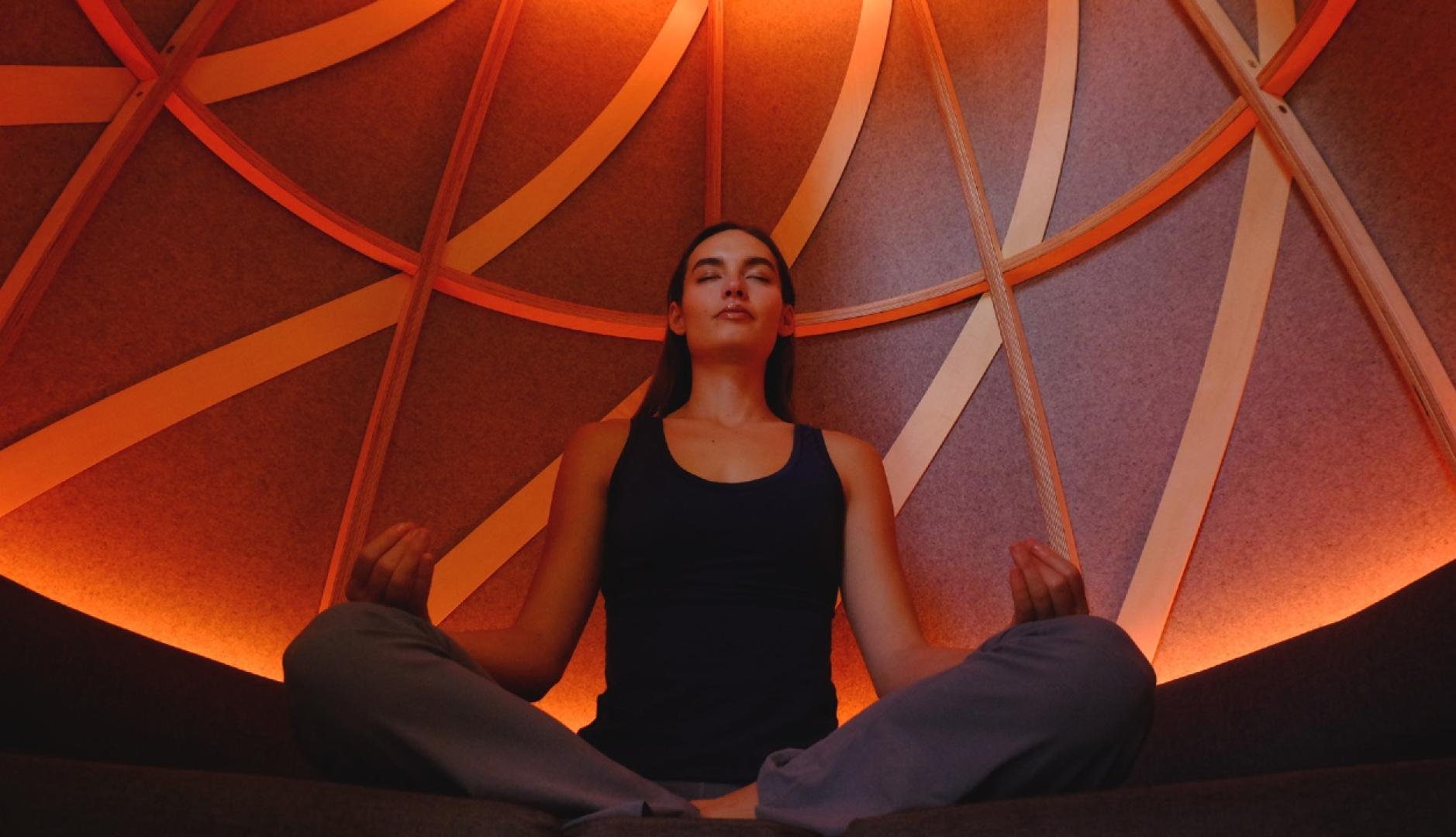
Mental health at work is no longer a secondary issue. Faced with increasingly demanding environments, meditation emerges as one of the most effective tools to improve daily well-being. And now, that practice is materialized in a physical space: an immersive capsule designed to promote calm and emotional balance during the workday.
This is the new version of the meditation pod by OpenSeed, developed in collaboration with Fuseproject, the studio of renowned designer Yves Béhar, and the Mexico City firm Tuux. The result is a sensory cabin with an enveloping design, conceived as “a welcoming womb” Made with wooden panels and wool felt, and illuminated with warm tones that invite meditation.
“From the beginning we asked ourselves one question: how to create an environment that, upon entering, would automatically make you feel calmer?”explains Daniel Marcoschamer, Founder of OpenSeed.
Priced at $22,500, the capsule is designed for offices, hospitals and even prisons. Inside, users find a 10-minute multi-sensory experience based on guided meditation. Using a touch screen, they can choose sessions to calm their mind after an intense meeting or recharge their energy in the middle of the day. The system combines elements such as:
- Light synchronized with breathing
- relaxation music
- Gentle vibrations on the floor and seat
- Aromatherapy with essences such as lavender
- Total acoustic insulation
The exterior warns when the capsule is occupied, and its structure has been designed to be shipped in a flat format, facilitating assembly in a few hours and reducing the environmental impact of transportation, a constant concern for Yves Béhar: “Shipping is always a high cost, both economically and environmentally. We wanted something that could be installed easily, without large boxes or infrastructure.”
Although the first version of the product has already been installed in companies such as Deloitte and Morgan Stanley – where some units register up to 16 uses per day – the new generation of the capsule has expanded its applications, for example, for hospitals that allow its use by both patients and healthcare personnel during their breaks. It is also designed for cancer centers, which are studying its impact on stress in patients. And even in prison facilities that offer it to police officers.
Daniel Marcoschamer, Founder of OpenSeed, explains: “We see wellness centers with much more expensive treatments. Our proposal is to turn something as necessary as meditation into an accessible tool for many people within their daily spaces.”
In a time marked by hyperproductivity, professional burnout and digital fatigue, creating environments that invite silence, introspection and self-care becomes not only desirable, but urgent, and confirms the trend that well-being is already a structural necessity.