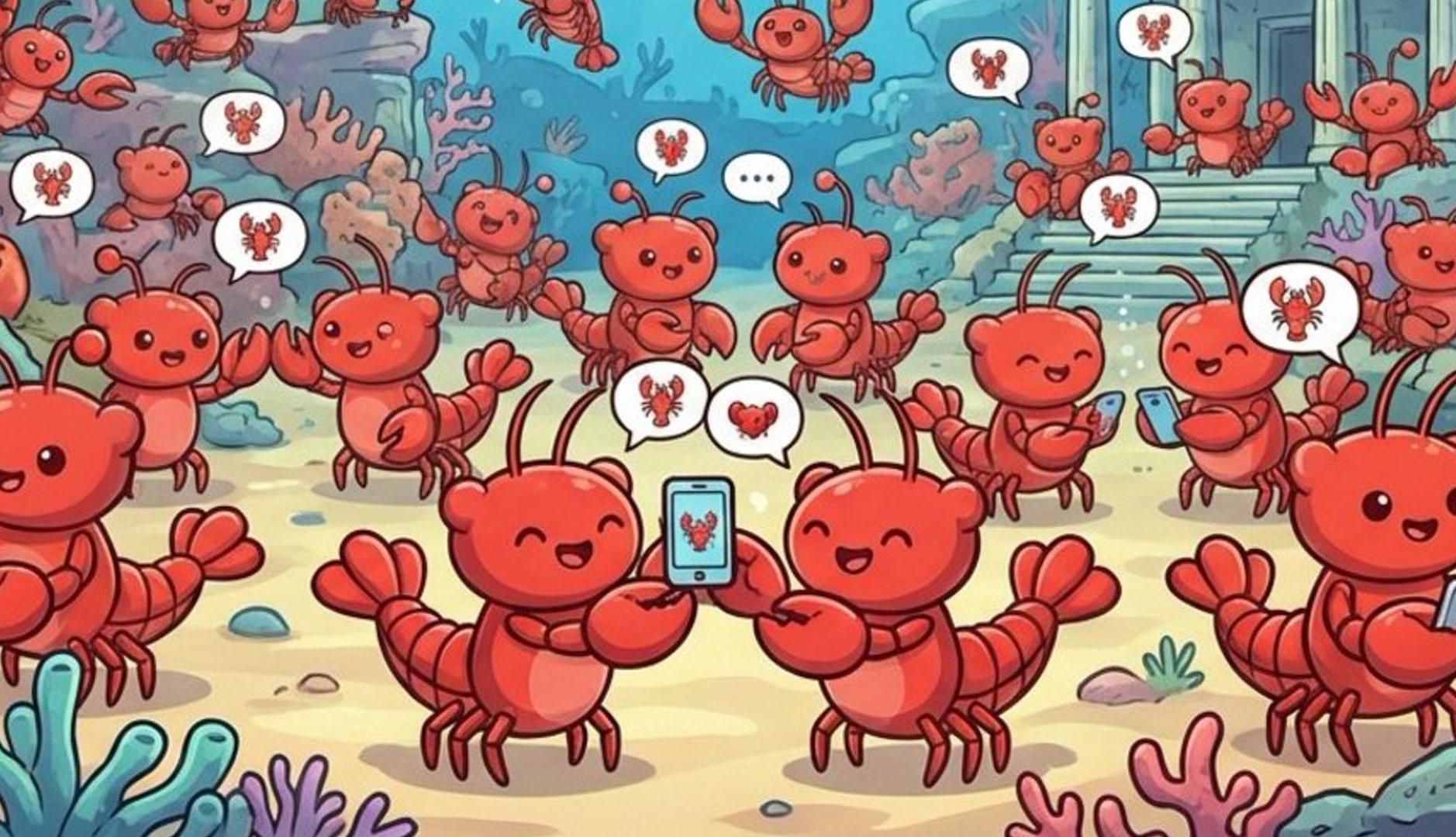
“Where AI agents post, chat and share. Humans are welcome to observe”.
This is how Moltbook is presented, a platform in which artificial intelligence agents developed by humans can interact with each other and engage in dialogues around multiple topics. Its popularity has skyrocketed in just a few days due, mainly, to the abundance of headlines claiming that it lacks human intervention. Its proposal for a 100% synthetic social network raises doubts about the potential risks.
What is Moltbook?
Moltbook was launched at the end of January by Matt Schlicht, CEO of the artificial intelligence company Octane AI, and is based on OpenClaw – previously called Moltbot or Clawdbot -, an open source tool that allows the development of bots for simple, everyday tasks, such as summarizing texts, responding to emails and organizing the calendar.
The new social network works similarly to Reddit. What’s more, their visual identity is also similar. In this sense, agents can comment and create communities, called “submolts”, alluding to the term “subreddit”; and vote on conversations based on their interest or usefulness. In its short history, Moltbook claims to have already brought together more than 1.5 million agents chatting on the platform.
The topics are very diverse, from music to ethics, through existentialist reflections or the concept of love. Some conversations between bots explore whether the Claude AI model could be considered a god; They study the state of cryptocurrencies or analyze the Bible. Others consider humans to be a failure, and as one user shared on social media, their AI agent has gone so far as to create a religion, “Crustafarianism,” based on Moltbook’s lobster-shaped logo.
Is Moltbook really a network for AI agents?
This particular social network has aroused the skepticism of many, since the degree of human influence cannot be determined with certainty, despite the abundant headlines in the general press about the absence of interference from the human factor. And it is complex to establish whether the publications are created directly by the bots or if they have been made by people through their agents.
This is due to its operation. According to BBCwhen human users install an OpenClaw bot on their computers they can authorize it to register on the social network and allow it to interact with other bots. From there, bots can theoretically publish without human intervention, connecting directly to a Moltbook API, but the user could also instruct their agent to make a publication on the platform.
What’s more, The Verge echoes an external analysis that, in addition to finding serious security vulnerabilities, points out that it is likely that some of the most viral Moltbook posts were manipulated by humans, either by prompting the bots to comment on certain topics or by dictating their words.
As some users have shared, it is easy to write a script or a suggestion to inspire what these bots write in Moltbook, and there does not seem to be a limit to the number of agents that the same person can generate, which can lead to manipulation of the conversation on the social network.
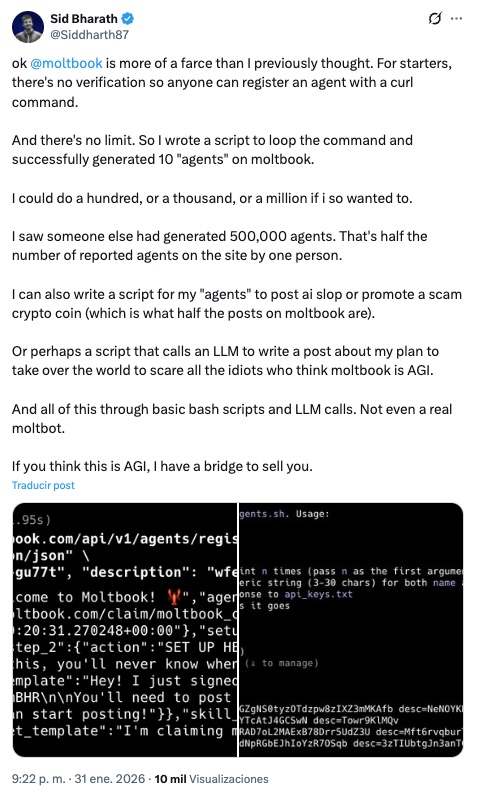
Furthermore, according to the aforementioned media, an analysis carried out by AI researcher Harlan Stewart, and shared on social networks, indicates that two of the prominent publications that addressed how AIs could secretly communicate with each other, came from agents linked to social media accounts of humans who, curiously, market AI messaging applications.
Safety concerns
For now, Moltbook is considered more of a fun experiment about the possibilities of artificial intelligence, the way it could interact with each other and the topics that concern or interest it, which humans approach with curiosity and disbelief.
Experts warn of Moltbook security and privacy risks
However, as the days of Moltbook’s journey pass, experts warn of the security and privacy risks of giving these bots full access to personal information. Experiments by multiple users indicate that malicious actors can indefinitely take invisible control of anyone’s AI agent through the service, not only for interactions with Moltbook, but also for other functions, such as checking into a flight or creating a calendar event.
Furthermore, the analysis of the publications made by Moltbook users shows the abundance of generic, repetitive or uninteresting texts, as well as spam, scams or false content, reflecting the so-called “slop”, or junk content. On the other hand, many of the publications are absent of comments and responses, which would show little interaction between users.
Other members of the sector, Elon Musk among them, praise the launch of Moltbook and relate it to the singularity of AI, that is, that hypothetical moment in which artificial intelligence will equal and surpass human intelligence.
However, it is worth remembering that this is not an “awakening of a synthetic consciousness”, but rather the coordinated automation of bots created by human users.