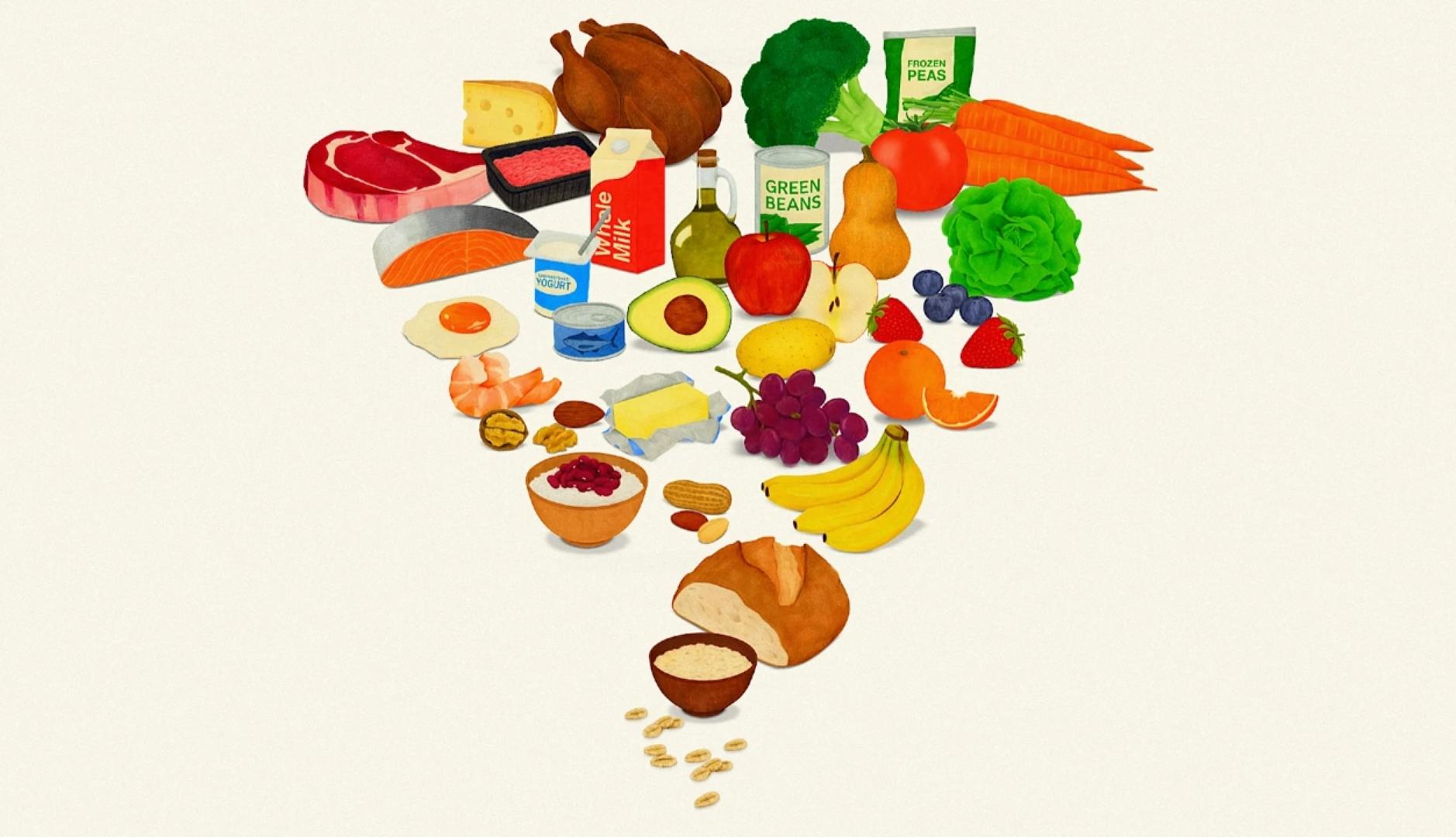
Donald Trump’s administration has given a visual twist to one of the most recognizable tools of nutrition education: the food pyramid. The US government has presented a new inverted pyramid, integrated into its updated dietary guidelines, with fewer food groups and a speech aligned with the “Make America Healthy Again” (MAHA) agenda promoted by the Department of Health.
The new proposal reduces the classic six-section structure to just three large blocks
The new proposal, developed by the United States Department of Agriculture, reduces the classic six-section structure to just three large blocks: proteins, dairy and healthy fats; fruits and vegetables; and whole grains. Ultra-processed foods and sweets disappear from the graph, while cereals – historically the base of the pyramid – begin to occupy the smallest space.
The redesign responds to a vision defended for years by the Secretary of Health, Robert F. Kennedy Jr., who publicly supported the change by stating that the pyramid “It was already upside down” and that this version simply “fixes it”. The new guide promotes the consumption of natural, whole or minimally processed foods, increases the recommendation of proteins and full-fat dairy products and eliminates clear quantitative references on alcohol consumption, limiting itself to suggesting “drink less.”
Beyond the nutritional content, the change is especially relevant from the point of view of design and public communication. The new official portal, realfood.gov, adopts a minimalist aesthetic clearly inspired by healthy consumer brands such as Chobani or Sweetgreen: plain fonts, white space and retro-style illustrations that evoke food publications from the 1970s.
The result is a visually attractive piece, although some nutrition experts have already pointed out some limitations as a pedagogical tool. The pyramid does not clearly indicate proportions, quantities or recommended servings. The placement of food within the graph is ambiguous and forces the user to interact with the web to obtain additional information. Even basic calculations, such as recommended protein intake, require the user to convert their weight to kilograms, a barrier for much of the US population.
A long history of redesigns
This is not the first time that the US government has tried to improve the clarity of its dietary guidelines through design. In 2005, a vertically segmented pyramid was introduced; In 2011, the pyramid format was completely abandoned to make way for MyPlate, a circular graph that represented the proportions of a plate. The 2026 version recovers the pyramid, but does so as an ideological and visual symbol, rather than as a precise didactic diagram.
The new pyramid also comes in a sensitive political context, just days after the Department of Health reduced the number of vaccines recommended for children, a decision that has generated concern in the medical community. In this framework, food redesign is interpreted as taking a cultural and political position, acting as a narrative vehicle.
According to the government itself, these guides are not intended to be a strict diet, but “a flexible framework intended to guide better choices”. But the new pyramid raises an open question: can design compensate for the lack of clarity when it comes to communicating public health?