Generation Z is informed mainly through social networks, but does not seem to trust them too much. In fact, the channels they use the most to access current affairs are precisely those to which they grant the least credibility. It is one of the main paradoxes drawn by an international investigation on media consumption and misinformation among young university students in Spain, the United States and Portugal.
The study “Paradoxes in the media consumption of Generation Z and their perception of fake news: an international comparative study”, published in the academic journal Communication and Societyanalyzes the responses of 405 university students: 150 from Spain, 151 from the United States and 104 from Portugal. The research has been carried out by Ana Pérez-Escoda, from the Francisco de Vitoria University (UFV), and Cristina Ruiz-Poveda, from the Complutense University of Madrid. Data was collected between November 2024 and May 2025.
News circulates in the same spaces as entertainment, memes, music or personal conversations
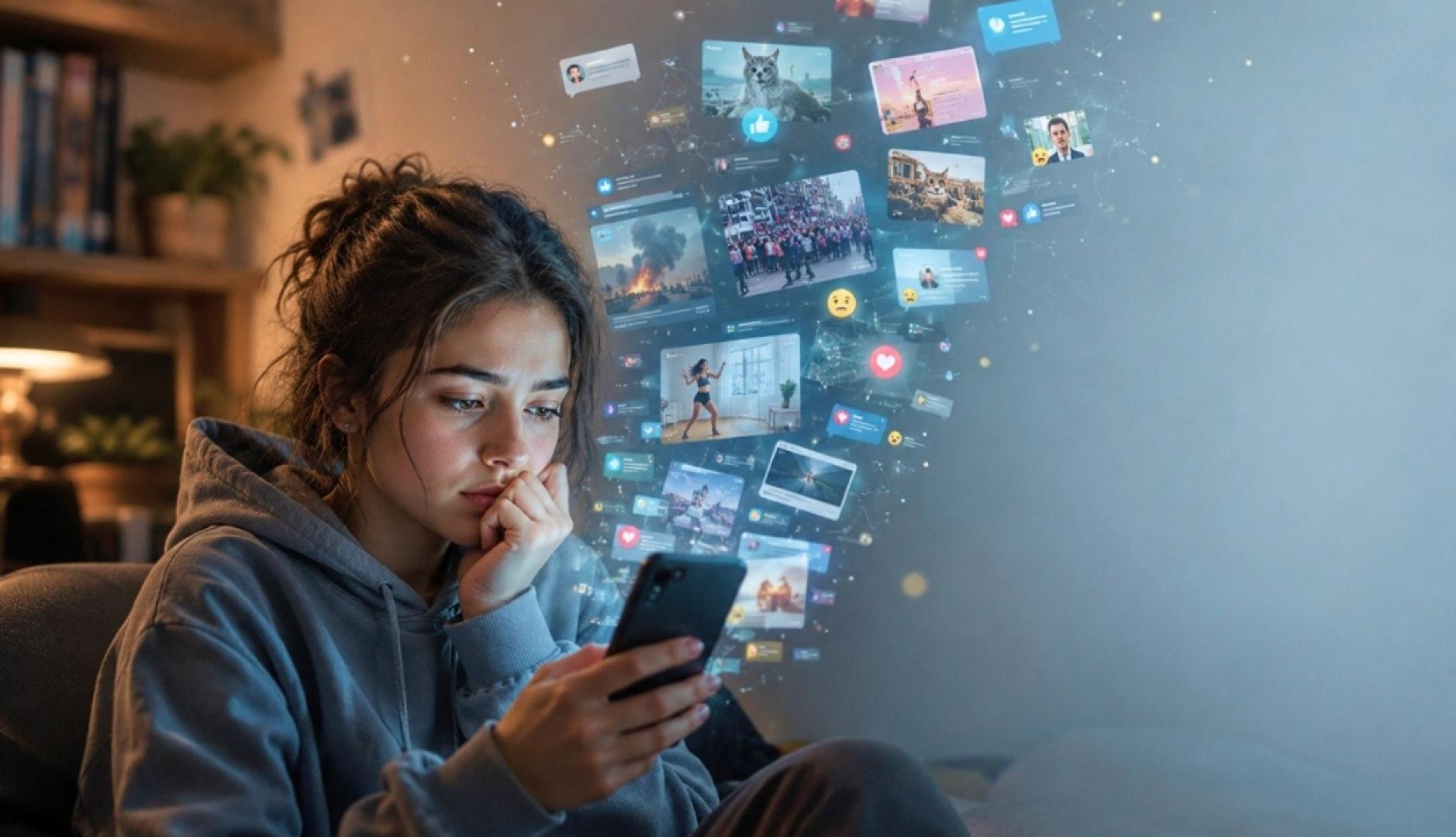
Their results offer a snapshot of a generation whose relationship with the news can no longer be explained solely by what media they consult. News circulates in the same spaces as entertainment, memes, music or personal conversations; Algorithms intervene in the selection of what appears on the screen and the borders between information and the rest of the content are increasingly less visible.
Researchers frame this behavior in what they call an information culture of rapid, superficial and continuous consumption. The smartphone functions as a gateway to a flow in which content of a very different nature appears practically without interruption and where social networks simultaneously perform entertainment, socialization and information functions.
75% of the sample claims to obtain information frequently or always through social networks, which are clearly the main information channel. Web pages occupy second position, with 64%, followed by digital press (47%), television (37%) and online television (20%). Radio and the printed press are relegated to 8%, while online radio only registers 6%.
The data thus confirms the predominance of digital environments, but also qualifies the idea that new generations have stopped being interested in current events. Information continues to be part of their daily consumption; What has changed substantially are the ways in which it reaches them.
There are also some differences between countries. The intensive use of web pages for information – adding responses from “occasionally” to “always” – reaches 93% among American students, compared to 85% of Spanish students and 823% of Portuguese students. Online television is also more present among Americans: 52% use it to some degree, compared to approximately 30% of the Spanish and Portuguese samples.
But the general trend transcends borders. The authors even point towards a certain international homogenization of youth media consumption: despite the cultural differences of Spain, Portugal and the United States, the main channels used for information and the preferred content are remarkably similar.
News competes with entertainment for attention
This convergence is best observed when analyzing what content young people consume. Leisure and entertainment lead with 73%, followed by humor and memes (64%) and music (52%). News occupies fourth position, with 35%.
Photography is significant because journalistic information no longer necessarily occupies a differentiated space within the media “diet.” It shares an environment, device and, often, format with content whose purpose is completely different.
The so-called “snack culture” of information consists of rapid and continuous consumption on mobile phones and platforms.
Researchers relate this phenomenon to the so-called “snack culture” of information: rapid and continuous consumption favored by mobile devices and platforms designed to maximize attention. In this context, a political news item can appear immediately after a meme and before a music video, without the user having even left the same application.
But the most interesting finding appears when comparing consumption and trust. The media that young people use the most to obtain information are also the ones that receive the least credibility. While social networks are used for information by 75% of the sample, only 9% attribute them credibility. In web pages the difference is also notable: they present 64% usage compared to 8% credibility.
The relationship is practically reversed in traditional channels. The radio obtains 34% credibility, although only 8% declare that they use it frequently or always to obtain information. The press registers 32% credibility compared to 8% of consumption, and television reaches 36% credibility, practically the same percentage as its use as an information source (37%). The digital press constitutes a partial exception: it registers 47% use and is the medium that obtains the highest percentage of credibility, with 50%.
Thus, Generation Z does not necessarily use networks because they consider them to be better sources of information. Convenience, accessibility, speed and the fact that they concentrate multiple uses seem to trump credibility.
Algorithms decide what information arrives
The study also analyzes the extent to which young people prefer to actively search for information or receive it through mechanisms where algorithms progressively intervene.
Spain presents the greatest inclination towards a deliberate search: 59% of Spanish students say they prefer to search for information according to their own interests, compared to 523% of the Portuguese and 38% of the Americans.
In the United States, on the contrary, 32% prefer to find information while browsing the Internet, practically double that in Spain (17%) and clearly above Portugal (19%).
The issue has implications that transcend comfort. The authors point out that the algorithms work like new gatekeepers or gatekeepers of access to information. A function that for decades corresponded primarily to journalists and editors is now also conditioned by recommendation systems that determine what content gets visibility. And this filter has a peculiarity: the user is not always aware that they are being filtered.
The second great paradox of the research appears around misinformation. Despite the weight of social networks in their consumption, a majority of the students analyzed consider that they hardly receive fake news.
Six out of ten respondents believe that fake news is practically absent from their consumption
27% say they never receive them and another 33% say they rarely receive them. That is, six out of ten participants believe that fake news is absent or practically absent from their consumption. Only around 20% claim to encounter them frequently or constantly.
One possibility is that the initiatives deployed to combat misinformation are working. The other is more problematic: that young people overestimate their ability to recognize fake news and, therefore, are not aware that they are exposed to it. The study does not conclude which of the two explanations is correct and calls for more research. It does confirm, however, that there is a statistically significant relationship between the medium used to obtain information and the reception of fake news, while an equivalent relationship is not detected with the country of origin.
Facebook, X, TikTok and misinformation
Young people’s distrust of digital platforms is also seen when they are asked directly which channels they believe spread the most fake news. Adding those who respond “frequently” and “always”, Facebook clearly tops the classification, with 78%. They are followed by X (66%), TikTok (65%), word of mouth (61%), Instagram (58%), websites (57%) and WhatsApp (53%).
Traditional media are far behind: only 27% identify them as channels that spread fake news frequently or constantly.
National differences also appear here. In Spain, 74% associate X with the frequent dissemination of fake news, compared to 68% in Portugal and 56% in the United States. On TikTok, the percentages are 69%, 64% and 63%, respectively.
The research also asks participants what topics they associate most with fake news. Politics appears, by far, as the main territory associated with fake news in the three markets analyzed. 81% of the Spanish sample, 74% of the American sample and 67% of the Portuguese sample associate it with them.
The second area is humor and gossip, although with a considerable gap between Spain (68%), the United States (52%) and Portugal (53%). Health and diet occupies third position in Spain and the United States, while in Portugal it registers a somewhat lower percentage.
Beyond the individual data, the researchers detect an underlying trend: digitalization is producing a certain homogenization of youth media habits between countries.
Spain, the United States and Portugal present differences in some channels and behaviors, but they share a general structure: predominance of social networks and websites, little weight of traditional press and radio, and permanent coexistence between information and entertainment.
YouTube is also the preferred social network for 33% of all participants, followed by Instagram (20%) and TikTok (18%). But interesting differences appear: YouTube reaches 40% in Spain and 33% in Portugal, while among American university students it drops to 26%. TikTok takes the opposite path: it is the preferred option for 27% of the American sample, compared to 14% of the Portuguese sample and 11% of the Spanish sample.
The challenge is learning to recognize hoaxes
The conclusions of the study place media literacy as a central issue. It is not enough to know how to use a platform, nor does technological familiarity automatically guarantee critical ability to interpret what appears on it. The authors recall that previous research has observed that young people may be aware of the problem of misinformation and, at the same time, overestimate their ability to differentiate true information from false content or not systematically verify what they receive.
The challenge takes on another dimension when informative selection is mediated by opaque algorithms. Platforms are not only containers: their recommendation systems order, prioritize and make visible one part of reality over another. Hence, contemporary media literacy also implies understanding, at least conceptually, why certain content reaches us.
For the media, the results pose an equally relevant dilemma. They retain a capital of credibility that does not necessarily translate into consumption. Generation Z can trust them more and yet get their information elsewhere. There probably lies one of the most interesting questions that the investigation opens up. The battle for new audiences is not only about recovering trust: it also requires recovering relevance, presence and distribution capacity.