“Marbella”, “Celeste”, “The Messiah” or “Soy Nevenka” are some of the series and films of the original Movistar Plus+ content catalog that have taken real facts as a reference for their scripts. They are examples of the way that reality is increasingly influencing the entertainment we consume. For its part, fiction is also molding the world in which we live.
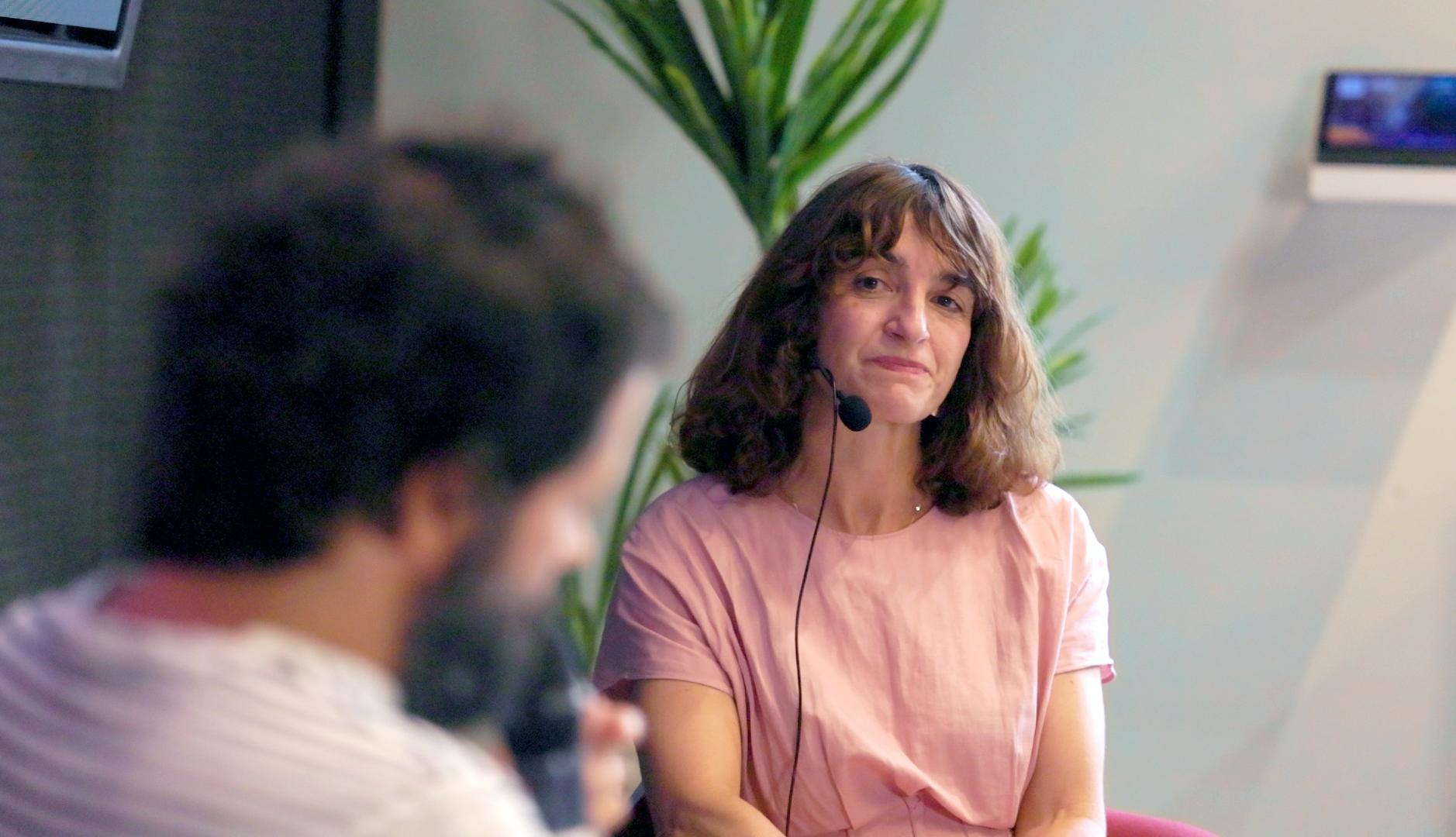
On the increasingly blurred lines between reality and fiction, Cristina Merino, Content Executive for original series of Movistar Plus+, and Luis, and Luis, strategy director in Media Arena, in a conversation that brought the title “The World as a show”. This was part of the In Real Life event (IRL), the project with which the Arena Media agency is exploring how the media and advertising industry configure reality and the way in which people understand the world. Together with the Cultural Research Laboratory Cell Lab, the agency has carried out a thorough indagation to treat different areas.
In this meeting the three first areas were addressed and three blocks of contents were structured: the era of the image and the light life in which we live immersed; the world as a show, about the increasingly close relationship between reality and fiction; and reality as drill, about the evolution and success of reality shows. Next, we collect what is raised in the second block, the third party coverage will be published throughout the next few weeks.
If you want to see the complete conversation, you have it in the following video; Already then you will find our editorial coverage with the most notable of this talk, with some extracts of the mights in the moments with relevant statements.
The reasons after the rise of reality
Reality and fiction have always been interconnected, an aspect that has been reflected in different artistic expressions. However, it has been observed with special force in the entertainment field for some years. The reasons are diverse and especially attend economic reasons, but also to consumer preferences.
One of the causes that great studies and content platforms produce and welcome more and more formats linked to reality is the evolution experienced by the audiovisual market itself. Given the proliferation of video services on demand, the different operators have been forced to increase production with the intention of capturing the attention and subscriptions of the spectators. Thus, it has gone from producing just a handful of series a year, to produce tens.
That is why reality has become a source of inspiration to generate the volume of content that the industry now offers. This is observed for both the production of fiction and documentaries, a format that has gained special relevance and interest in recent years.
Obtain results and profitable investments leads industry to assume minimum risks
To this factor is also added the budget. And it is that the pressure of the studies and the producers to obtain results and make investments to assume minimum risks. These risks are reduced if the audience is already familiar with the story to be told and connects with it. Moreover, many spectators tend to take refuge in already known stories, seeking security and comfort in a context of uncertainty that causes uneasiness. Hence, for example, that the production of reboots or prequences and sequelae of series and films has hatched.
Likewise, these contents inspired or articulated by reality have the advantage of not needing such an exhaustive promotion campaign. “If you talk about a real event that has had a certain impact on public opinion, as could be the 23-F, the marketing campaign is almost done“Cristina Merino said.”We already know the fact, we have an idea and an opinion established. And that is a long way earned at a time where there is so much message saturation”
The increasing approach of entertainment to reality also raises moral dilemmas to those responsible for producing the contents and generates numerous conversations about the limits of ethics. Specifically, the genus True Crime, which has gained enormous popularity in the last decade, is one of the most debates. “It is a genre that we barely work, but we are guided by the principle of not growing the pain of a victim with the story that we are going to tell”Merino explained.
Along these lines, he also points out that the increasingly diffuse limits between fiction and reality have contributed to reduce the thresholds of empathy or pain, causing certain issues to be normalized in life. “In the same way that non -fiction is spreading from fiction, it also passes the other way around“He said during the session.”We are already seeing many fiction methods in the dynamics of politics, companies or journalism. How roles are taken, how complex problems are exposed with too simple dichotomies …”
Differentiation and relevance
The choice of these issues or the way to deal with them is one of the issues that can articulate the positioning of a market on demand in the market. Saturation and high competition in the world of platforms pushes different players to configure differential value proposals to make between noise and achieve relevance. In the case of Movistar Plus+, as Merino said, they are committed to “making Spanish series and not series in Spain”, referring to a production based on cultural value, identity and representation of reality.
“We try to promote our difference for supporting the viewers of the creators”He added, noting that the production of stories about certain issues is not given so much for a matter of corporate responsibility, but of philosophy to support national talent.”We make original stories and surround the creator, we give him the means for his vision to gain relevance and become an artifact to reach all types of audiences, instead of making a more formula -based entertainment type”
The platform user experience can also influence the preference of viewers by one service or another. Cristina Merino pointed out that the content tends to be prioritized, but issues such as recommendation systems, outlines through algorithms, interface design or the correct functioning of applications are also decisive in consideration and consumption. “If you don’t have a platform that works well, you leave outside many people”, He said.
Different platforms, different worlds?
During the session, Íñigo de Luis and Cristina Merino also talked about whether to have certain platforms is contributing to configure our reality. That is, if for example, see more Netflix’s contents, which have a more global character, is moving away from local identities, or if it is generating social gaps.
“On the one hand, I think the perceptions are denaturing and that seems to me a bit dangerous, but at the same time I do not think about it, because I see how the public chooses its own stories”Said Merino.“In our case, Spanish cinema is the best data gives us in terms of consumption. I think if you can choose, the spectator chooses Spanish content”
In this regard, Movistar Plus +’s strategy seems to be the path of betting on the content and stories with local character, although Cristina Merino predicted that the exchange between reality and fiction will still be a trend in the entertainment industry.
He argued his response referring to budget pressure, to the stagnation of subscriptions or the deceleration of the growth of large players. “I think we still have a few years of adjustment in which we will continue to live things that we have already seen before, although perhaps influenced by contemporaneity”Merino specified.
And perhaps at that crossroads you are the key to connect.
At the end of the meeting, from Reason.Why we talked to Cristina Merino and Íñigo de Luis about some of the topics discussed. Here you can know your visions about the current situation of the media landscape or the value of your own stories.
If you prefer to listen to the audio of this meeting, here we leave it in podcast format: