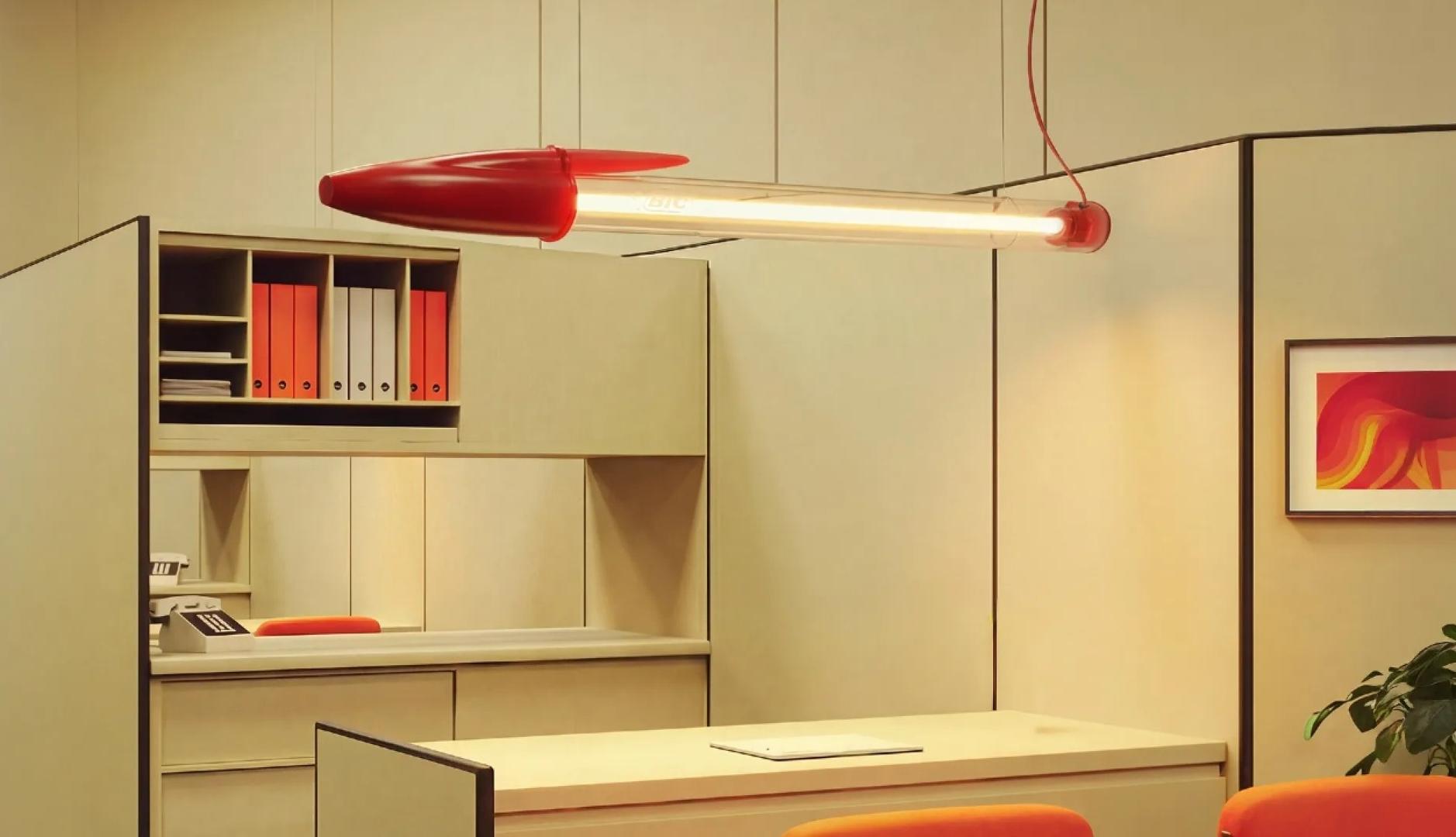
The Bic Cristal turns 75 years old and has become a piece of lighting. The Italian brand Seletti has presented the “Bic Lamp”, a large-scale reinterpretation of the legendary writing instrument, transforming its silhouette into a luminous household object that pays tribute to its cultural and design legacy.
In 2006, its manufacturer Société Bic revealed that more than one hundred billion units had been sold worldwide.
With its transparent hexagonal plastic body and its unmistakable colored cap, the Bic Cristal has been ubiquitous since its launch. The origin of the so-called Bic Biro dates back to 1930, when the Hungarian-Argentine inventor László Bíró conceived the ball mechanism after observing children playing with marbles, which left a trail when they rolled. Years later, in 1944, French businessman Marcel Bich acquired the rights to the design and invested in Swiss technology to perfect a tiny one-millimeter stainless steel sphere, resulting in a reliable, fluid and accessible writing instrument.
In 2006, its manufacturer Société Bic revealed that more than one hundred billion units had been sold worldwide.
Seletti now brings this everyday object into lighting with the “Bic Lamp”, which reproduces the pen at a scale of 12:1 and comes in standing, hanging and wall versions. The collection respects the most recognizable colors of the original – black, red and blue – and maintains its silhouette, amplified to become a leading element of the space.
“At Seletti we have always played with the concept of design based on memory, placing people’s personal experiences at the center of the objects we create”explains Stefano Seletti, Artistic Director of the firm. “With Bic Lamp we transform a universal and instantly recognizable shape, which lives in everyone’s memory, into something completely new.”
The piece fits into the pop spirit of Seletti, a brand that has built its identity by reinterpreting domestic objects and popular codes from an ironic and provocative perspective. In this case, the lamp celebrates an anniversary by turning a symbol of everyday writing into an object of contemporary design and demonstrating how industrial icons can find new lives beyond their original function.