Television maintains a prominent position in the information trust of Spaniards, even in an environment marked by the multiplication of channels, digital consumption and concern about misinformation. 59% of those surveyed identify it as the medium through which they receive the most truthful, reliable and contrasted information, ahead of the radio (43%) and the press (40%). Social networks (10%) and video platforms (5%) are considerably behind.
This is reflected in the seventh edition of the Barometer on the social perception of free-to-air television, promoted by the Union of Open Commercial Televisions (UTECA) and prepared with the collaboration of Sigma Dos and Dos30. The study examines the valuation of the media, information habits, the protection of minors and the social contribution of free television.
The results also reflect a majority support for the continuity of the free-to-air television model: 95% consider that free television is a good of general interest to which all people have the right, while 84% recognize its function of social cohesion due to its accessibility.
The barometer has been prepared from 1,231 online interviews carried out between September 1 and 14, 2026 with people over 18 years of age who watch television at least once a week. The sample has been selected through simple random sampling with quotas for sex, age and autonomous community.
The report establishes an estimated margin of error of ±2.78 percentage points, with a confidence level of 95.5%. But it is worth keeping in mind that the universe analyzed is made up of people who consume television weekly and that the study is promoted by UTECA, an organization that represents the interests of free-to-air commercial television stations. Its results allow us to know the perception of that audience, but they do not constitute an objective measurement of the informative quality of each channel.
Television leads information preferences, also among young people
71% of participants choose television as a channel to obtain daily information, a proportion that increases 3.1 points compared to 2025. They are followed by the press, both printed and digital (46%), and social networks (37%).
And the preference for television increases when extraordinary events or high-impact news occur. In these circumstances, 78% resort to it, 3.3 points more than the previous year, while social networks obtain 36%.
67% of young people point to television as an option to obtain daily information
One of the most significant results is found in the young public. Among respondents aged 18 to 34, 67% point to television as an option for daily information, compared to 59% who mention social networks. When faced with extraordinary news, the preference for television reaches 76% and that of social networks stands at 55%.
The study also distinguishes between the habitual choice of a channel and the search for information that is considered safe. When asked where to go to obtain trustworthy information content, television once again leads the answers, with 59%, followed by the press (46%) and radio (36%). Social networks register 16% and video platforms, 7%.
The difference also appears in the evaluation of journalistic work. 94% affirm that, when faced with news of great impact, they prefer to seek information and opinion among professional television, press and radio journalists rather than among influencers. Among young people, that percentage reaches 89%.
Likewise, 88.4% of those surveyed declare that they prefer traditional media over social networks because they have professionals who contrast, verify and analyze the information.
Social networks are far from credible
The distance between the channels is especially pronounced when questions are asked about truthfulness and trust. Television obtains 59% in the perception of truthful, reliable and verified information, seven points more than in 2023 and its best record since the beginning of the barometer in 2020. Radio reaches 43% and the press, 40%. Social networks are at 10%, their lowest result since 2023, while video platforms register 5%.
The data point to a difference between the use of digital channels and the trust that citizens place in them. Although social networks have a relevant presence in information habits, especially among young people, their valuation as a source of proven information is significantly lower.
Plurality constitutes another of the attributes that the participants consider important. 94% maintain that the diversity of journalists, approaches and news programs helps them form their own opinion. In the specific case of television, 89% consider that the variety of programs and news programs contributes to offering them a more plural vision of society.
Misinformation worries, but not everyone fights it
Concern about hoaxes constitutes one of the central axes of the study. 92% of those surveyed consider that misinformation is a problem in today’s society, a perception widely shared among different age groups.
However, the barometer also allows us to observe how this concern is translated into specific behaviors.
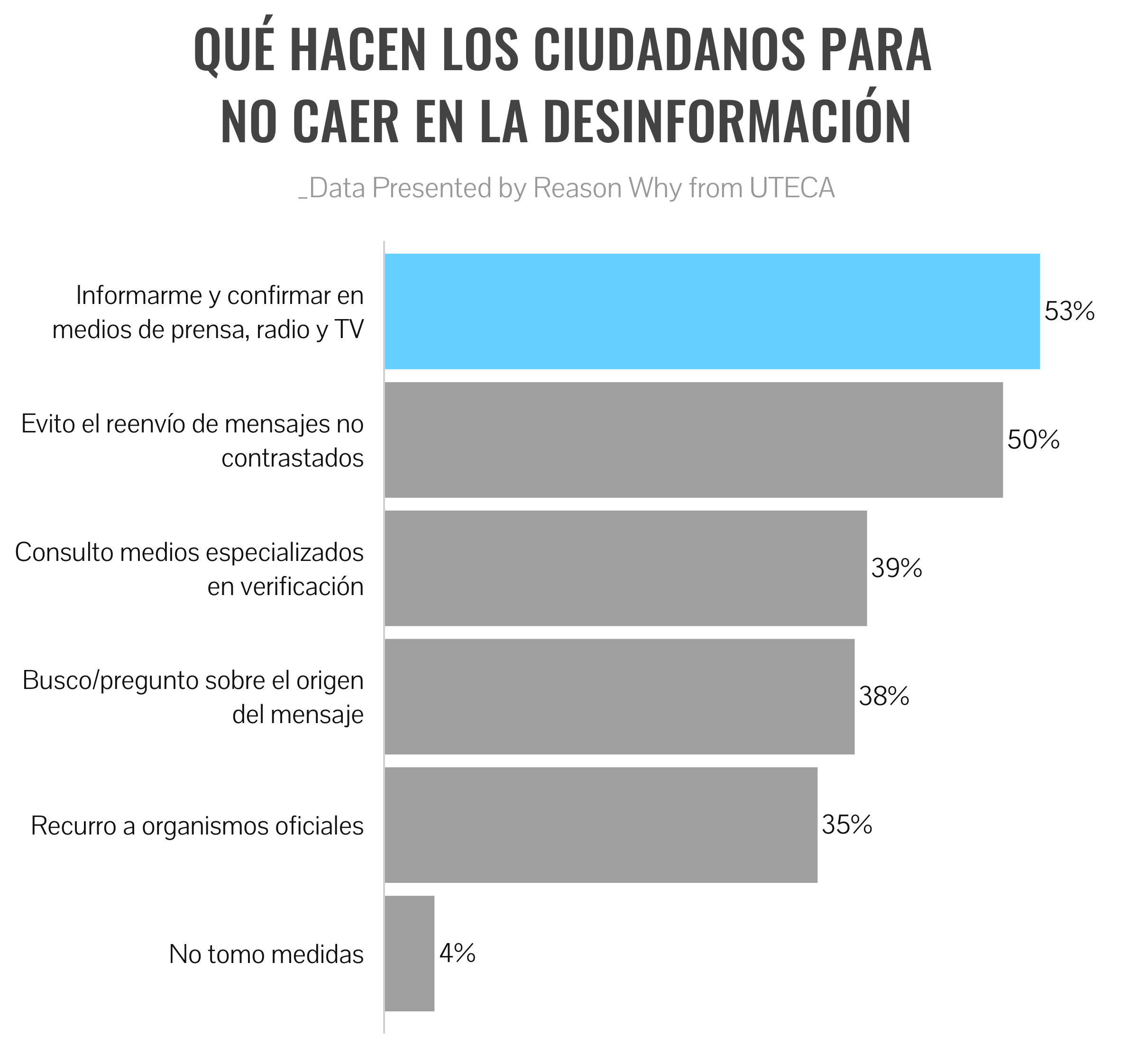
The most common measure to avoid falling into misinformation is to inform yourself and confirm the content through the press, radio and television, a practice mentioned by 53% of the participants. They are followed by avoiding forwarding messages that have not been verified (50%), consulting specialized verification media (39%), investigating or asking about the origin of the message (38%) and resorting to official organizations (35%). 4% acknowledge not taking any measures to protect themselves from hoaxes, the highest percentage since 2024. Among those under 34 years of age, however, that proportion drops to 2%.
The importance attributed to professional journalism is also reflected in other responses: 80% consider that, if television, radio and the press did not exist, more misinformation would circulate. Among young people between 18 and 34 years old, this perception rises to 87%. For their part, 81% maintain that professional journalists are the best guarantee for having truthful information in the face of misinformation.
These responses reflect the declared confidence in the role of the media and its professionals, although they do not allow us to determine by themselves the real effectiveness of the measures that citizens apply to identify false content.
Parents feel calmer when their children watch television
The protection of minors is another area in which the barometer identifies relevant differences between television and digital environments.
62% of fathers and mothers with minors in their care choose television as the channel they trust most for their children to consume content alone, considering that they are more controlled. The figure has increased compared to the previous year.
At the opposite extreme are social networks, with 4%, their worst result in the last five years. Video platforms get 12%.
This perception corresponds to a general concern about the content available on the Internet. 91% of parents surveyed express concern about the lack of control over what their children can access through digital devices. Furthermore, 93% would like the content controls and child protection measures that exist on television to also be applied on the internet. The percentage increases 2.2 points compared to 2025.
Along the same lines, 88% prefer to give their children control of the television rather than the mobile phone.
Free television is claimed as a space for social cohesion
Beyond information and entertainment, the barometer analyzes the value that citizens attribute to television as an accessible and shared service.
95% agree that free television constitutes a good of general interest to which everyone has the right, one point more than in 2025 and the highest percentage since 2023.
The consensus hardly shows any differences between generations: it reaches 9% among young people aged 18 to 34, 95% among adults aged 35 to 54 and 96% among those over 55.
95% believe free TV is necessary to guarantee access to quality content
It also increases the appreciation of its social cohesion function. 84% consider that free-to-air television contributes to uniting society because it is accessible to all audiences, 5.1 points more than the previous year. Among young people, the proportion reaches 86%.
On the other hand, 95% believe the existence of free television is necessary to guarantee widespread access to quality content.
The study incorporates an issue linked to the evolution of audiovisual consumption devices: more than 73% of those surveyed would like to have more direct access to traditional channels from the remote control of televisions connected to the Internet. This result becomes relevant in a market in which free-to-air television shares the main home screen with applications, platforms and other audiovisual services. For networks, the ease of access and visibility of their channels are issues that directly affect their presence before the viewer.
The campaign that UTECA launched last July revolved around this issue, in which it denounced the difficulties in accessing free linear television from connected televisions. Through humor, the association questioned whether such an everyday action as watching television had become complicated between applications, menus and featured content, and demanded direct and visible access to DTT channels from the home screen and the controls of the Smart TVs.
Entertainment, education and awareness campaigns
Television also leads several of the social functions examined in the report, although the results show generational differences.
65% consider it the medium that entertains them the most, compared to 34% who mention social networks and 22% who mention video platforms.
Among young people aged 18 to 34, the order changes: social networks lead entertainment preferences with 64%, followed by television, with 51%.
As for the company, television obtains 53% of the responses and radio, 35%. It is also in first position when asked which medium helps most to educate due to the content it offers. Television reaches 56%, followed by radio (33%) and the press (33%). Video platforms (14%) and social networks (11%) occupy the last positions.
65% consider it the medium that entertains them the most
For UTECA, the results support the relevance of free-to-air television in an increasingly fragmented audiovisual scenario and reinforce its arguments in favor of accessibility, editorial responsibility and the protection of minors.
The president of the association, Eduardo Olano, has valued the results, pointing out that the television stations appreciate the trust of citizens and are committed to continuing to act with responsibility and rigor to contribute to building an informed, plural and diverse society.
UTECA, established in 1998, brings together Atresmedia, DKISS, Mediaset España, Net TV, Real Madrid TV, Ten, Trece and Veo TV, whose associates manage 21 free digital terrestrial television channels.
The study therefore offers a snapshot of the trust and expectations that a sample of regular viewers place on free television. Its conclusions reflect a high recognition of its informative and social role, while evidencing the differences between generations and the distance between digital consumption habits and the credibility attributed to each medium.
More info: Barometer – The social perception of free-to-air TV