In the popular imagination, meditating is often confused with “emptying the mind”: slowing down, silencing the noise and remaining in a kind of cognitive pause. The problem is that the brain is not a switch and neither is attention. A new work published in Neuroscience of Consciousness It gets precisely into that crack between myth and mechanism: observing what happens when people who have spent years training attention as if it were an instrument meditate. 
The study brought together 12 monks of the Thai Forest tradition from the Santacittārāma monastery, near Rome, all with a very high level of practice experience. The article reports an average of more than 15,000 hours, with a wide range between participants. In a laboratory at the University of Chieti-Pescara (Italy), researchers recorded their brain activity with MEG (magnetoencephalography), a non-invasive technique that measures magnetic fields generated by neuronal electrical activity.
The analysis challenges the idea of “calm brain” as synonymous with “blank brain” when meditating
As part of the research, two meditation styles with different attentional logics were compared. Samatha is described as a focused attention meditation that involves maintaining concentration on an object or, for example, on breathing, to stabilize the mind. Vipassana, on the other hand, is an open monitoring practice that consists of observing sensations, thoughts and emotions as they appear, without selecting or judging. Karim Jerbi, professor of psychology at the University of Montreal and co-author of the work, illustrates it like this: “With Samatha, you narrow your field of attention, as if you were narrowing the beam of a flashlight; with Vipassana, on the contrary, you widen it.” 
What this study brings to the table challenges the idea of “calm brain” as synonymous with “blank brain” when meditating. And in both types of meditation, the brain signals showed an increase in complexity compared to a state of rest or rest with eyes closed. During meditation you can see how the activity does not disappear, but rather becomes richer in information and less reducible to a simple pattern. The article quantifies this complexity with several metrics and the general result indicates that, during meditation, the brain enters a dynamic regime different from that of “rest.” 
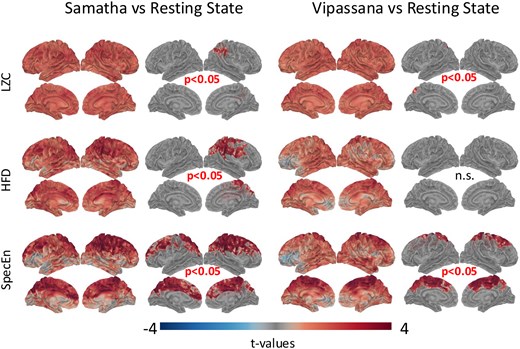
In both Samatha and Vipassana, more richness and dynamism is observed in the brain signal. In the case of Samatha, this effect is even more consistent in some regions of the brain.
In parallel, the team analyzed brain “criticality.” It is a concept imported from statistical physics that, applied to the brain, describes the idea of operating near a boundary between order and chaos. In this intermediate zone – if it exists and if the brain visits it – it is assumed that neural networks can be stable enough to transmit information reliably and, at the same time, flexible enough to quickly adapt to new things. In Jerbi’s own words, excess rigidity makes adaptation difficult. The underlying thesis is that a “well-adjusted” brain would be one capable of learning, changing tasks, and responding efficiently. 
And although Samatha and Vipassana increase complexity, they would not do so with the same dynamic configuration. The work uses, among other indicators, a criticality deviation coefficient derived from the analysis of neuronal “avalanches.” The authors observe a tendency for Vipassana to bring the system closer to that more “critical” point of balance, while Samatha is associated with a relatively more stable and concentrated state.
Another key to the study lies in how brain oscillations were analyzed. Much research on meditation has talked about increases in “gamma” activity, associated with attentional and working memory processes. This study, however, observes reductions in gamma power during meditation when the oscillatory component is separated from the aperiodic component of the signal. The interpretation is that, without that correction, some of what appears to be a change in “gamma” could actually be a broader shift in the spectral background. That is, measuring well matters, because if what is “rhythm” is not separated from what is “structured noise”, what belongs to the general architecture of the signal can be attributed to a frequency band. 
Meditation can be a training of attentional mechanisms that modulates brain dynamics
The general framework proposed by the study is that of meditation as training of attentional mechanisms that modulates brain dynamics. Miracles are not promised, but this does fit with the idea that if the practice involves directing and sustaining attention, it should be noticeable in how the brain organizes its activity. And that can help fine-tune meditation-based interventions for stress, anxiety or depression, with a relevant distinction: not all meditations train the same or lead to exactly the same type of state. 
It must also be taken into account that the sample with 12 monks is quite small, given that these are very difficult participants to recruit due to their level of experience. But having been able to observe these expert meditators with MEG under controlled conditions allows us to record a neurophysiological “imprint” of mental states that, for centuries, had been described rather from within.
More info: Article published in Neuroscience of Consciousness