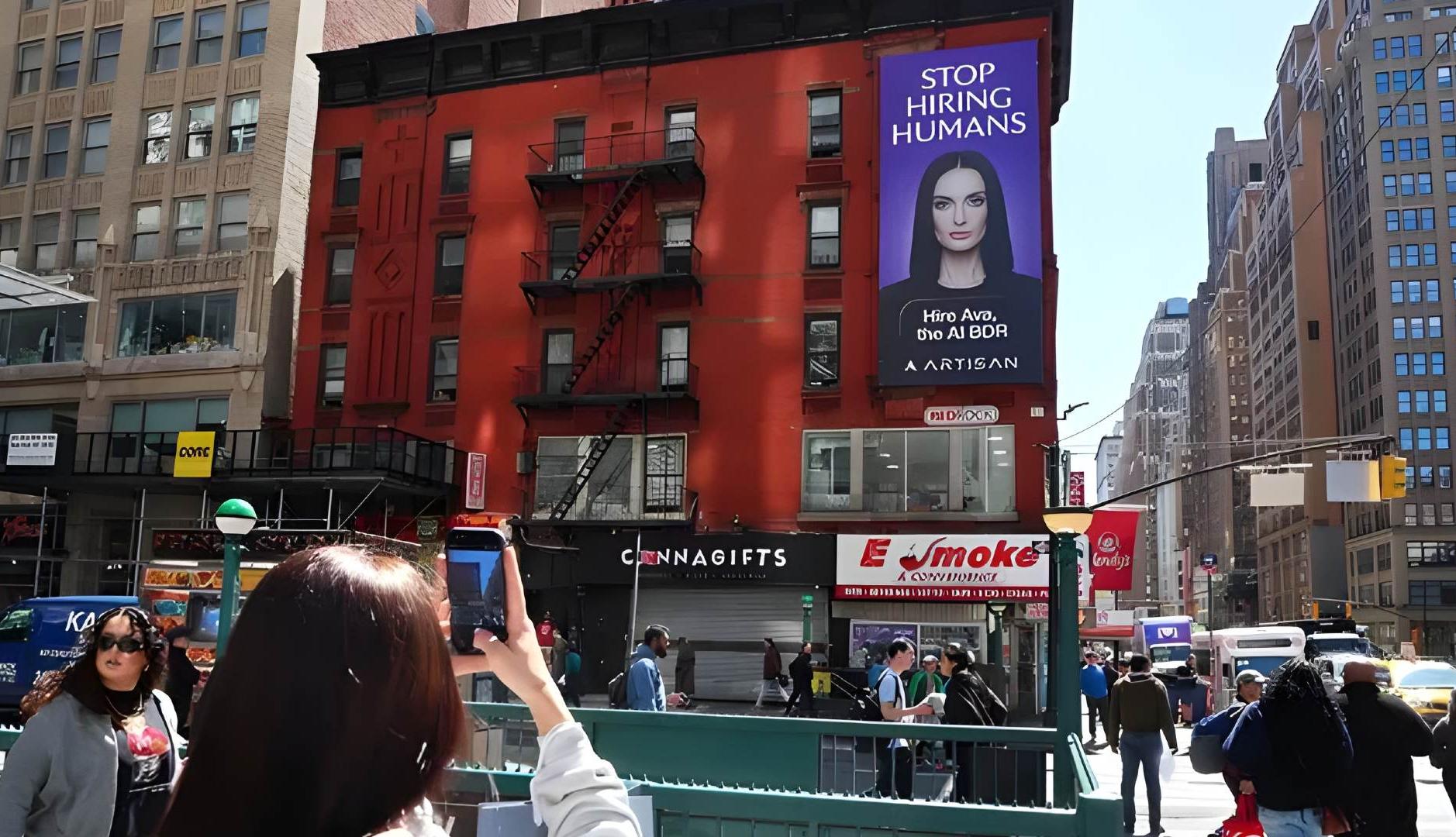
“Stop hiring humans. Hire Ava“.
That is the controversial message that Artisan, specialized in artificial intelligence software to automate workflows, has been launching for a few weeks. With outdoor advertising pieces deployed in New York and San Francisco, the firm promotes the new version of Ava, its autonomous sales representative powered by AI.
The company claims that the tool is the only artificial intelligence Business Development Representative, with the ability to search for potential clients, write personalized emails, manage responses and schedule meetings. The solution, as Artisan points out on its website, helps sales teams generate sales opportunities at a fifth of the cost of a human professional.
For this reason, the company is encouraging companies to replace part of their equipment with its software. He does this with direct messages that praise the number and efficiency of tasks Ava can accomplish, and by ridiculing the performance of human workers. One of the pieces, under the message “Fire Steve. Hire Ava,” exposes a fictitious message chain in which the human apologizes for not being able to go to work, while the agent claims to have arranged 12 meetings and to have identified almost 1,300 potential clients.
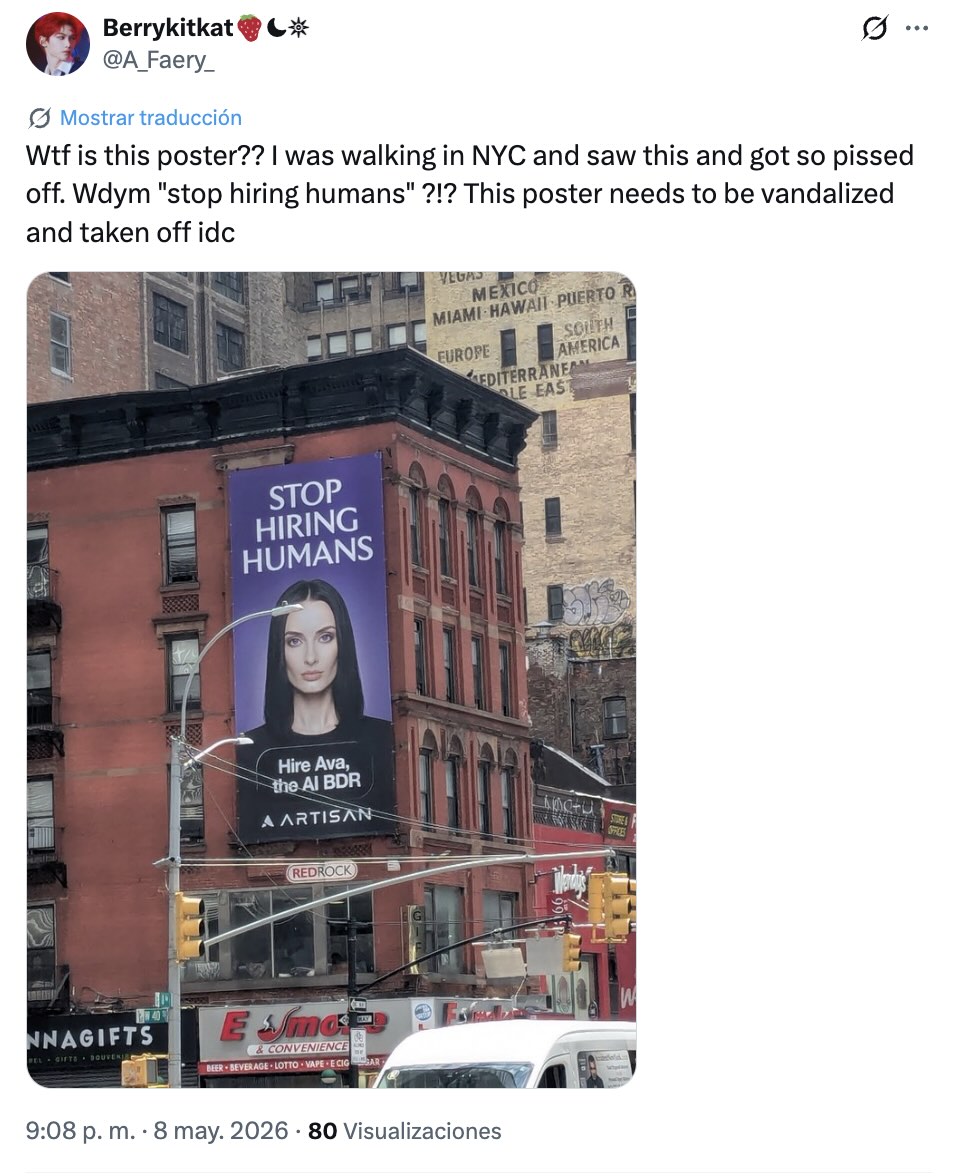
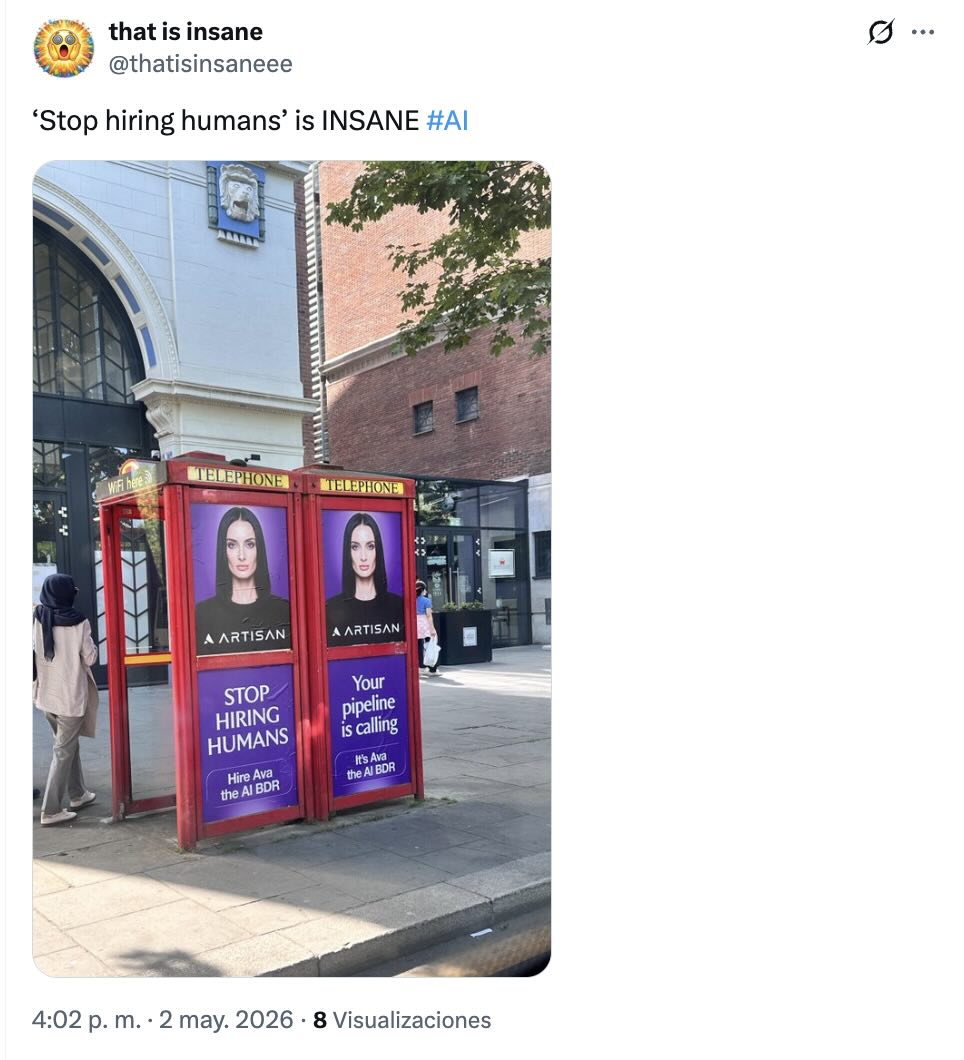
On billboards, billboards and marquees, the campaign has deployed the claim “Stop hiring humans” on the streets of the two largest business enclaves in the United States. The messages have aroused the animosity of users, many of whom even invite vandalizing the creatives.
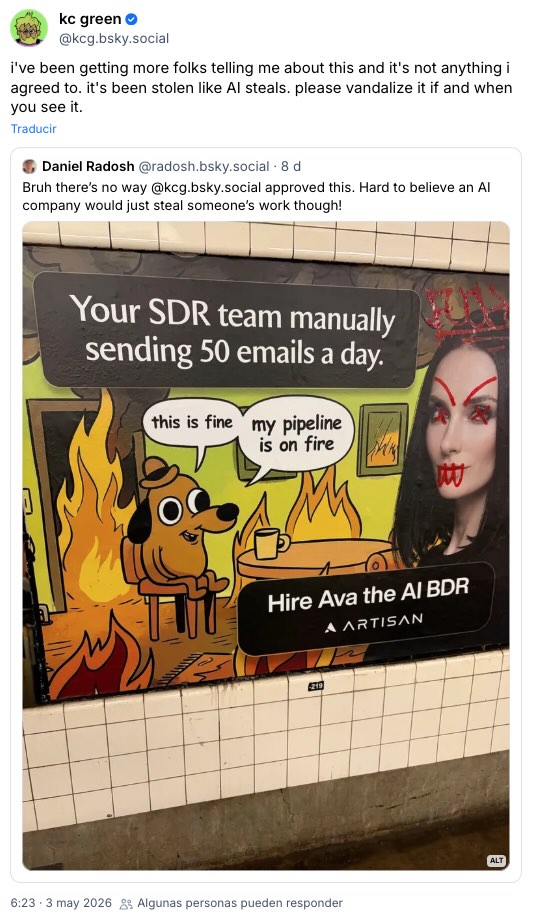
In addition, other pieces have used the popular “It’s fine” meme to parody the day-to-day life of the commercial department and highlight the opportunities that Ava’s incorporation into organizations would provide. The image, however, as shared by the creator himself, artist KC Green, has been used without consent. According to TechCrunch, the company has contacted Green and he is considering taking legal action.
The display of outdoor advertising expands the efforts of an audiovisual campaign launched in April and which included the participation of Jordan Belfort, a former American broker and ex-convict, known for his autobiographical book “The Wolf of Wall Street.” Following the traditional April’s Fool’s jokes, the company claimed to have hired him as a sales manager, and he started a competition between the human team and Ava to demonstrate the capabilities of the tool.
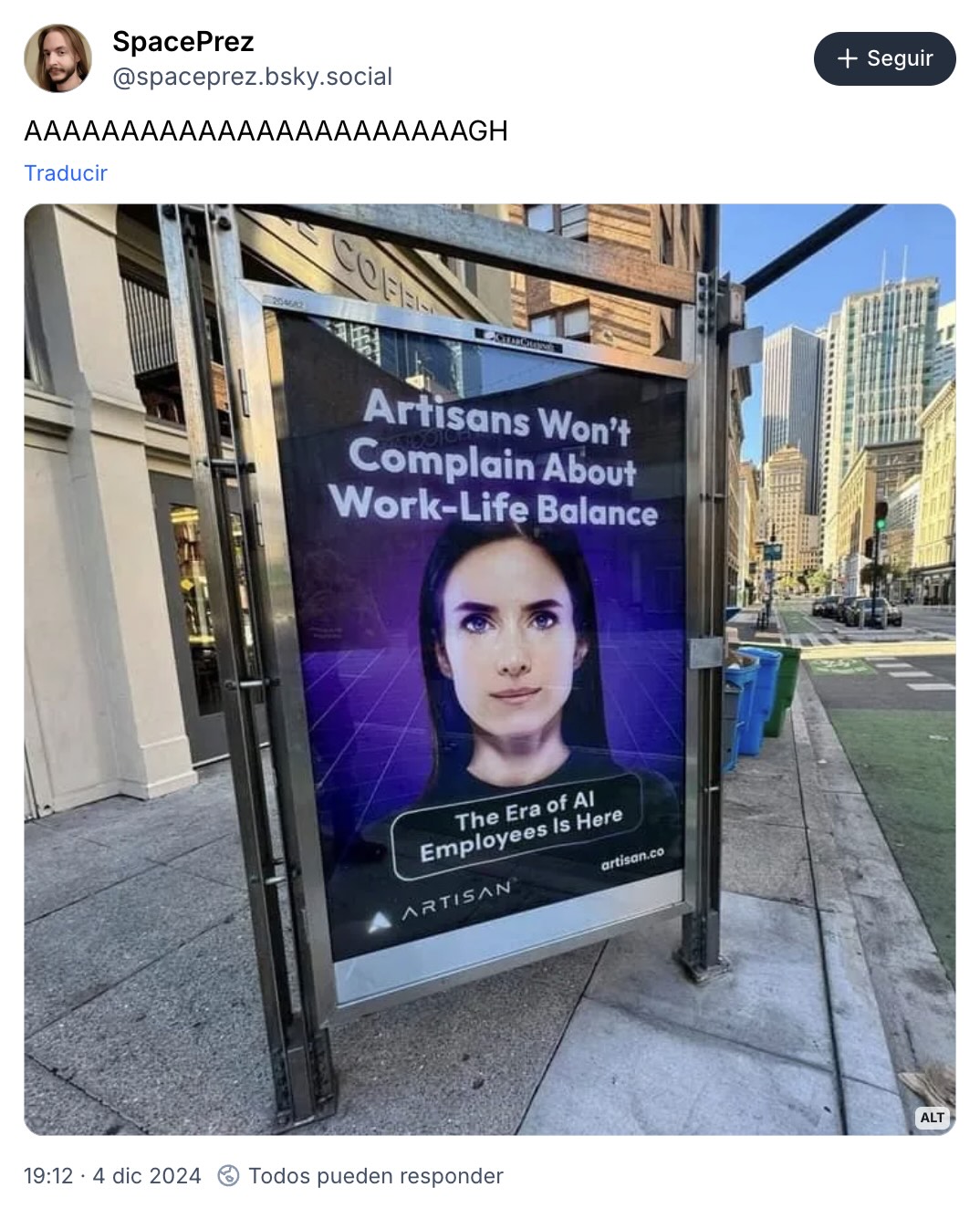
The advertising campaign follows the communication line that Artisan has deployed over recent years. In 2024, it already launched a campaign advancing the consolidation of “artificial intelligence employees” in order to promote the first version of its automated sales agent. “The ‘artisians’ will not complain about the balance between life and work,” the creativity noted then.
A campaign that requires explanation
The company’s “anti-human” speech has gone viral and has aroused such reactions among the audience that Jaspar Carmichael-Jack, Co-Founder & CEO of Artisan, has explained the firm’s position in a post on the official blog, qualifying the message launched by the campaign. In it he points out that “Stop hiring humans” is not a phrase about humans in general, but about a category of work.
“That category is the worst part of cold prospecting: the mass emailing, the constant repetition of templates, the tedious task of building lists. We saw that work misery for years before creating Ava“, he explains. “Our conviction is simple: AI should do the work it can do best, especially the work that was never good for humans. Humans should do the work that requires human intervention”.
He explains that “cold prospecting” exhausts people and is one of the main causes of resignation among commercial agents. “The job, as it stands, involves typing a slightly modified version of the same opening sentence into a tool eight hundred times a week, sending it to strangers, being ignored most of the time, getting a “no” the rest of the time.“notes Carmichael-Jack. “We don’t think the role should be eliminated. It has inherently human components. A human voice on the phone, listening, adapting, creating a moment of connection with a stranger, is something AI is not good at and probably shouldn’t be.”.
In this sense, he considers that the future of work involves the coexistence of human talent and artificial intelligence tools. And he has gone further, defending a real universal basic income, “enough so that no one has to take a job that leaves them exhausted just to pay the rent“; as well as the four- or three-day work week, since it is understood that “work should take up less time in life”.
However, he is aware that neither society nor the market have reached that point yet. “The transition between here and there will be uneven and politically difficult, and to pretend otherwise is a form of dishonesty. I don’t think the solution is to slow down technology“says the CEO of Artisan in the publication.
However, he defends the campaign and the message launched by the company. He points out that using a hook that attracts attention is the key to the success of any campaign that has managed to capture the attention of the public, and argues that creativity and the post fulfill different functions, the second being aimed at those who want to go deeper and understand the nuances of the slogan. “The billboard is a provocation. It works because it is uncomfortable. The underlying idea is more subtle than three words on a wall, but those three words still mean what they say: stop hiring humans for work that AI can do better, and stop pretending that work was ever good for humans.”he explains.
In this regard, he believes that Ava will help companies move forward in this direction. “When I think about what will come after this product, this company, this decade, I think of a world where people work less and live longer. I want our billboards to be remembered as a step towards that future”, he concludes.
However, negative user reviews point to counterproductive execution and a gap in that ambition.