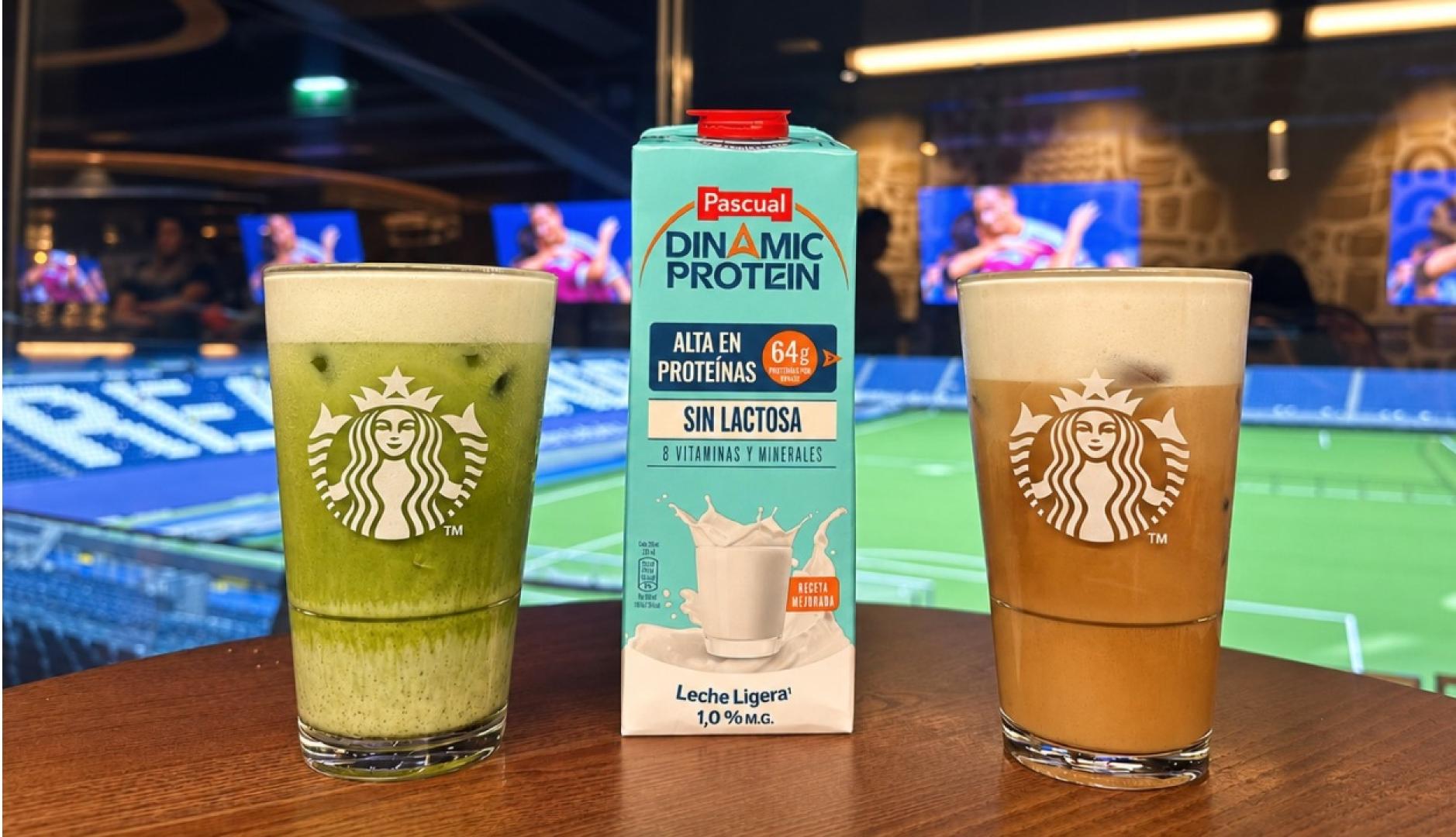
Protein has been spreading for months into categories that until recently were outside its usual territory. Snacks, pasta, drinks, cereals or soft drinks have been incorporating enriched formulations to respond to a consumer who seeks to add this nutrient to increasingly everyday moments. Doritos or Gallo are some of the recent examples, while Pascual has worked on this trend with its Dinamic Protein range.
Now the movement goes one step further and leaves the supermarket to fully enter organized catering. Starbucks and Pascual have reached an agreement whereby the chain incorporates Dinamic Protein as a new dairy alternative in its establishments in Spain, both in two specific recipes and in the customization of other drinks on its menu.
The alliance seeks to transfer to consumption outside the home a category that, according to data provided by the companies, already exceeds 520 million euros in Spain, grows by 22% and is present in 61% of homes.
From functional product to option within the cafeteria
Dinamic Protein provides 64 grams of protein per liter and is enriched with eight vitamins and minerals. Its incorporation into Starbucks initially materializes in two proposals, Protein Latte and Protein Matcha, although customers will also be able to select it as a dairy alternative to customize other drinks.
The alliance is supported by Starbucks’ culture of customization: six out of ten customers in Spain adapt their drink
The movement fits with one of the features that Starbucks has made a central part of its proposal. According to the company, six out of ten customers in Spain personalize their drink, either by modifying ingredients, quantities or characteristics of the recipe. “Mornings are one of the most relevant times for Starbucks and also one of those that best reflect how our customers’ preferences are evolving”explains Antonio Romero, General Director of Starbucks Iberia. The alliance, he points out, allows us to add “a new functional alternative” combining Pascual’s dairy innovation with the quality, the work of the baristas and the customization capacity of Starbucks.
For Pascual, the agreement allows the protein category to be extended to new consumption occasions. Juan Luis González Maroto, General Director of Lácteos de Pascual, considers that the incorporation of Dinamic Protein to the chain will contribute to “democratize access to this type of top-quality functional drinks outside the home.”
Antonio Romero, DG Starbucks Iberia, and Juan Luis González, DG Pascual Lácteos
Protein finds new opportunities for consumption
The morning slot appears as one of the especially relevant spaces for this strategy. 40% of Starbucks customers go to their establishments in the morning and six out of ten Lattes and Cappuccinos are served before 12:00 p.m., according to company data. Matcha also shows the extent to which personalization is beginning to intersect with the search for functional proposals: Starbucks points out that 20% of these drinks are already customized with protein.
The collaboration is also the first expression of “El Mañanismo”, the new Starbucks platform developed together with Dentsu Creative and amplified by Havas PR. The brand starts from its experience around consumption during the first hours of the day to build a creative territory with a journey in communication, content, product, experiences and activations. The idea is based on the fact that there is no single way to start the day well and that each consumer has their own rhythms, rituals and needs.
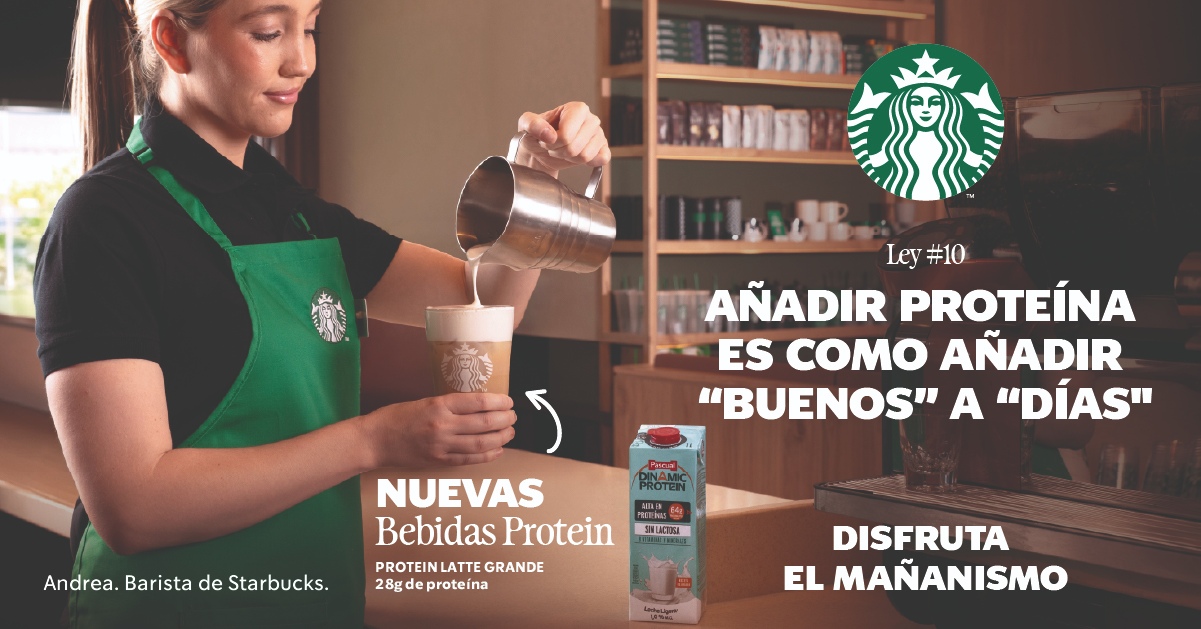
The concept takes shape through “The Laws of Morningism”, a collection of observations about everyday situations that will function as the platform’s creative code. Among the first are messages such as “Adding protein is like adding ‘good’ to ‘days’”, “A short coffee can improve a very long day” or “Your hunger doesn’t care how fast you are.” Protein Latte and Protein Matcha thus inaugurate this territory from the product, linking the protein trend with one of the moments of consumption that Starbucks seeks to reinforce: the morning.
The entry of Dinamic Protein into Starbucks thus reflects a broader evolution of the trend. If in the first stage the protein claim was concentrated mainly in categories linked to sports and specialized nutrition, brands are progressively moving it towards mass consumption products and ordinary moments of the day.
In recent months, this evolution has led Doritos to present a protein version of its snacks and Gallo to launch a pasta with 40% more protein than its classic version. The incorporation of Pascual to Starbucks now adds another front: that of coffee shops and immediate consumption.
Protein Latte and Protein Matcha are now available in Starbucks stores in Spain.