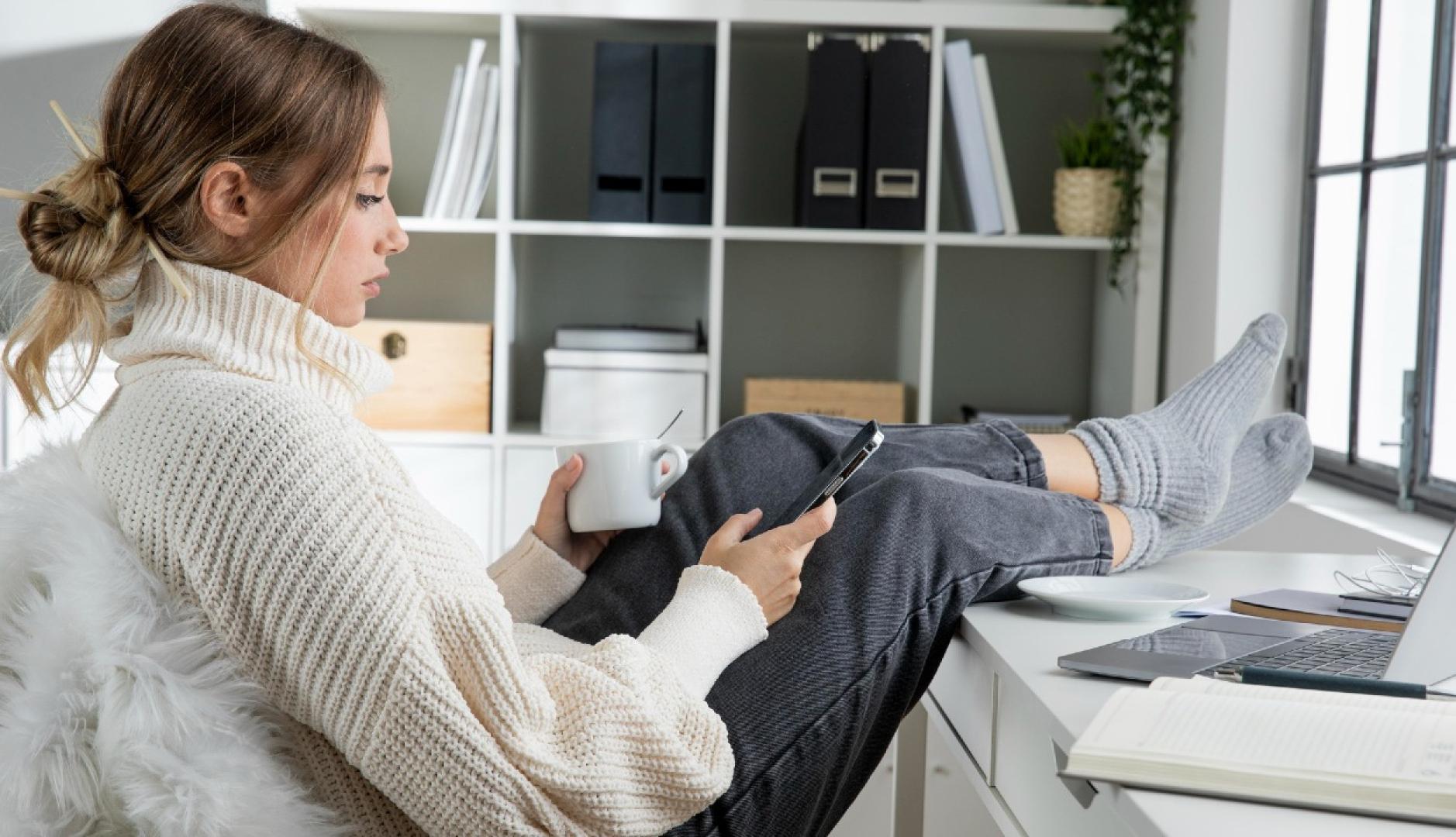
Socks, slippers and even foot warmers are beginning to form part of the dress code in certain technology offices in the United Kingdom and Silicon Valley. What at first glance may seem like an eccentricity actually responds to a very contemporary concern: how to make the workplace feel less like an obligation and more like a space of well-being.
According to Guardianseveral British companies – such as helloSKIN, Tao Climate or Tech West Midlands – have instituted no-shoes policies in their offices, inspired by American start-ups that have been exploring new ways to promote comfort, reduce anxiety and improve concentration. Although it is not yet a mainstream trend, the simple gesture of taking off your shoes when entering is making its way as a sign of cultural change.
Natalie James, Founder of skincare brand helloSKIN, introduced a socks-only policy in her office in 2024. “Offices are, by nature, stressful environments”he explains. “If a gesture like taking off your shoes makes you feel more comfortable and, therefore, more creative, then it is an obvious decision”. Of course, the trend is applied under certain rules: bare feet are not allowed, socks must be clean and without holes, and footwear is still mandatory in the kitchen, bathroom and outdoors.
The benefits, according to James, have been tangible: greater calm, better concentration and a visible improvement in creative processes. Gary Byrnes, CEO of Tao Climate, shares the vision. “An office can be a boring and challenging place. Anything that makes it more bearable is good for productivity, well-being and happiness”he maintains.
“Wearing shoes makes me feel disconnected from the ground. I would say I can only concentrate 70%”
For Andy Hague, CEO of Tech West Midlands and a neurodivergent person, the decision is even more personal. “Wearing shoes makes me feel disconnected from the ground. That lack of sensitivity destabilizes me. I would say I can only concentrate 70%. The rest of my attention is thinking ‘this doesn’t feel good.’
And the phenomenon has crossed the Atlantic. Fortune reports that start-ups such as Cursor (AI unicorn valued at $9.9 billion), Speak (backed by OpenAI) or Whop (founded by members of Gen Z) have implemented similar policies. According to Cursor employee Ben Lang, “I have never worked in a start-up where this rule did not exist.”
The argument is not only aesthetic or comfort: there is also a strategic background. In environments where marathon days are worked – such as the “996” model (from 9 a.m. to 9 p.m., six days a week) common in the technology sector – any initiative that reduces tension and promotes creativity can be welcomed. “In an era where anxiety reaches epidemic levels, creating more comfortable spaces can generate significant advantages for innovation and cohesion”says Anita Williams Woolley, professor of organizational behavior at Carnegie Mellon University, cited by Fortune.
But not everyone is convinced. Aaron Asadi, CEO of Enterprise Nation, is skeptical: “We believe in shoes. We encourage start-ups to develop their own culture, but we prefer to focus on collaborative tools, cost control and ethics in AI integration, rather than reviews about socks.”
Questions arise around equity and inclusion, or even the risk of a generation gap
Questions also arise around equity and inclusion. Professor Mustafa Özbilgin, an expert on workplace inclusion at Brunel University, warns that these types of policies can put disproportionate pressure on women. “Men can afford informality, but for women, dress remains a key factor in professional judgment”. Furthermore, it raises the risk of a generation gap: what for younger workers may symbolize creativity, for older workers may be perceived as a lack of professionalism.
But even beyond the technology sector, the trend finds unusual followers. Amanda Nicols, Deputy Executive Director of the Delapré Abbey Preservation Trust in Northampton, England – an institution that operates in a 12th century building – also works barefoot. “I spend the day running in and out. Not wearing shoes helps me move faster. If I get my feet dirty, I just wash them.”.
Could this custom become widespread in traditional offices? It doesn’t seem entirely feasible in the short term, but as conversations around mental health, inclusion, and organizational culture grow, companies could see these small gestures as a way to reframe the relationship between comfort and productivity. The work environment increasingly demands more flexibility and empathy due to its current “competition” with teleworking models, so promoting comfort in the office could be seen as an extra claim for in-person performance.