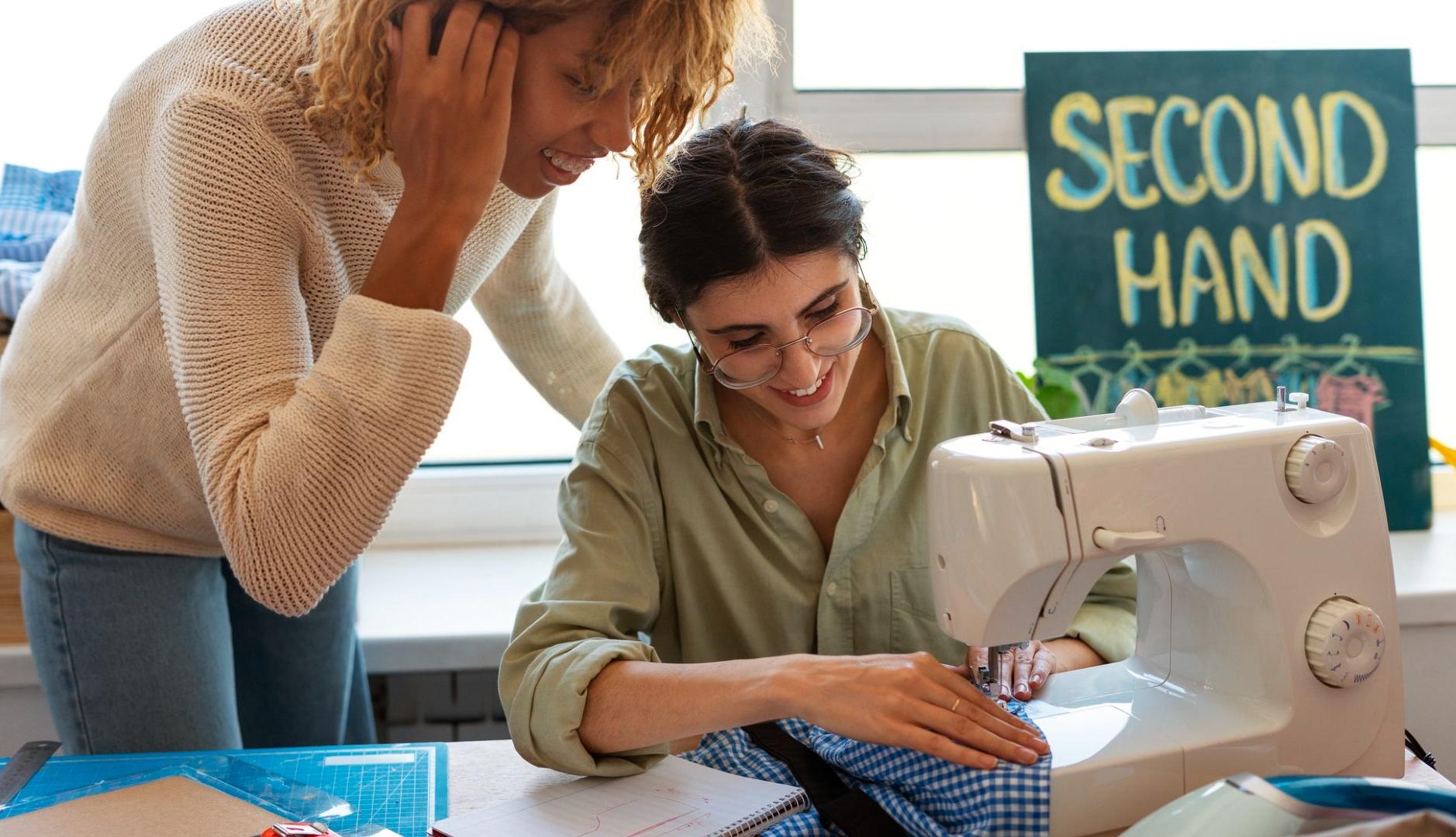
For decades, repairing a garment was a skill taught in classrooms, but since the 1970s, as home economics classes disappeared and large global fashion brands consolidated, some generations have grown up without even minimal knowledge of sewing. Now, in a context marked by economic complexity and environmental concern, brands are recovering these skills to connect with new generations of consumers.
Levi’s sewing workshops
Proof of this is the “Wear Longer” program, promoted by Levi’s at the beginning of this year and which consists of a free educational course aimed at high school students, developed together with Discovery Education. It consists of four sessions designed to fit different subjects – from STEM to social sciences – and teaches how to repair garments by hand, without the need for sewing machines.
The objective is to offer users a practical, transferable and applicable skill in both professional and personal life, and thus satisfy the interest of new generations in sustainability and fashion. The firm’s employees participate in the course and teach students four basic tasks: sewing a button, hemming, mending a hole and fixing a tear.
Original Levi’s Instagram post.
The course has been carried out over the last few months in different parts of the United States and expands the repair and customization services that Levi’s offers in hundreds of stores around the world. It’s all part of it. As the brand itself explains, its commitment to durability and prolonged use of the garments. “When someone invests time and care in fixing a garment, their relationship with it changes. It stops being something disposable and begins to have emotional value” says Paul Dillinger, Vice President of Global Product Innovation at Levi’s.
Primark and its repair sessions
Levi’s initiative is not isolated, rather it is part of a trend among the big brands in the sector and that has circularity at the center of a strategy aimed, on the one hand, at connecting emotionally with consumers and, on the other, at alleviating the negative perception of the industry in relation to its environmental impact. It is worth remembering that the UN considers fashion and textile manufacturing to be one of the most polluting sectors globally. According to Greenpeace, fashion is responsible for around 10% of annual carbon emissions, and fast fashion is the second largest consumer of water in the world.
Before Levi’s, in early 2025, Primark already explored holding free repair workshops in several of its stores in Spain. As the brand noted in a statement, the sessions taught essential sewing skills, such as changing buttons, fixing zippers and adding pockets. No prior experience was required, and participants received a sewing kit, a booklet with repair instructions, and a reusable bag to practice at home.
Original post by Rosa Sorroche on Instagram
The intention, as Primark noted at the time, was to help customers extend the life of their garments, reduce textile waste and contribute to a more circular fashion economy. “We believe that small changes, like learning how to mend a garment or recycle textiles responsibly, can make a big difference in reducing waste and building a more sustainable future.”; explained Carlos Inacio, General Director of Primark Iberia.
Until then, under the “Love It For Longer” concept, the brand had already held more than 400 repair workshops in France, Italy, the Netherlands, the United Kingdom and Ireland, offering more than 7,000 free spaces to customers and employees.
Mango and the skills of the trade
Mango is also another of the brands that have found in sewing a way to reinforce circularity and sustainability, although from a more industrial point of view. In January of this year, it launched “Craft Your Future”, a training program aimed at promoting technical profiles in order to respond to the lack of generational change in key disciplines in the sector, such as pattern making and clothing.
The course, developed in collaboration with the LCI Barcelona design school, lasted five months and was developed through different modules that delved into industrial pattern making, advanced manufacturing, quality control and digital tools applied to product development. The initiative focused on craft as a differential element of the firm’s creative model, while at the same time offering real training and professional development opportunities to young talents.
Original post by LCI Barcelona on Instagram
Between emotional connection and sustainable footprint
The trend reflects how sewing and repair are being revalued based on different perspectives. On the one hand, as a savings formula to meet the needs of a generation that is more aware of its consumption; and, on the other, as the recovery of traditional trades to maintain the commitment to design and craftsmanship in an increasingly technical and homogeneous market. In addition, knowledge and skills related to sewing are also being revitalized as a method of customer loyalty.
And these types of initiatives would be more aimed at deepening the relationship with consumers and positioning brands as generators of value than at a practical and tangible reduction of their respective environmental impacts. They are aligned, in this sense, with the multiple actions and programs launched to promote the reuse of garments and the buying and selling of second-hand clothing.
Experts and some consumers consider that these programs around sewing and repair can help reduce the environmental impact of a garment, since it would delay or replace a new purchase, but their limited nature would not compensate or slow down the continuous growth of clothing production and consumption.
According to data from the European Environment Agency, in 2022 European Union citizens consumed an average of 19 kg of clothing, footwear and home textiles, up from 17 kg in 2019. Furthermore, between 4% and 9% of all textile products marketed in Europe are destroyed without having been used for their original purpose, with the processing and destruction of returned or unsold textiles estimated to be responsible for up to 5.6 million tons of greenhouse gas emissions.
Although initiatives linked to sewing and repair are honorable efforts by brands to contribute to a change in mentality and consumer behavior, reuse continues to be a challenge in terms of profitability and scalability. This is why different movements and initiatives have emerged that urge governments and authorities to adopt policies that strengthen the profitability of services linked to sustainability.
The Ellen Macarthur Foundation, focused on the circular economy, proposes reducing VAT on second-hand products, reducing labor taxes and Extended Producer Responsibility (EPR). Their initiative, which has the support of H&M, Primark and Zalando, ensures that such measures could raise gross profit margins up to 55% for resale and around 41% for repair.