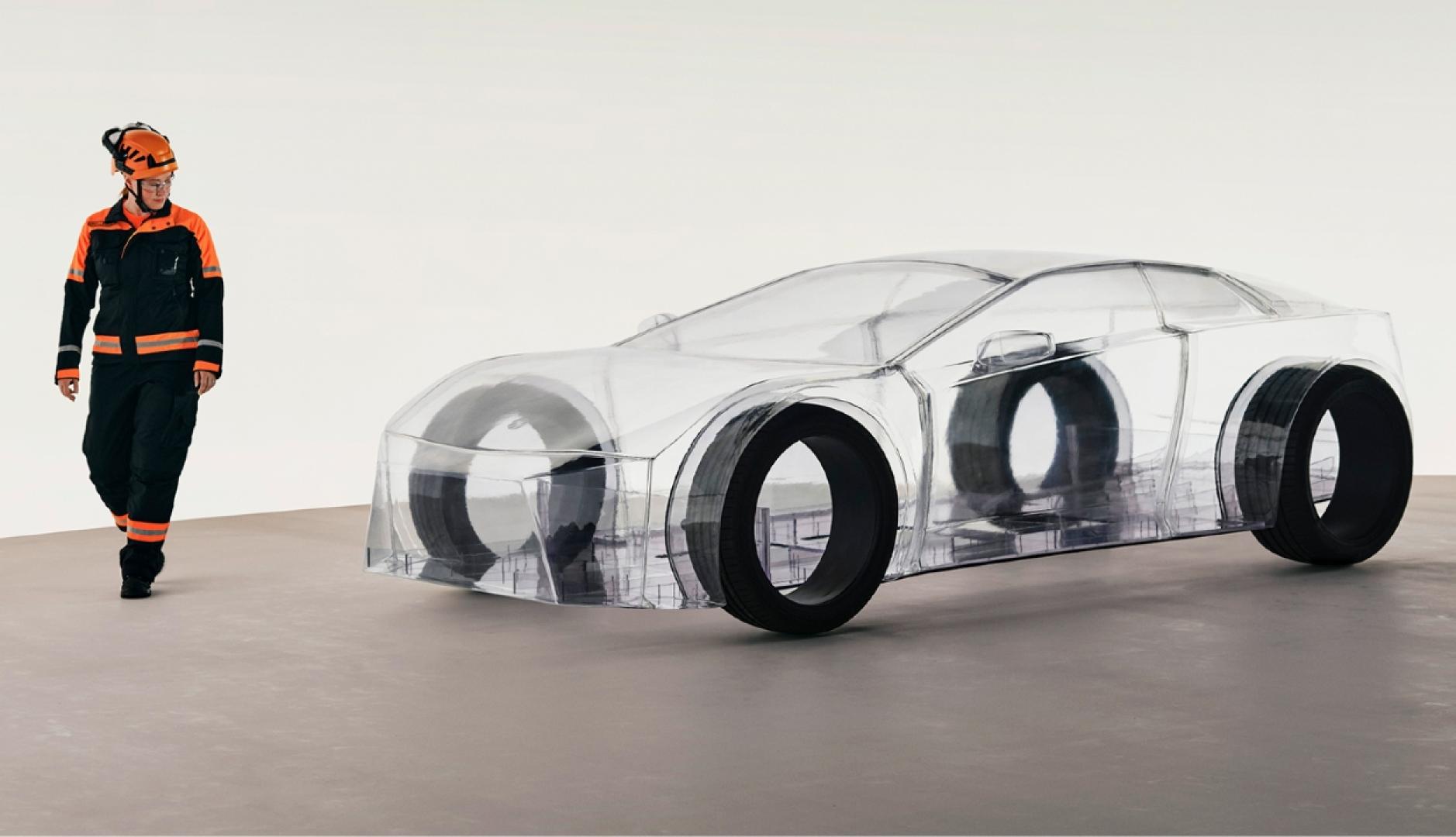
The electric car has established itself as an icon of the sustainable future, but Sandvik – a global engineering group specialized in industrial solutions, mining and materials technology – and BBDO Nordics have opted for a radical provocation: building an electric vehicle that cannot move, function or, strictly speaking, exist. It is called eNimon – “no mine” backwards – and it is the first electric car in the world manufactured without metals or minerals from mining.
The result is a full-scale car, completely transparent and converted into a kind of industrial ghost. The piece is exhibited in the National Museum of Science and Technology, one of the main Scandinavian spaces dedicated to innovation and industrial history. There, in a context that celebrates technological progress, the installation sends the message that without mining, the green transition stops.
More than 90% of an average electric car is made up of materials of mining origin and, according to project data, an electric vehicle requires up to six times more mineral inputs than a conventional one. By eliminating elements such as lithium, copper, nickel or cobalt, eNimon is reduced to an empty shell that forcefully visualizes the material dependence on electrification.
“We wanted to create an electric car that was missing everything that makes an electric car possible”explains Isaac Bonnier, Art Director at BBDO Nordics. “Building a full-scale ‘nothing’ was a huge challenge, but that is precisely the point: eNimon shows how impossible the green transition is if we forget where its materials come from.”
The initiative is part of Sandvik’s line of projects that use engineering as a narrative tool. In 2022, the company had already achieved international notoriety with “Impossible Statue”, a sculpture created with AI and advanced technology that brought together four historical artists in a single piece.
With eNimon, Sandvik once again uses a physical installation to transfer a complex debate to the visual and comprehensible field. This is not about glorifying mining, but rather underlining its structural role in electrification and reinforcing the need for responsible, safer, smarter and more sustainable mining. Thus, instead of showing what mining can build, the project focuses on what happens when it disappears.