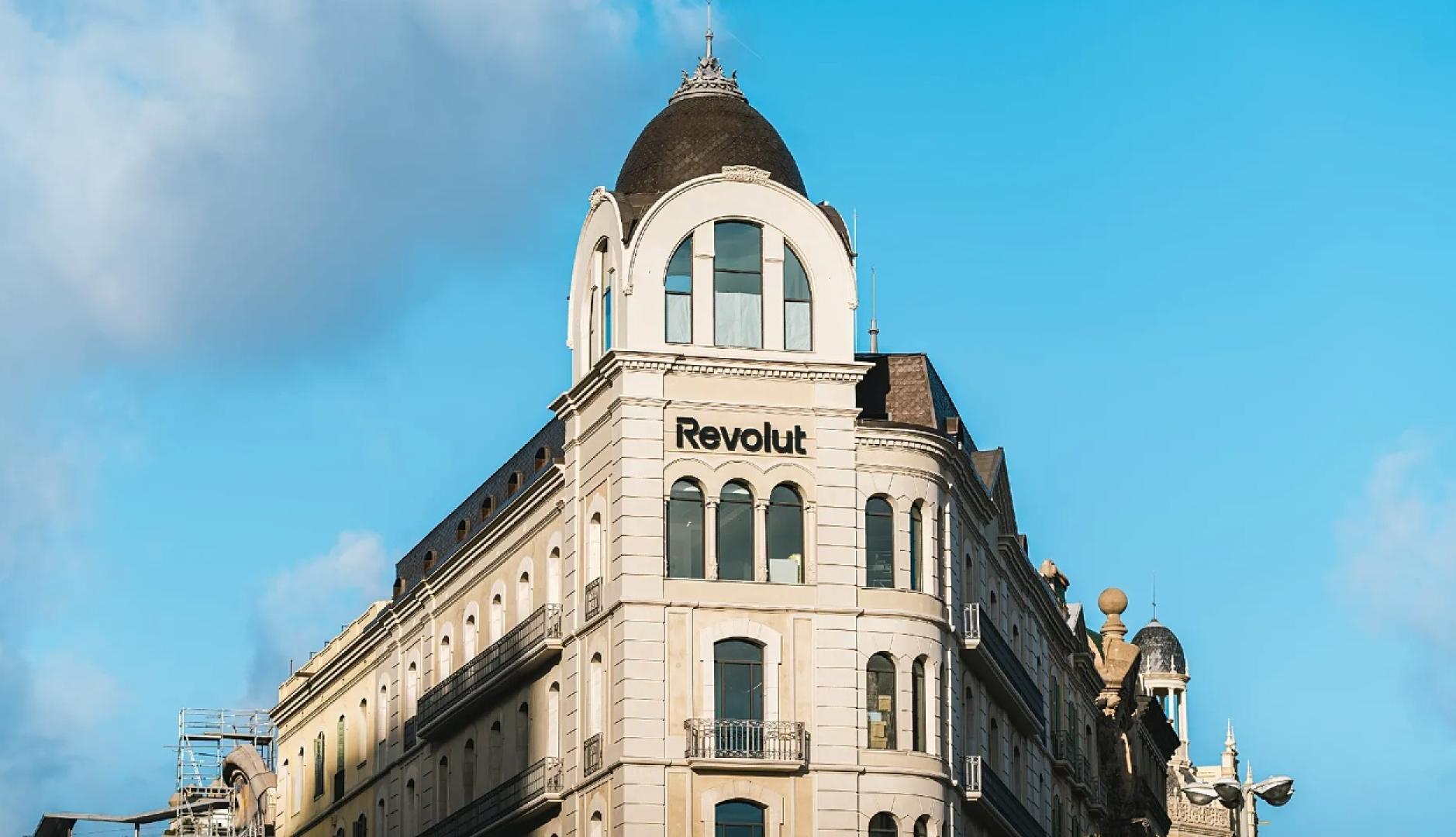
Revolut is preparing the opening of its first global physical store in Barcelona, in a move that marks a relevant change in its customer relationship model. The space, which will be located in the area around Plaça Catalunya and is scheduled to open between the end of 2026 and the beginning of 2027, will not be a temporary format, but rather a permanent establishment conceived as a pilot. With more than 20 employees and a design comparable to that of an Apple Store, the goal is to create an immersive environment that allows you to tangibly experience the brand’s ecosystem.
“This will not be a temporary space, but a permanent and highly visible place that will give life to our ecosystem”the company has explained. Along the same lines, Antoine Le Nel, Global Chief Growth & Marketing Officer at Revolut, has pointed out in a Linkedin post: “We want to make financial innovation more accessible to the public, and making it tangible is the best way to achieve this.” The choice of Barcelona responds to its role as a strategic market – it is the third for the company globally – and its combination of local density, international projection, tourism and innovation. “It is a natural environment to try this format”he added.
The opening of the space is part of a broader transition: the evolution of Revolut from a fintech born in 2015 as an application towards a digital bank with a physical presence. With around 70 million customers worldwide and record results in 2025 thanks to its revenues of €5.2 billion (46% more), the company is expanding its offering towards regulated financial products, such as loans or deposits.
The store will function as a point of contact aimed at explaining the product, generating trust and facilitating conversion.
In this context, the store will function as a point of contact aimed at explaining the product, generating trust and facilitating the conversion of new users. The approach is close to Apple’s retail model: a space more focused on the experience and relationship with the brand than on the direct transaction. For a company whose acquisition has been mostly digital, presence in a location with high international traffic allows access to audiences that are difficult to reach through conventional channels.
Barcelona as a strategic hub for Revolut
The commitment to the city goes beyond retail. Revolut already has about 700 employees in Barcelona and plans to reach 1,000 in 2028, after the incorporation of 300 new profiles in the coming years. This summer it will move its global innovation hub to a building at the intersection of Avinguda Diagonal and Passeig de Gràcia, one of the city’s main commercial arteries. In addition, it has begun the deployment of its own ATMs – including interfaces in Catalan – and plans to launch its website and app in this language in 2027.
Spain is thus consolidated as one of the key markets for the company, with six million clients, while Madrid will host a new office before the end of 2026, with a forecast of 500 additional employees. In parallel, Revolut has announced the opening of its European headquarters in Paris, which will generate 400 jobs, and continues to process banking licenses in France and the United States, after having obtained the one in the United Kingdom in March 2026.
All these movements are part of a strategy of institutional consolidation with a view to a future IPO. Revolut aims for a valuation of up to $200 billion in its IPO, not expected before 2028, which would place it among the largest European companies. Its five-year, £10 billion investment plan, along with the expansion of its physical and regulatory network, is in response to building a stronger brand and business infrastructure.
The Barcelona store is, in this sense, one of the most visible elements of this transition: a step from a digital native brand towards a broader presence, which combines product, experience and trust in the physical space.