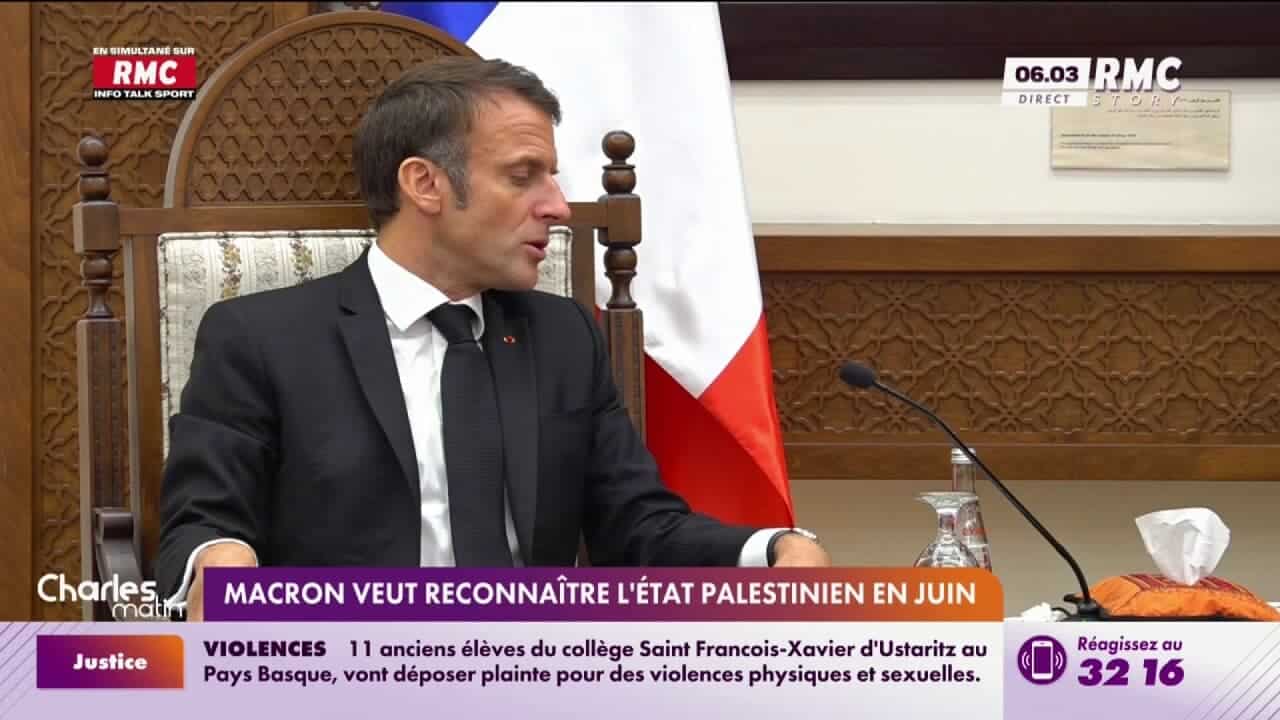
As the Israeli-Palestinian conflict intensifies, discussions concerning the recognition of the Palestinian State are increasing in France. The President of the Republic, Emmanuel Macron, recalled wanting to recognize the State of Palestine very soon, in June. Several countries have already given rise to this recognition, but for what purpose? What are the concrete effects of this diplomatic act?
Palestine, what status on the international scene
Since the Palestine sharing plan In 1947, the agreements mentioned the division of the territory between A Hebrew State And A Palestinian State. Thus, the initial text originally of Israel provides The journey to a state of Palestine.
When Yasser Arafat declares the state of Palestine in 1988 and accepts resolution 242 delimiting the Palestinian and Israeli territories, already Several dozen countries recognize Palestine As a state, including the Arab League, the USSR or several African States. In 1993, Oslo agreements mark a large step in this process of sovereignty, with the Mutual recognition of Israel OLP (Palestine Liberation Organization).
Today 147 countries on 193 UN member states recognize the State of Palestine. In 2024, Spain, Ireland and Norway have also announced to recognize this state. Thus, the fact that France recognizes a Palestinian state, that is to say a sovereign and politically organized territory, would not constitute a revolutionary advance on a regional scale.
In international law, we define a State as ” a community that consists ofa territory and a population subject to organized political power (and) is characterized by sovereignty“. (Arbitration Commission for the former Yugoslavia: “Badinter Commission” 1991). It is also specified that “The principles of international law … make it possible to define under what conditions an entity constitutes a State”but that “” the existence (or disappearance) of the State is a question of fact ”.
Thus, it is important to remember that The existence of a state is preliminary to its recognition. Consequently, the fact that France recognizes the State of Palestine would not mean that Palestine has just fulfilled the conditions to be a state: France would simply take note of its existence.
The will for France of a solution to two states
Overall, if Macron recognizes the State of Palestine, that would mean that France would start to respect its sovereigntythat is to say the right for Palestine to have “The competence of his competence”. The French state would therefore recognize that Palestine must have the exclusivity of theinternal and external authority on its territory, without any interference. A diplomatic advance, which would perhaps allow Germany or the United Kingdom to reconsider the question, but also to add a third country recognizing the State of Palestine to the UN Security Council. A majority of 3 permanent members out of 5 would then recognize Palestine as a State in the Security Council, A rather symbolic advance which would not weigh in the face of the right of individual veto.
If France wants to recognize the Palestine State, it is because it would like to move towards a two -state solution – that initially planned in the Palestine sharing plan, a text resulting from the Zionist movement. At the moment, Emmanuel Macron is also trying, as Bertrand Badie underlines in an interview for opinion, to do recognize the Israeli State by certain Arab countries. A kind of mediation without concrete effect to the Near East, which simply reshapes diplomatic relations between France, Western powers and Israel.
Why so many debates around the Palestine State?
If already 147 States recognize the Palestinian State, and that ultimately it is not the recognition of the international community that defines the existence of a State, why do we still debate this diplomatic act?
At first, it is important that states recognizing their existence for ensure their respective sovereignty – although it already exists. This recognition allows you to have a better voice and a better placeconsidered more legitimate, on the international scene. This is precisely what some people oppose the French recognition of the Palestinian State.
Several opposition arguments consist in saying that there is no real institutionalized political entity in Palestine and therefore no Palestinian State. Others put their finger on the idea that recognizing the Palestinian state would then amount to recognizing a Hamas governmentwhich intensifies the debates. It is however important to emphasize that at the international level, it is always Palestinian authority and not Hamas which represents Palestineeven if the Islamist organization took control of Gaza in 2007. It is also a question of not indulging in a sophism mixing the Gaza strip and Palestine.