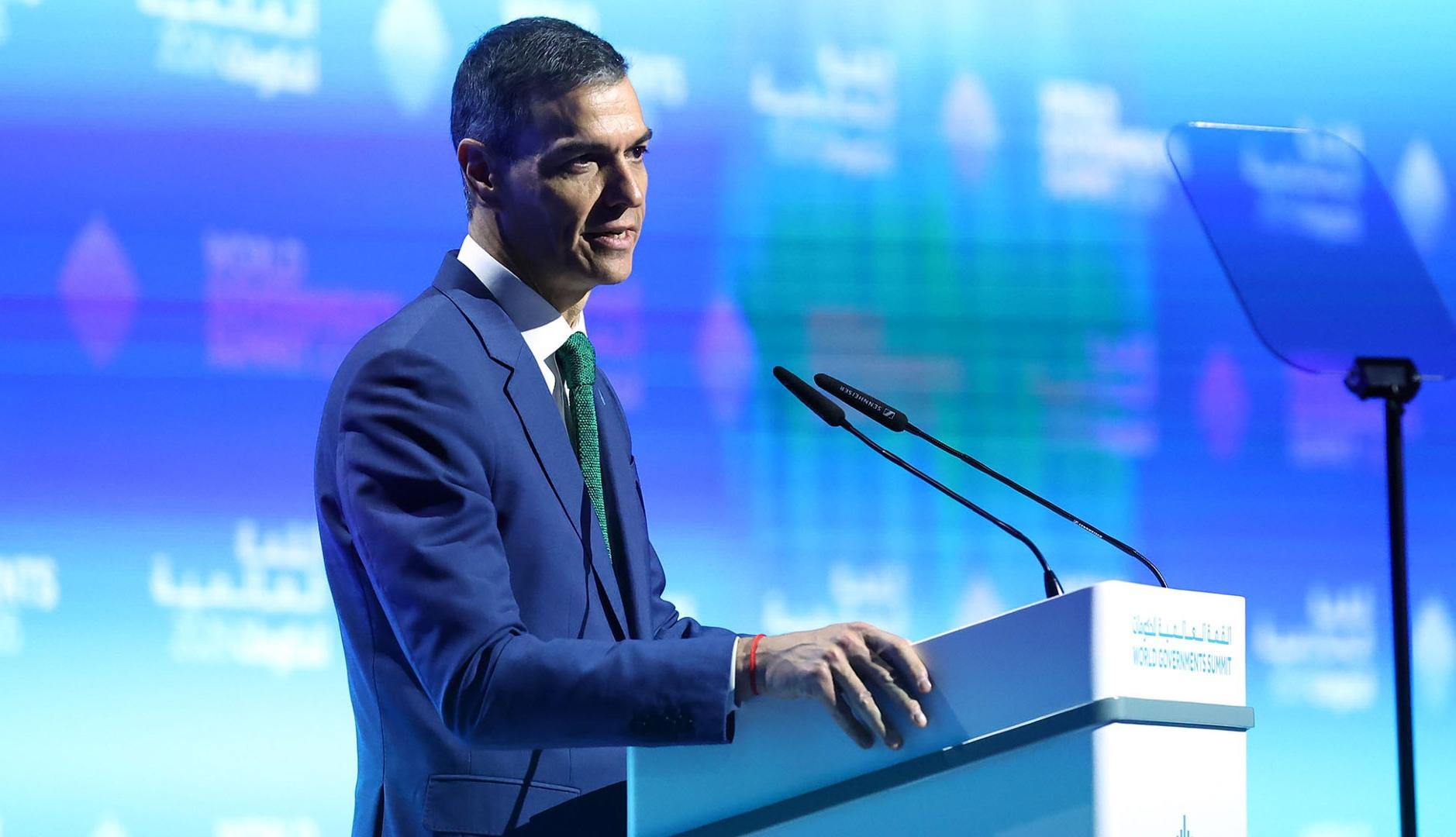
The President of the Government, Pedro Sánchez, has announced five legislative and regulatory measures, some of them already known, as part of a package aimed at achieving a safer and more respectful digital environment. The prohibition of access to social networks for minors under 16 years of age is one of them.
He communicated this during his participation in the World Governments Summit, held in Dubai, and in which he reflected, among other things, on misgovernment in content control, the expansion of disinformation and hate speech or the lack of protection of data or personal information.
Social networks are the focus of the announced measures. As Sánchez explained in his speech, digital governance is a central issue of the current era and he assures that it must be addressed globally against “to the failed state that the social media ecosystem has become where ‘laws are ignored and crimes are tolerated’“, as reported from Moncloa.
The objective of the measures is “regain control of digital governance and social networks” and “guarantee a safe, democratic and respectful digital environment with fundamental rights“. Also “confront the abuses of large digital platforms”.
These are the measures announced:
Prohibit social networks for minors under 16 years of age
The President of the Government has assured in the forum that Spain will prohibit access to digital platforms for minors under sixteen years of age. The proposal is contemplated in the bill for the protection of minors in digital environments, which is currently being processed in Congress.
The text was approved by the Council of Ministers in a first round in June 2024 and received the green light in March 2025. Five portfolios participated in its drafting: Presidency, Justice and Relations with the Courts, Digital Transformation, Youth and Children and Social Rights, Consumption and Agenda 2030, and Equality.
The regulations would raise the minimum age to access and register on social networks from 14 to 16 years old. This is also the age of consent for the processing of personal data (regulated in the Data Protection Law) and, therefore, necessary to open an account on this type of platform.
To make this effective, the law refers to the obligation of digital platforms to implement effective age verification systems.
The measure would put Spain on par with countries that have advanced on this path. Australia became the first country in the world to prohibit access to social networks for minors under 16 years of age on December 10, 2025; and France joined earlier this year. Denmark and Portugal are also working on the implementation of the measure.
End to impunity for social media managers
One of the main novelties of the measures announced by Pedro Sánchez is to attribute legal responsibility for infractions committed on digital platforms to their directors if content that violates the law or is considered hateful is not removed.
This represents an expansion of what the European Union establishes in the Digital Services Regulation. This already demands responsibilities for the content they disseminate to large platforms, which has led, among other things, to the imposition of million-dollar fines, such as the one applied to
The manipulation of algorithms, classified as a crime
Likewise, Pedro Sánchez has announced the criminalization of the manipulation of algorithms and the amplification of illegal content. “LDisinformation does not arise from nowhere, it is something that is created, promoted and spread by certain actors whom we will investigate, as well as the platforms whose algorithms amplify disinformation in exchange for benefits.“, said the President.
This would be aligned with what is included in the Action Plan for Democracy, approved in 2024; and would also expand some of the crimes included in the bill for the protection of minors in digital environments, which include deepfakes and grooming.
A tool to measure hate and polarization
In relation to the previous measure, Sánchez has announced the creation of a tracking, quantification and traceability system that allows establishing a “Footprint of Hate and Polarization”. The objective is, as reported from Moncloa, to stop the amplification of hate speech and expose the permissiveness of digital platforms “that feed this type of content whose impact is influencing a greater social division”.
“Hate has long been treated as invisible and impossible to quantify”
“For a long time, hate has been treated as invisible and impossible to quantify, but we are going to change that with a tool that will be the basis for defining future sanctions. Because spreading hate has to have an economic, legal and moral cost”, commented the President.
However, it has not specified how the tool works or who will be in charge of developing it.
Investigation of Grok, TikTok and Instagram
Lastly, Sánchez has announced that the government will work with the prosecutor’s office to investigate possible infractions committed by Grok, TikTok and Instagram. “We are going to have zero tolerance and we are going to defend our digital sovereignty against any type of foreign coercion”, he pointed out.
Pedro Sánchez has recognized the titanic battle that all this entails and that the challenges facing the social media industry exceed the capabilities of a single country. For this reason, it has also announced Spain’s accession to five other European countries in the “Coalition of the Digitally Disposed” to advance in a coordinated manner in the application of stricter, faster and more effective regulation of social platforms.
He has not specified which countries make up this coalition, but has announced that they will meet in the coming days.