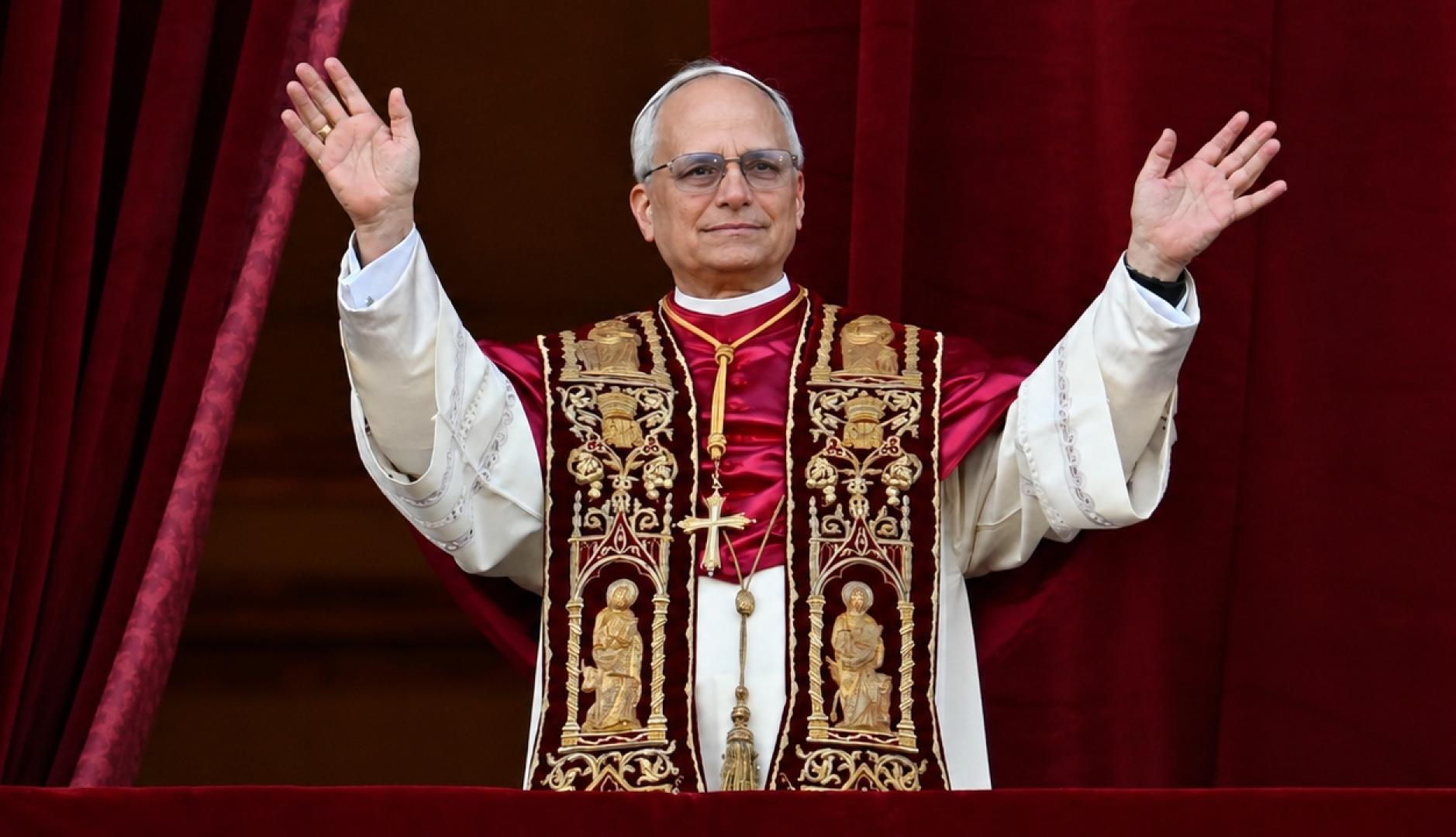
Pope Leo XIV has once again placed artificial intelligence among the great challenges of our time. Four months after dedicating a good part of his first encyclical, “Magnifica Humanitas”, to the impact of this technology on dignity, freedom, employment and human relations, the pontiff has taken advantage of his official visit to France to insist on the need to keep the person at the center of technological development.
He did so during his speech before the authorities, civil society and the diplomatic corps at the Elysee Palace in Paris. There he warned of the risk of “losing our humanity” in the middle of a “paradise of machines” that invades and conditions our daily lives. The expression recovers a reflection by the French writer Georges Bernanos and has served him to demand greater ethical training in the face of the implementation of technological systems that are increasingly present in people’s lives.
“In order not to lose our humanity in the midst of the ‘Paradise of Machines’ that invade and condition our daily lives, it is urgent to train minds in ethical discernment capable of distinguishing what is morally good,” Leo XIV has pointed out.
The new statement continues an issue that has occupied a prominent place since the beginning of his pontificate. Leo XIV himself recalled in Paris that he considered “indispensable” address artificial intelligence in his first encyclical with the aim of “return to placing the human person at the center of all reflection.”
In his speech he related current technological advances to a question that transcends the capabilities of the tools themselves: what happens when scientific and technical progress is separated from the ethical criteria that determine how they should be used.
The Pope has turned to historical experience to illustrate this concern. When addressing the conflicts and weapons developed during the 20th century, he recalled how humanity has proven that scientific progress, when separated from wisdom, can be used as an instrument of destruction. From that perspective, it demands that new technologies remain at the service of the person and not be used as instruments of domination or injustice.
His reflection also stops at the very concept of “intelligence” applied to machines. Leo XIV points out that societies have progressively delegated tasks previously performed by human beings to them and that, more recently, certain artificial systems have even received the name of a specifically human faculty.
Faced with this advance, he warns of a possible process of “dehumanization” in which ideas and relationships are impoverished while people end up being evaluated mainly using criteria of efficiency and productivity.
A concern that already marked his first encyclical
The words spoken in Paris deepen the position on artificial intelligence that Leo XIV established in May with “Magnifica Humanitas: On the custody of the human person in the time of artificial intelligence.”
In that document, the Pope warned of the concentration of technological power in large companies, the biases of the systems, their possible impact on personal relationships, employment, privacy and misinformation, as well as the growing dependence on digital platforms.
He also called for a policy “more present”adequate legal frameworks, independent monitoring mechanisms and greater user training. One of its central approaches was that artificial intelligence should not be understood as a morally neutral technology, since both its design and its applications incorporate human decisions.
Now, Leo XIV has condensed a good part of that approach around the idea of “paradise of machines”. His proposal involves accompanying technological expansion with education for ethical discernment, so that the increase in the capabilities of the systems does not displace issues related to human freedom and dignity.
Artificial intelligence has also been one of the issues addressed in the meeting between Leo XIV and the French president, Emmanuel Macron. The Elysée has noted that both addressed the main global challenges shared by France and the Holy See, including specifically climate and AI.
The new statements thus reinforce a line that Leo XIV has maintained since the beginning of his pontificate. And the debate on artificial intelligence, according to him, should not be limited to how much the technology can do and extend to who sets its objectives, under what principles it is developed and what place it ultimately reserves for people.