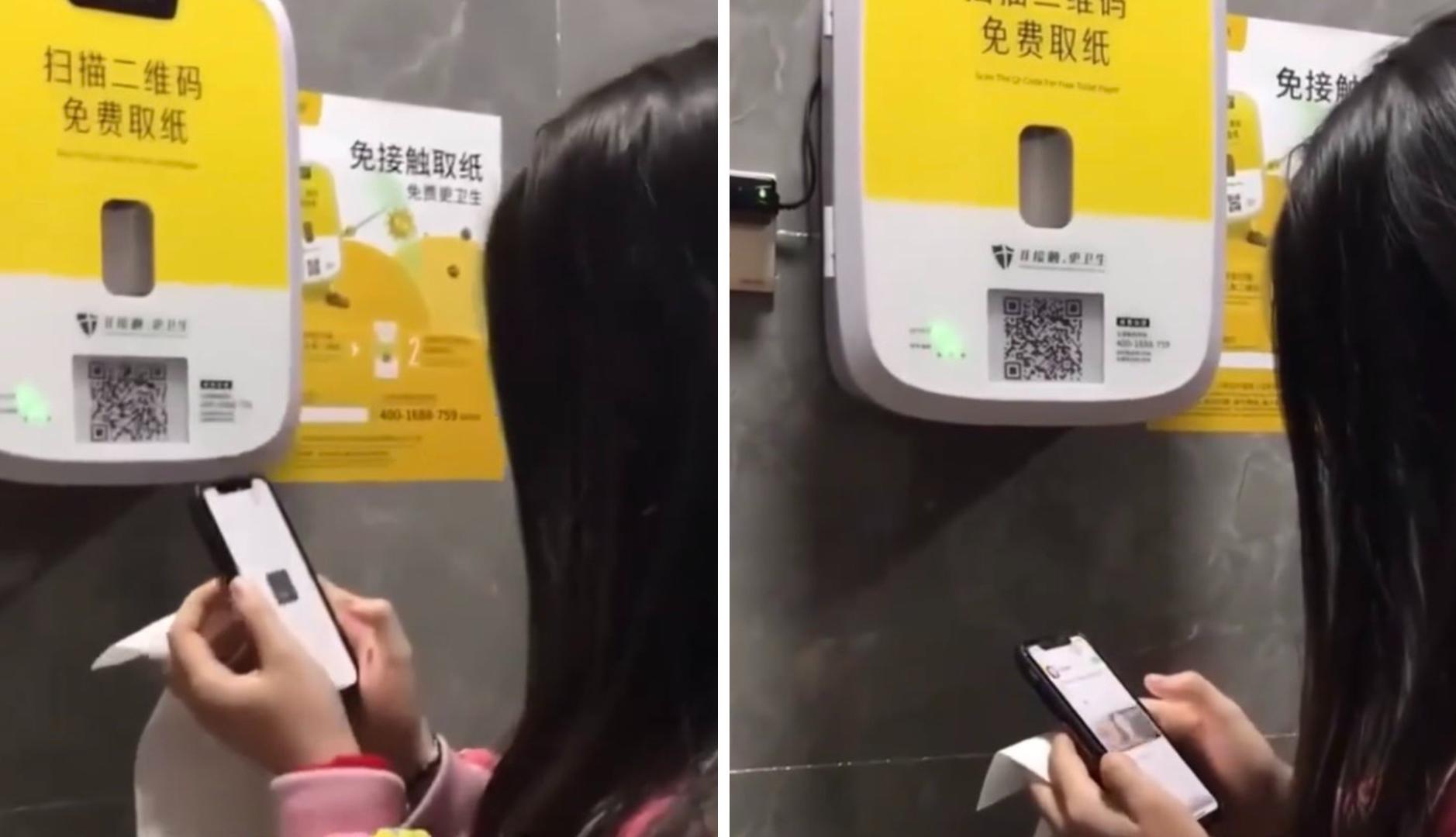
Pay or view ads. It is the dichotomy that has been established in the business models of multiple industries, especially those related to entertainment. But it is also the formula that is being applied in China in some of its public bathrooms with the intention of reducing the cost of toilet paper.
Over the last few weeks, a video has gone viral in which a young woman scans a QR code located on a toilet paper dispenser. By doing so, she is taken to a website that offers her the possibility of paying 5 yen or watching a video, presumably an advertisement, in order to activate the mechanism. In the video, the young woman chooses to watch the advertising to obtain a limited amount of paper.
It is worth contextualizing that the video was initially published by China Insidera news portal with a conservative line and opposition to the Chinese Communist Party. It is associated with the Falun Gong religious movement and The Epoch Timesa conservative international media.
The media does not report the date or place of the recording, nor the type of bathroom in which the dispenser is located.
The objective of the device would be to reduce the cost of toilet paper, as well as limit user access to the resource. And paper usurpation is a behavior that the authorities have been fighting against in recent years. Already in 2017, The New York Times reported on practices implemented to prevent the theft of toilet paper in public bathrooms in Beijing.
On that occasion, the media reported on the installation of high-tech toilet paper dispensers equipped with facial recognition software in several bathrooms. To operate them, visitors had to stare at the device for three seconds before the machine dispensed a two-foot-long sheet of toilet paper. If they needed more, they had to wait nine minutes.
The availability of toilet paper in public spaces is something that has traditionally been scarce in China. What’s more, many establishments and public places apply the policy of not offering the resource, so that each user must carry their own on a regular basis. This is something that can be seen among the comments of the publication made by China Insider on Instagram to publicize the new dispenser.
Furthermore, the device may not be new and may have been on the Chinese market for some years, judging by previous posts made by some users on social networks such as Reddit. The dispensers could have been created as a result of the pandemic, seeking to eliminate the traditional method of collecting paper and avoid the possible transmission of diseases.
The inclusion of advertising, however, would add a layer to the approach, by offering a new source of income for the owners of the dispensers and the possibility of avoiding spending for users, especially in a country with a high poverty rate.
The initiative, however, has been received with mixed feelings. Most users call the measure capitalist and emphasize that toilet paper, as a necessary object, should be offered free of charge. They also question what happens if the person does not have a telephone or internet access.