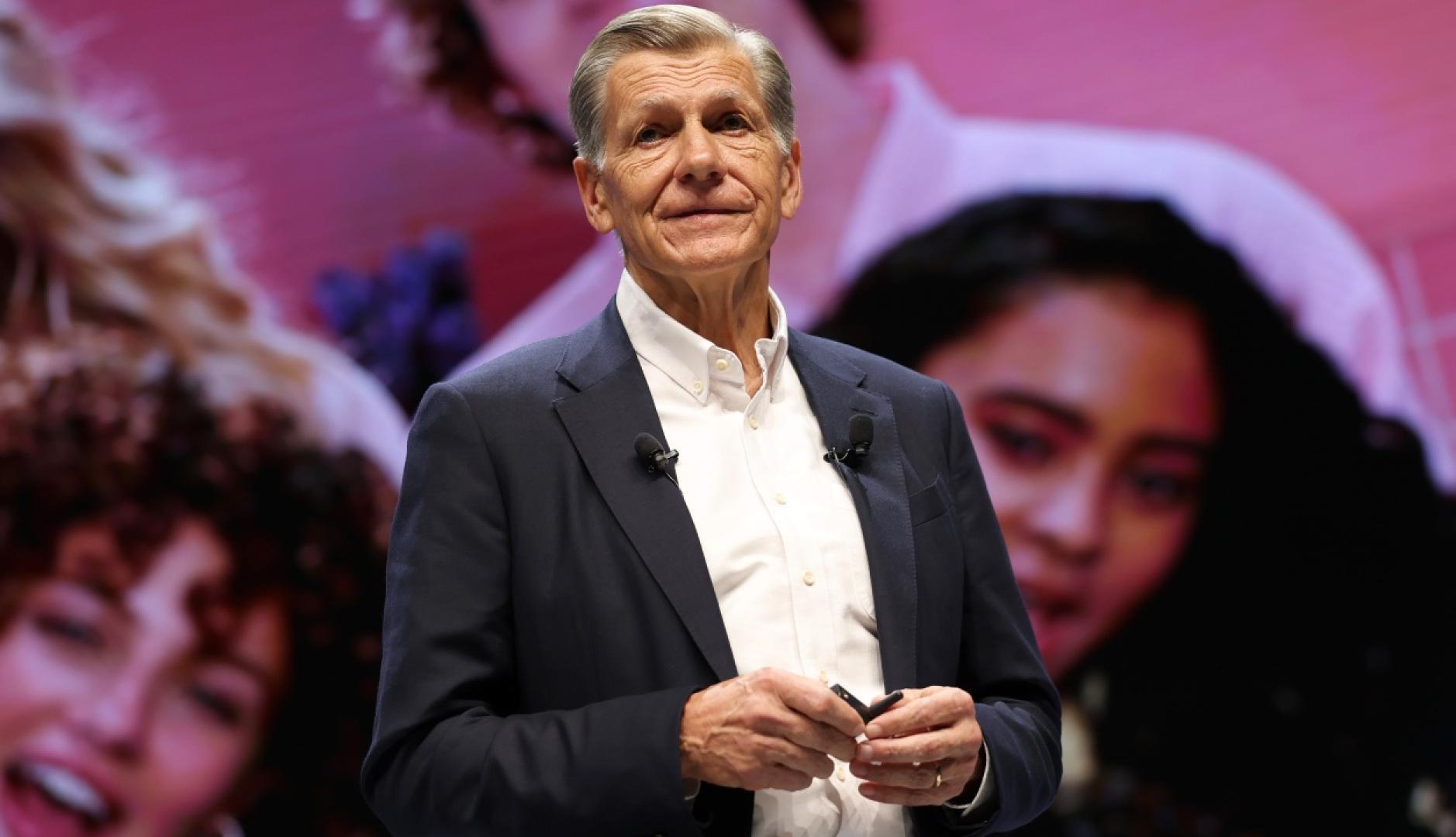
More volume of communication assets, more varied and created and distributed at greater speed. These are the keys to current brand communication, in which technological resources, and notably artificial intelligence, play a growing role. What hasn’t changed are the building blocks that remain real human insights. These are the basic ideas of the presentation that Marc Pritchard, General Brand Director of P&G, made within the Cannes Lions conference program and which was titled “Robots can’t build brands: the new S-curve of creative transformation.”
“Devoting yourself to brand building has never been as fun as it is now”
“Devoting yourself to brand building has never been as fun as it is now thanks to all the tools and opportunities we have at our fingertips”Pritchard said to begin his talk. “I’m going to show you why by answering some questions that I know you have in your head.”
One of the tools that the well-known marketing professional alluded to throughout the talk was AI, and it is curious to see this if you remember the conference that Pritchard gave on the same stage last year, titled “Timeless lessons for building brands through creativity”, in which he said that he was not going to talk about artificial intelligence. Despite this, he did highlight its capabilities and stressed that in P&G’s marketing area they were already using it in everything that could be useful for the development of campaigns.
In his speech this year, Pritchard has made reference to this use several times and has also resorted to AI as a narrative argument, as he structured the talk as a series of questions asked to a supposed robot that, in a humorous wink, appeared on the screen as a humanoid with a metal torso and the face of the manager himself.
The first question he asked was “How is the brand building landscape changing and what do those changes mean?” The answer was that there are three constantly evolving changes: the fragmentation of media and content; the convergence of media and commerce, and the acceleration that AI brings to all processes.
The conjunction of these phenomena has launched the transformation of brand construction into a classic S-shaped curve in which it can now be assumed, based on Pritchard’s arguments, that an inflection point is being drawn marked by exponential levels of fragmentation, the convergence between advertising and commerce, and the revolution that this has experienced due to the expansion of electronic commerce (which in turn has become a medium). “All this makes creating brands, keeping them in the top of mind of consumers and achieving conversion into sales is now very difficult, but at the same time, very interesting”Pritchard commented.
Furthermore, all of the processes mentioned, Pritchard indicated, have been seen turbocharged in recent times due to the emergence of AI: “People can have personalized experiences at any point of contact with the brand, great language models give people all the information they need, generative AI is revolutionizing creativity on all fronts and agentic AI is in turn changing the way people buy, as they increasingly understand their needs.”
Change the how but not the what
The second question was: “What changes and what remains with all these movements?” And the answer, as follows: “What changes is how we work to achieve the volume, speed and variety of brand assets that are needed to build those brands. What does not change are the fundamentals of that construction.”
These foundations consist, according to Pritchard, in that “Brands must continue to discover real human insights that generate meaningful ideas that, in turn, can come true at a price that compensates. A robot has no intuition, no empathy, nor the human capacity for observation to discover insights. That cannot be replicated with technology.”
What it is useful for, however, is to broadcast, with the required volume, speed and variety, the flow of continuous brand messages that, in the current fragmented landscape, is necessary to maintain and enhance the memory, which is what leads to the purchase. The brand can no longer be cultivated through a limited number of advertisements broadcast in campaigns with a time period between them. “The old advertising process was sequential and very slow, it could last months, even more than a year”Pritchard said. “Now the brand is in permanent contact with consumers and communications are developed in a matter of days or even hours. But the voice of the brand will always be needed, reinforced with an idea that highlights its benefits and inspires trust.”
“Now the brand is in permanent contact with consumers and communications are developed in a matter of days or hours”
That voice, which gives the brand’s point of view on all channels, is no longer, in any case, the sole heritage of the advertiser and its advertising campaigns: added to it, through social networks, are the opinions of what Pritchard called experts (influencers, content creators, spokespersons…) and those of the consumers themselves. These are the most genuine, according to the P&G manager, and therefore the ones that have the most value. “They are all influenced by the algorithm, but they are all human voices”Pritchard commented. “The algorithm and AI can expand them, but not generate them.” As an example of communication based on human insights, which give voice to the brand, Pritchard screened several recent Old Spice spots, including this one:
‘Founders’ at full speed
This reflection led to the third question that Pritchard posed to his robotic alter ego: “What is the impact of the new landscape on those responsible for building brands, agencies and retailers?” And the answer that appeared on the screen was: “All brand builders are now direct-to-consumer founders – with their hands on the keyboard – sprinting to achieve consumer engagement every day, getting the best out of their agencies according to a modular approach and operating with retailers through an integrated end-to-end ecosystem. And all at great speed.”
Pritchard once again insisted here on the idea that professionals no longer enjoy long periods of time to develop their campaigns. The flow of creativity and communication must be continuous. “It is a constant marathon run like a sprint, not a pleasant walk”he pointed out, “And when it comes to agencies, there is no longer one that does all the work for a brand, but rather we take advantage of the strengths of our best collaborators with a modular approach and they must also be able to work with our internal team to produce the material with the variety and speed that is necessary today”. The work with distribution, according to the P&G brand director, follows the same guidelines of dynamism and the ability to react quickly to their needs at any given moment.
An example of work for which P&G used its own AI tools for idea generation is a campaign for Secret deodorant, a brand that had to quickly reverse its sales decline. The insight reached was that the smell produced by stress is worse than the normal smell of sweat, and that produces more stress in the person, which in turn produces more sweat… The creative concept he suggested was “Fresh under pressure”, which became, “with a little human touch”said Pritchard, in “Fresher under pressure.” P&G then used its AI tools to test various narrative options, produce the spot (which was created internally) and generate assets for social networks, of which ten times more were created than would have been possible in the same time with the usual processes. This is the spot:
Like never before was possible
The next question that Marc Pritchard posed to the Cannes audience was “How to use AI?” and he gave this answer: “Use AI tools to develop better insights and ideas, execute them better and faster at the scale needed to generate massive awareness, traffic and conversion, all at a volume and speed never before possible.”
Pritchard only added at this point that the answer was missing a statement, and that is that AI added to human creativity allows for an enormous acceleration of work. As an example, he gave a campaign developed in a few weeks for a Pantene product that protects hair from ultraviolet rays. He reported that AI contributed to the development and refinement of the concept and the reproduction of all communication pieces of the campaign.
According to Pritchard, all of this allowed us to multiply by five the volume of communication assets and the speed with which the campaign was created and disseminated, in addition to reducing its price five-fold. “In a few months, the product and the campaign reached the entire European market. Technology did not give the idea, but it helped give life to a human insight at the speed with which popular culture moves.”
“Sales are the most important ROI data”
Fifth question: “All well and good, but how do you recognize what works? What about ROI?” And his response: “What matters is sales growth. And with the convergence of media and commerce in retail media this information should finally be available.” In his comment on the matter, Pritchard insisted that sales are the most important data and knowing this saves time and resources in debates about ROI indicators that are dubious. “That’s why we invest in retail media: creativity is linked to commerce and that gives us a clear signal about sales. It’s common sense, we no longer drive with ice on the windshield when it comes to measuring ROI.”
The sixth and final question, and its corresponding answer, was Pritchard’s way of saying goodbye to the audience: “Could you give us some advice on how to be successful in 2026 and beyond?” “Be prepared for the most fun you’ve ever had in brand building.”
“I have never been more excited about this job,” he added. This is an era of creativity unlike anything we have ever known. Throughout time, creativity has always been, and will continue to be, a deeply human endeavor. Robots don’t build brands. You do, robots don’t have fun. You do.”