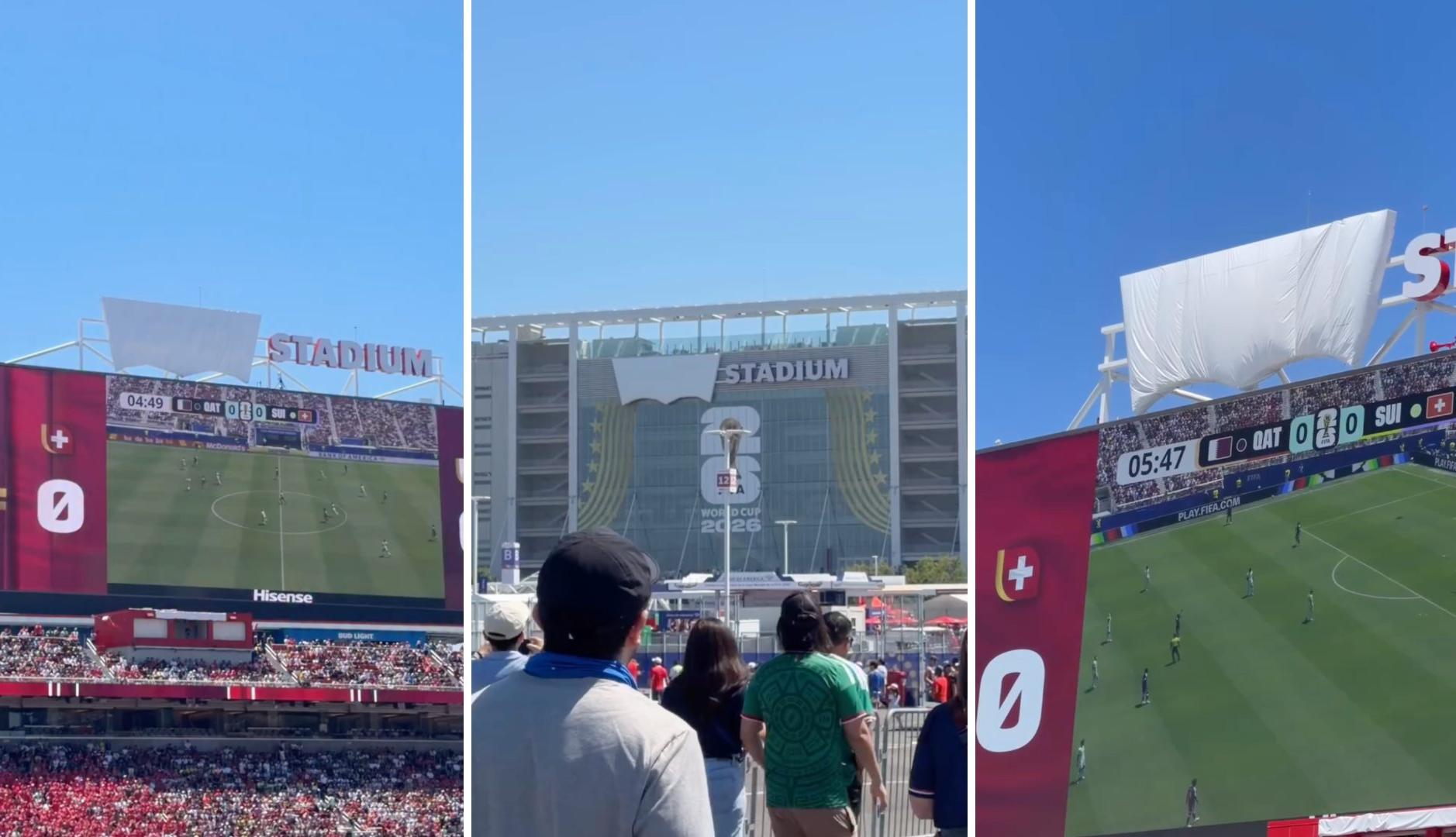
Logos covered with white cloth or names covered with stickers or adhesive tape. Beyond the goals, the concealment of non-sponsoring brands is already among the images left by this World Cup, which has been taking place since June 11 in Mexico, the United States and Canada. And FIFA is trying to minimize or eliminate the presence of all advertising in the stadiums that does not correspond to the official sponsors.
Its objective is to protect the exclusive rights of its official sponsors, among which are Coca-Cola, Visa, Lenovo, Hyundai or Qatar Airways. The policy of the international soccer governing body is not new, but it is especially notable in this edition of the tournament due to the high penetration of naming rights for stadiums in sports sponsorship in the US market.
FIFA has forced to temporarily change the name of some World Cup venues
One of the actions that FIFA has launched with the intention of eliminating every last trace of third-party sponsors at the competition venues has been the change of stadium names. Thus, it has decided to rename a large part of the venues in which the matches are played, imposing on them the name of the city in which they are located to replace the usual sponsor brand.
In this sense, Gillette Stadium, home of the New England Patriots rugby team, is temporarily Boston Stadium; while Mercedes-Benz is now Atlanta Stadium and MetLife Stadium, where the Jets and Giants play, is now called New York New Jersey Stadium. For its part, Levi’s Stadium in Santa Clara, California, has been renamed San Francisco Bay Area Stadium, despite being more than 60 kilometers from the city that is giving it its name.
In addition, FIFA is forcing brands to eliminate their visual presence, which implies alterations to the external appearance of the stadiums in most cases. The Gillette logo in the stadium located in Boston, where the match between Scotland and Haiti was recently played, has been covered with white fabrics.
In the case of the Atlanta stadium, the recognizable Mercedes-Benz logo remains on the façade, since removing it, as stated by the venue, could affect the structure and the mobile roof of the building. However, it has been hidden with a giant tarp displaying the 2026 World Cup logo.
But the most notable case has been that of Levi’s, whose logo, although covered with white canvas, is still easily identifiable due to its peculiar shape. Far from considering it an inconvenience, the brand is capitalizing on the situation intelligently and ingeniously, turning it into a strategic opportunity to gain notoriety and visibility.
The fashion brand has given prominence to the obligation to hide the logo in the stadium in its communication through social networks. Among other things, he has published a video on Instagram with different images of his covered emblem, highlighting the absurdity of FIFA’s policy. “Welcome the world to the beautiful (redacted) stadium!” (Welcoming the world to the beautiful (redacted) stadium), he ironically noted in the publication.
In addition, Levi’s has even modified its profile image on social networks with the shape of its logo covered by white tarps, transferring to the digital environment the physical presence that it is now forced to take in the stadium.
The removal of brands extends far beyond the facades of the stadiums and encompasses other aspects related to the World Cup venues. According to The New York Timesin the press boxes at Levi’s Stadium, where food and drinks are served, logos on condiment bottles have also been covered. In other locations, names and logos have been covered up on signage, or card payment terminals have been changed.