Can listening to music help prevent HIV? This is what UNAIDS, the Joint United Nations Program on HIV/AIDS, is exploring in Brazil in its new campaign, in which it uses funk, one of the most listened to musical styles in the country, and the features of Spotify to deliver its awareness message to young people.
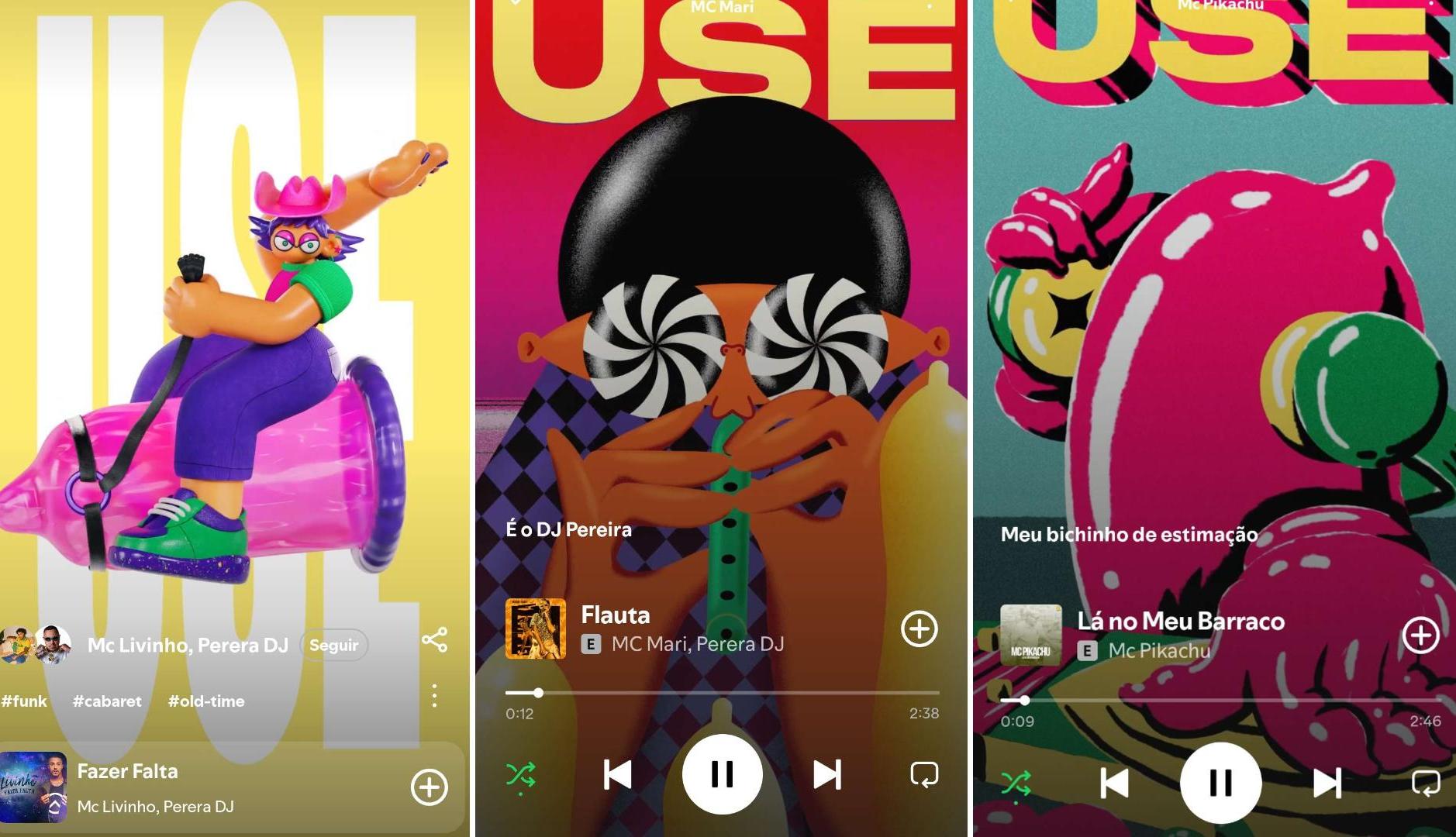
The “Proibidão Protegidão” initiative, developed together with the Africa Creative agency, uses music to connect directly with new generations, as well as Spotify Canvas, a visual element that can be added to songs as covers and that allow eight-second videos to be played in a loop. In this campaign, the tool for creators becomes an innovative advertising space to disseminate information about HIV prevention.
Thus, the original videos of hits by MC Livinho, MC Mari, Mc Davi and MC Pikachu have been replaced by animations that promote the use of condoms. They show different animated illustrations to the beat of the songs, such as a young man using a condom as if it were a surfboard or an animated condom as if it were a DJ.
The songs that are part of the initiative are “Fazer Falta”, by MC Livinho; “Nenhum Link”, by Mc Davi; “Flute”, by Mc Mari; or “Lá no Meu Barraco”, by Mc Pikachu. Together, the songs reach around 300 million views on the platform, which significantly increases the potential to reach teenagers and young people up to 29 years old.
The choice of funk as a platform for raising awareness responds to the enormous reach of this genre among Generation Z. As the organization explains in a statement, by linking to these songs a message of protection is introduced in a context in which sexuality is present and is openly debated, but it continues to talk about sex, promoting autonomy and the ability to choose in matters of prevention.
“If there is a genre that talks a lot about sex, it is explicit funk, one of the most listened to among young Brazilians. Covers of the biggest hits are now also real warnings about safe sex. Because we want you to enjoy, but with the security of knowing how to take care of yourself“, comment from UNAIDS Brazil.. “Today, the step-by-step prevention process is comprehensive, and you have the autonomy to choose what best suits you.”.
In this sense, it communicates the free services available to citizens by the Brazilian Unified Health System (SUS). In addition to condoms, lubricants, HIV self-tests, they can count on PrEP (Pre-Exposure Prophylaxis); a daily pill for those who want to protect themselves before having sex without a condom; o PEP (Post-Exposure Prophylaxis), a medical treatment applicable after possible exposure to HIV.
The objective of the initiative is to prevent new HIV infections among the population. According to data from the Brazilian Ministry of Health, more than 48% of new infections in 2024 were recorded in people between 15 and 29 years old. The figure is aligned with the variation experienced in the percentage of young people between 13 and 17 years old who say they use condoms in sexual relations, which fell from 72.5% in 2009 to 59% in 2019.