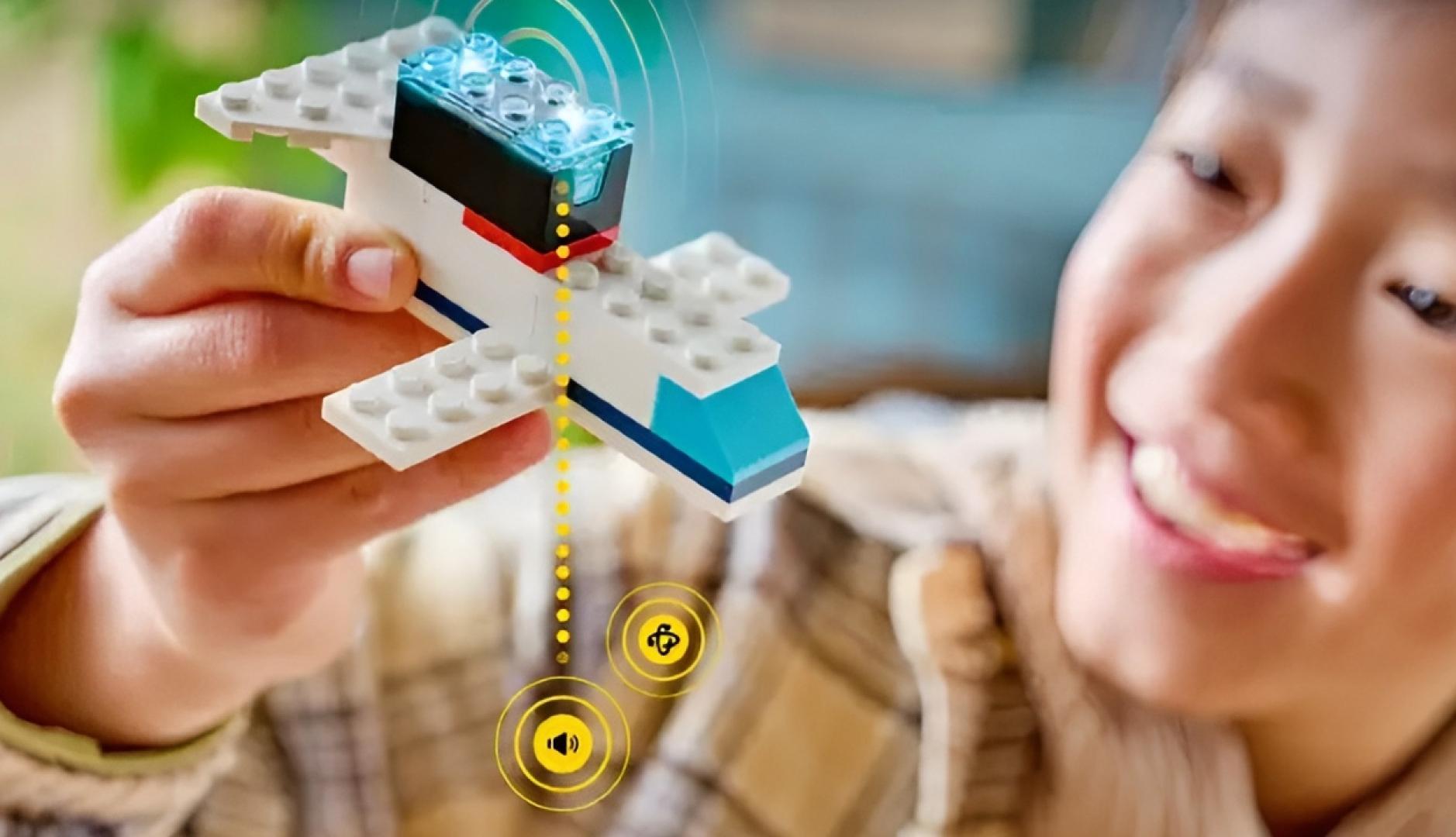
The Lego Group has taken one of those steps that only a brand that has built its relevance on consistency allows. At the CES being held this week in Las Vegas, the company has presented Lego Smart Play, a new interactive game system that introduces sound, light and behavior into physical constructions, without breaking with its analog DNA or pushing children towards yet another screen.
The proposal is born from a very specific tension: how to remain relevant for a digital native generation without betraying the essence of creative and open play. Thus, Smart Play responds to this challenge with a solution through which creations react to movement, proximity and the context of the game, generating sounds and behaviors that accompany the child’s imagination instead of directing it.
Lego Smart Play is its biggest advance since the introduction of the minifigure in 1978
“Everything we do is driven by a constant appetite for innovation”explained Julia Goldin, Chief Product & Marketing Officer at the LEGO Group, who emphasizes that the technology has been developed with an educational and long-term logic, not as a one-off effect. The company itself has recognized that Lego Smart Play is its greatest advance since the introduction of the minifigure in 1978 and conceives it as a platform designed for the next century of play, compatible with bricks from 1958 and those that do not yet exist.
The system is built around three elements:
- The Smart Brick, externally indistinguishable from a standard piece, integrates sensors, accelerometers, a small speaker and its own chip developed by Lego. It reacts based on how it is moved, rotated or positioned within the construction.
- Smart Tags allow behaviors, sounds and lights to be modulated, and can interact with each other to create more complex responses.
- Smart Minifigures, for their part, incorporate programmed “personalities”, with moods and reactions that are manifested through the brick itself.
The key is that everything works without an internet connection, without applications and without artificial intelligence. Lego has decided, at least for now, to stay out of the hype of AI. “We believe that today there are enormous opportunities that do not require AI”says Tom Donaldson, Senior Vice President and head of the Creative Play Lab. In this sense, the priority has been to design a lasting experience, capable of coexisting for decades with the rest of the Lego system. And there will be no obsolescence because the improvements will come via software, not by replacing hardware.
Eight years of development
The development of Lego Smart Play, as explained by the company, began almost a decade ago, after a series of studies carried out in 2017 that identified three clear expectations among children: playing socially, that their actions had real consequences within the game and that the experience evolved over time. The challenge for Lego was to integrate those demands into its historic game system without breaking it. To do this, he brought together a multidisciplinary team with experts in engineering, design, sound, user experience and computing, with a clear ambition: to ensure that physical constructions react coherently to the characters, the context and the way in which they are manipulated, opening up unprecedented territory in the physical game.
After years of prototyping and testing, Lego ruled out the use of external screens and devices to keep the technology in the background and preserve the essence of the game. The result was a completely new technical system based on Smart Bricks with wireless charging, sensors, sound and a proprietary positioning system developed from scratch, capable of identifying the relationship between bricks, labels and minifigures.
As Lego recognizes, the project was on the verge of being abandoned after several failed attempts, but a final adjustment made it viable and gave rise to a portfolio of 25 patents.
As part of this process, Lego also developed a specific ASIC chip for Smart Play, smaller than a Lego spike, which allows the generation of a dynamic and practically infinite soundscape, making each interaction come to life without resorting to screens or limiting creativity.
The commercial launch of Smart Play will arrive on March 1 with three Star Wars sets (Luke Skywalker’s X-Wing, Darth Vader’s TIE Fighter and a combination of the Emperor’s Throne with an A-Wing) chosen not only for their commercial appeal, but as a narrative stress test. Sound, movement, rhythm and fiction must be integrated without friction so that if it works there, it can work in any Lego universe.
Thus, starting in 2026, this new system will allow Lego constructions to come to life and react to the way children play, thanks to smart bricks that respond to movement, proximity and context, expanding the narrative possibilities of physical play without displacing it, but rather allowing it to evolve.
In a stressed toy market, Lego closed 2024 with record revenues of $10.8 billion and maintained growth in the first half of 2025. Competition for child care is increasing, but the company seems convinced that the answer is not to look like a tablet.