“I thought about titling this paper ‘Are We All Screwed?’, but I don’t think it would have been very helpful.”
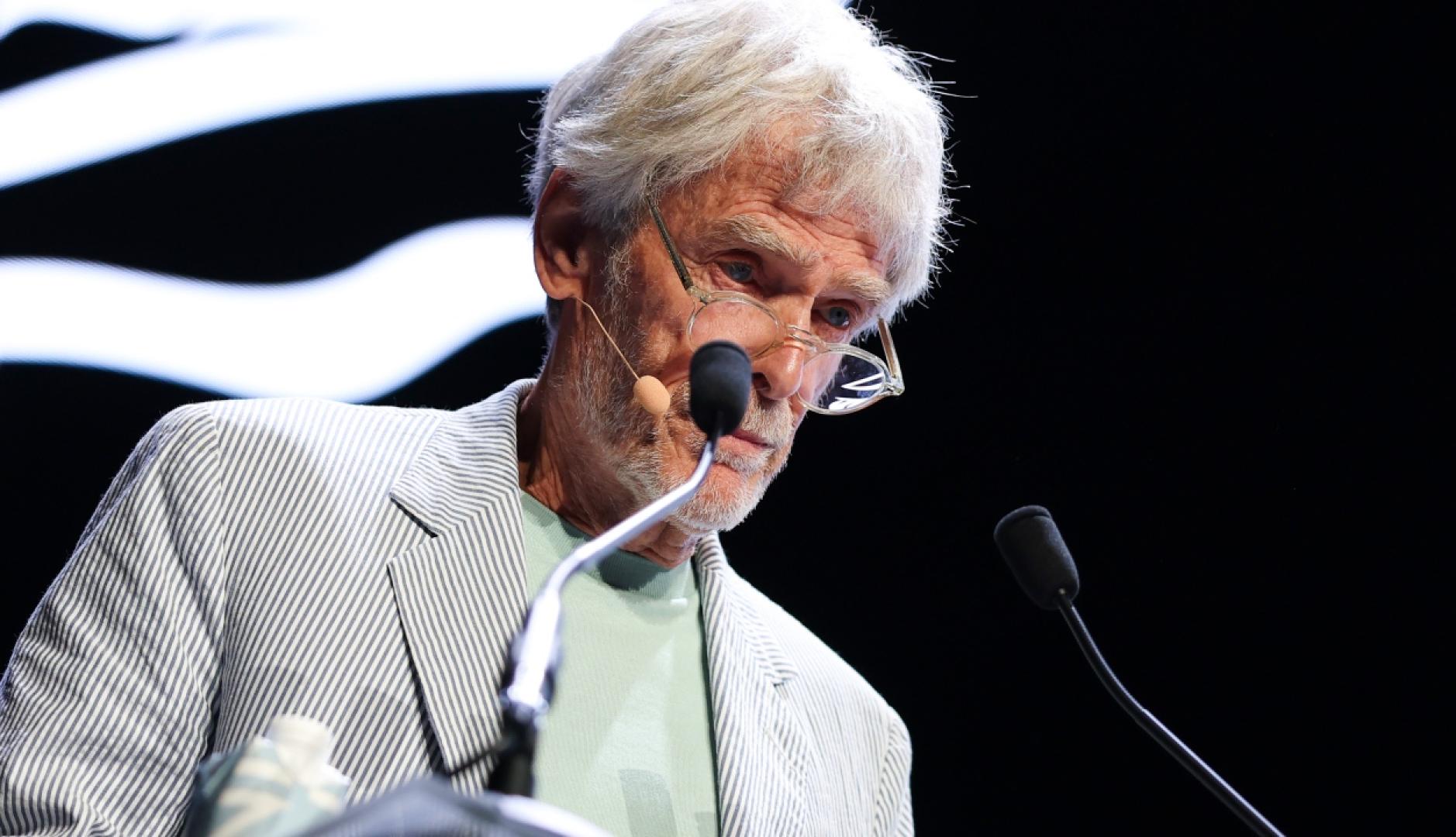
This is how John Hegarty began his intervention in the Cannes Lions 2026 conference program, a legend of advertising creativity, one of the most respected voices in the industry and a classic of the festival in every sense, both for the large number of lions he won during his career in agencies – notably in his own, the legendary Bartle Bogle Hegarty – and for his regular presence on the event’s speakers’ gallery.
Finally, his conference was announced with the title “Stop working in advertising” and constituted a plea in favor of the recovery, by the industry, of the ability to captivate and persuade audiences through the power of stories. A power that he once had and that served to build great brands and, through them, to grow the economy. A power that, from their point of view, has currently remained in the hands of the entertainment industry and advertisers must focus on it to recover the seductive power of their messages.
Hegarty began by saying that the advertising industry always seems to be on the verge of a big change, there is a constant feeling that something important is going to happen, “but creative revolutions”said the British advertiser, “They do not occur in isolation, they happen because there is a change in society. Currently, this change is oriented towards the relationship with technology, the effects of which are being questioned in many aspects and we can remember in that sense what has happened in Australia”. Hegarty was referring here to the ban on the use of social networks for children under 16 years of age that was approved in the oceanic country at the end of last year.
Inspiration to build brands
Referring more specifically to the problems of the advertising industry, Hegarty noted that “We have perfected the art of bullying and abandoned the ability to inspire. And inspiration is how brands are built.”
He then projected on the screen a quote that, he said, seemed particularly accurate: “A brand is the most valuable real estate in the world, it occupies a corner in someone’s mind.” And he said that’s what you have to aspire to, to “enhance the brand and make it part of popular culture. If we make it famous, it will get more sales, it will have more value…”.
According to Hegarty, “advertising is failing”
The negative reality facing that aspiration, Hegarty said, is the fact that people pay money to avoid advertising. There are 900 million people in the world who use ad blockers and when looking for reasons to explain this reality, it seems that the most important one is that “We are making a worse product. I have not read any economics books”he continued, “in which it is stated that the formula for business success consists of making a worse product. But that is what we are doing. It is not strange that people disconnect. However, those same people do not disconnect from Netflix, from the World Cup… People abandon what they do not like and sadly, today one of those things is advertising. We have to be honest with ourselves and recognize it because if not, nothing will change. Advertising is failing.”
The most serious consequence of this failure is that with bad publicity it is more difficult for brands to get their message across, with which good brands lose value and the economy suffers for it. “Due to the insistence on promotion over persuasion, advertising is not generating change in society”said John Hegarty. “And advertising is fundamental for an economy: it generates ideas, good brands, growth…”
The British advertiser pointed out that everything we read in recent years is that our economies lack growth “And I genuinely think that’s partly because we’ve opted for promotion instead of persuasion: we don’t do things that we can tell people are interesting, that they’ll like to talk about, or even recommend to their friends. We forget that the ultimate function of advertising is to boost the economy. That’s the way it is, and if you don’t like it, work on something else.”
The world lives in the age of attention and there is enormous competition to win it. The solution for the advertising sector is not to abandon the battle, but to redouble the commitment to win it; and that is achieved, in Hegarty’s opinion, with creativity, consistency and quality.
Currently, the winner in this battle for attention is the entertainment industry, fundamentally the audiovisual industry. It is a rival that advertising should not aspire to beat but emulate and that today achieves, for example, according to a data that Hegarty cited, that people spend four hours a day on average watching audiovisual content online. “The reason the entertainment sector is successful is that it does things that people like”said. “Why don’t we do things that people like? It seems obvious, right? The fundamental lesson we can draw from the entertainment industry is that to captivate people you have to entertain them. Again, obvious.”
Uninteresting things
In that sense, the problem with advertising activity is that you have to talk to people about things that do not necessarily interest them: toothpaste, a vacuum cleaner… How do you connect with them to captivate them and sell them those products? For Hegarty, the entertainment industry has a lesson that can be learned: use the power of stories and captivate with them, even to spread arguments that are not very attractive. And he gave as an example, in this case, the successful Netflix series “Adolescence.”
“Why doesn’t advertising do this? What has happened to us? Advertising has forgotten the art of telling stories”Hegarty said. “My theory is that now we have marketing directors who have been trained in the digital age and who do not know how to build a brand. They know how to launch it, establish it, but they do not know how to build it, they do not know how to take it outside the boundaries of what social networks can do.”
Here he appealed to the experience as an investor in start-ups that he accumulated with his company The Garage Soho, created when he abandoned advertising activity. “Entrepreneurs believed that the value of the company was in the idea, but that is not the case, the value is in the brand”said. “It is important to make it famous and now we don’t know how to achieve that. This hurts the brands themselves, the advertising industry and the economy in general.”
As a contrast to the negative reality he was painting, Hegarty cited what he believes is a great recent example of quality storytelling by a brand. The “Backyard legends” campaign, carried out by Adidas on the occasion of the Soccer World Cup.
After joking that the piece is five minutes long and that his career had been built on the constant synthesis effort required by one-minute spots, Hegarty commented: “I know you’re going to tell me that this is Adidas, that it’s an advertisement for the World Cup and that you work for a detergent or something like that and you can’t hope to do something like that… Yes, you can. That’s the power of creativity.”
“The first thing is to ensure that creativity is at the center of the advertising industry and not at the edges”
In view of all this, apparently a little desolate, Hegarty asked: “What do we do? How do we move forward? We cannot continue like this: We have to change, and the first thing is to ensure that creativity is at the center of the advertising industry and not at the edges”.
Here he remembered a meal he had had with John Lasseter, founder of Pixar (“How lucky I was, I ate with John Lasseter”) and repeated “a wonderfully simple observation” What he did to her and caught her attention: “If you want to have a creative company, you have to put creative people in charge of it.”
“This is the thing, we creatives have to be occupying those positions”Hegarty stressed, “as we did at BBH, where I considered that my main job as a boss was to ensure that nothing and no one stood in the way of a good idea. The good companies of the future will have to operate this way, it will be the way to make a difference”.
“And while we’re at it”he added, “Let’s get rid of the CEO or, better yet, let’s transform him from Chief Executive Officer to Creative Executive Officer. If we don’t change the structures, nothing will happen.”
Hegarty recalled here that the main message of his conference is that to captivate you have to entertain and, as an example, he played a video of a project to fight climate change aimed especially at the younger generations in which he has been working for the United Nations:
Hegarty concluded by saying that he is optimistic about the return of quality creative work that can captivate audiences, but insisted that the sector has to rethink the way it operates, it has to do something fundamentally different because, if not, nothing will change. “The advertising industry has to be more loved to be successful.”