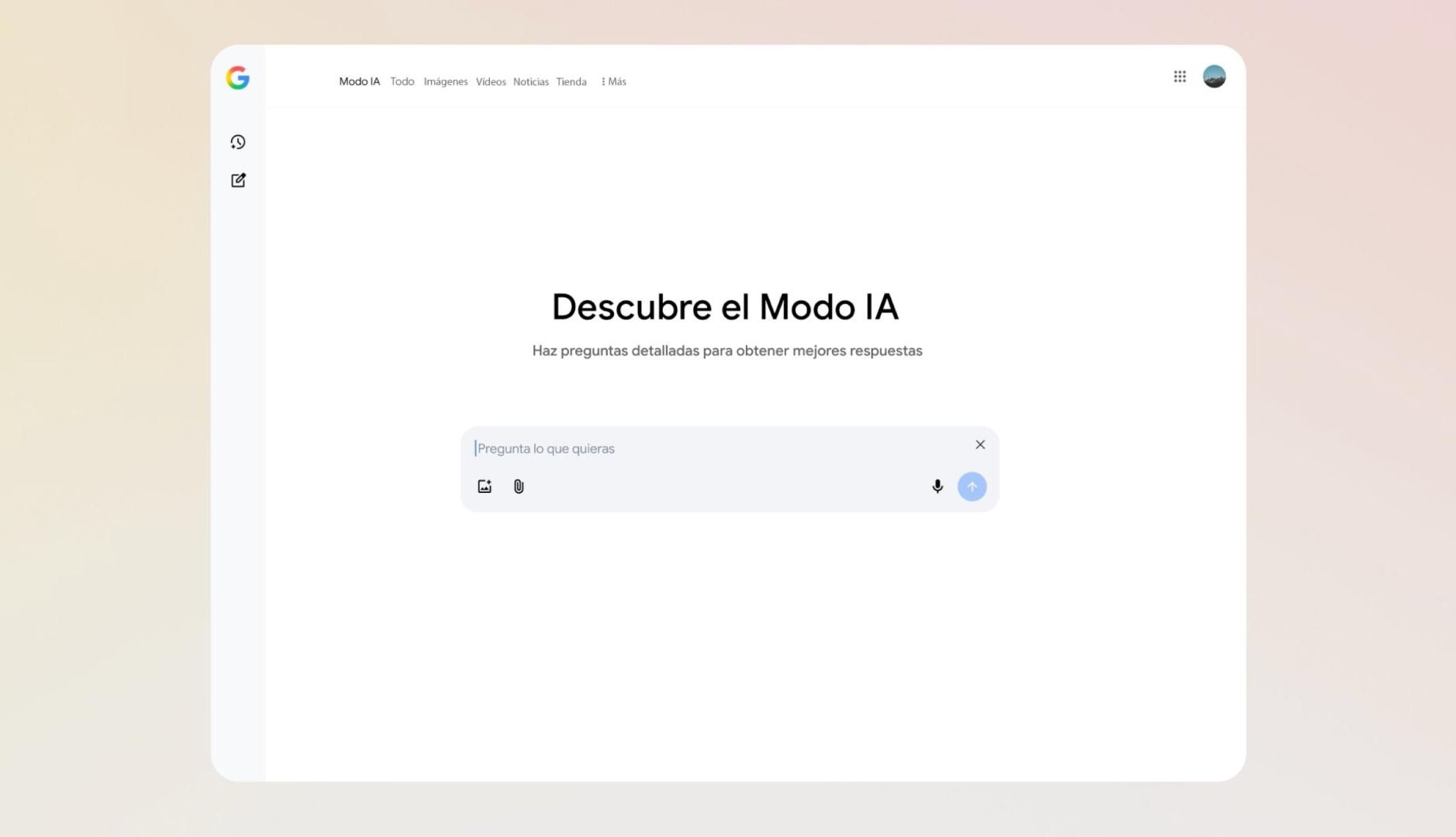
Google is already deploying its AI Mode in Spain. This means that Internet users in our country will now be able to use the artificial intelligence-assisted search proposed by the company, with more advanced reasoning and multimodality, and with the ability to delve deeper into the information through follow-up questions and useful links to the website.
AI Mode was already activated last May in the United States, and now it is activated in 36 new languages and 50 new territories, including Spain. Google points out that it is “more powerful search experience”since it is designed to understand what you are really looking for, no matter how complex it may be, and provide agile and detailed answers.
AI Mode supports queries in text, voice and images
Users can make use of the new search option, which is available as a new button on the results page and in the Google app for Android and iOS, and supports searches in text, voice and images. The tool is based on advanced models from Gemini, Google’s artificial intelligence.
As the company explains, AI Mode supports different types of questions, and points out that it is especially useful for asking exploratory questions, that is, those that do not have a single, direct answer. Also for more complex tasks, such as searching for information, planning a trip or understanding instructions.
Google points out that thanks to query decomposition techniques, Modo IA can analyze the question into several subtopics, launch multiple simultaneous searches and offer a more relevant and useful answer. As an example, he assures that the new tool can prepare a comparative table on different methods of preparing coffee, a query that can be expanded with subsequent questions.
According to the company, early adopters of AI Mode ask questions two to three times longer than traditional search queries.
One of the main differences of Modo IA compared to traditional search is its multimodal nature, since it allows interaction not only by text, but also by audio and image. The tool is capable of answering questions related to photographs taken by the user’s mobile camera.
“Helping people discover content on the internet has always been at the heart of Google’s mission, and continues to be.“, the company points out in a statement. “AI Mode allows you to express exactly what you are looking for and access web content in different formats, opening new opportunities to discover content”.
With the announcement of the arrival of AI Mode in Spain, Google seems to want to allay concerns related to search and traditional SEO, aspects on which it has built its business model. And with AI-assisted search, the answers will be displayed directly on the Google page itself, and it will no longer be necessary to visit different pages one by one to gather information, which could drastically reduce traffic to websites.
Thus, Google points out that, despite the evolution that AI provides for search, its fundamental mission is to help people access information and points of view from diverse sources. He points out, in this sense, that since launching Vista created with AI (AI Overview) – the summary generated by artificial intelligence that appears at the top of Google search results – he has observed that users visit a greater diversity of websites in search of answers to more complex questions.
Additionally, it ensures that when a user clicks on a link contained in an AI View, that click is of higher quality for the website in question, because it comes from a user who will likely spend more time on the page when visiting it.
It has also announced that AI Mode makes use of its basic quality and classification systems, and that it is working to offer more verifiable results. In this sense, Google explains that the goal is to show an AI-based answer whenever possible, but in cases where there is not much trust, a set of search results will be seen on the web.
The deployment of AI Mode by Google globally over the last few months is a response to the growing adoption of artificial intelligence tools, such as ChatGPT or Perplexity, by consumers. The consolidation of these options threatens the penetration of Google, which has dominated Search for decades, and has led the multinational to step on the accelerator in the artificial intelligence race.