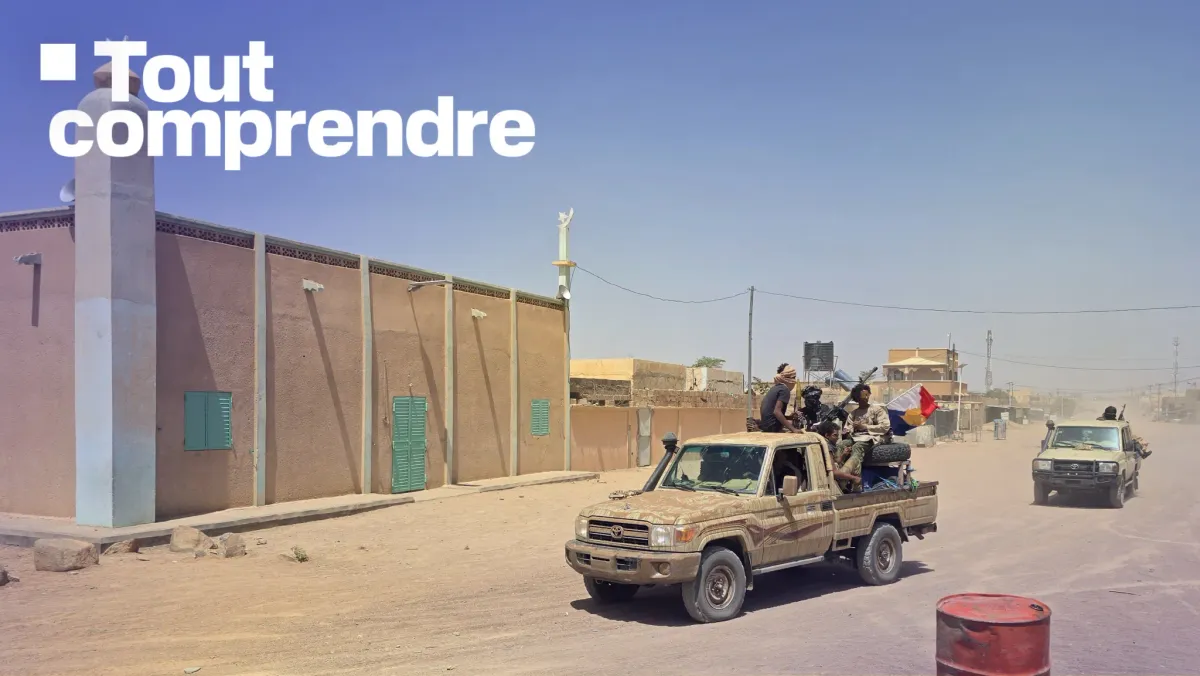
Saturday morning, Mali woke up at war. Not the distant war of the desert, that of forgotten ambushes in the dunes. This time, the fighting broke out in the heart of the cities, in the streets of Bamako, just a few kilometers from the presidency. In a few hours, the country fell into the most serious security crisis it has experienced in fourteen years.
An unprecedented alliance that changes everything
From dawn on April 25, 2026, two armed groups simultaneously struck six Malian cities: Bamako, Kati, Mopti, Sévaré, Gao and Kidal. On one side, the Support Group for Islam and Muslims, a jihadist movement linked to Al-Qaeda. On the other, the Azawad Liberation Front, a Tuareg independence rebellion which has been demanding for years the creation of a state in the north of the country. These two organizations had never allied before. However, they committed together that morning, in total coordination, across the entire Malian territory.
It is precisely this novelty that alarms Sahel specialists. Until now, jihadists and Tuareg separatists pursued distinct objectives and operated separately. Their rapprochement opens a new phase of the Malian conflict, much more complex to contain for an already weakened junta. In Kati, a garrison town located fifteen kilometers from Bamako and the military heart of the country, attackers in Malian uniforms entered the town on motorbikes, while a vehicle bomb attack simultaneously targeted the home of the Minister of Defense.
The Minister of Defense killed, a turning point for the country
Sadio Camara did not survive. The Malian Minister of Defense died in the explosion which completely destroyed his residence in Kati. The suicide bomber drove a vehicle packed with explosives to the general’s home, leaving him no chance. His death constitutes a major political and symbolic blow for the junta in power since the 2020 coup.
However, it is the silence of his superior which raises the most questions. General Assimi Goïta, head of the Malian junta, has not made any public appearance since the attacks began. According to security sources, he was exfiltrated from Kati in the early hours and is in a safe place. But more than thirty-six hours after the offensive, he still has not spoken. This silence baffles observers and fuels speculation about the real state of power in Bamako. At the same time, the head of intelligence and the chief of staff of the armed forces were both injured during the fighting.
Kidal falls, the Russians pack up
The fall of Kidal alone sums up the scale of the disaster for the junta. In November 2023, the Malian army, supported by Russian mercenaries from the Wagner group, then renamed Africa Corps, recaptured the city from the Tuareg rebels after a decade of control. This victory represented one of the strong symbolic markers of the regime. In less than twenty-four hours, it evaporated.
The Azawad Liberation Front negotiated a peaceful withdrawal agreement directly with Russian soldiers. The Africa Corps left Kidal without a fight. “Kidal is declared free”said the FLA spokesperson. Several analysts believe that this episode has lasting damage to the credibility of the Russian-Malian military partnership, one of the central arguments of which was precisely the capacity to hold the strategic cities of the north.
On Sunday evening, the fighting lost intensity across the entire territory. The junta imposed a three-day nighttime curfew on the Bamako district. Officially, she claims to be in control of the situation. On the ground, the reality remains much more uncertain.