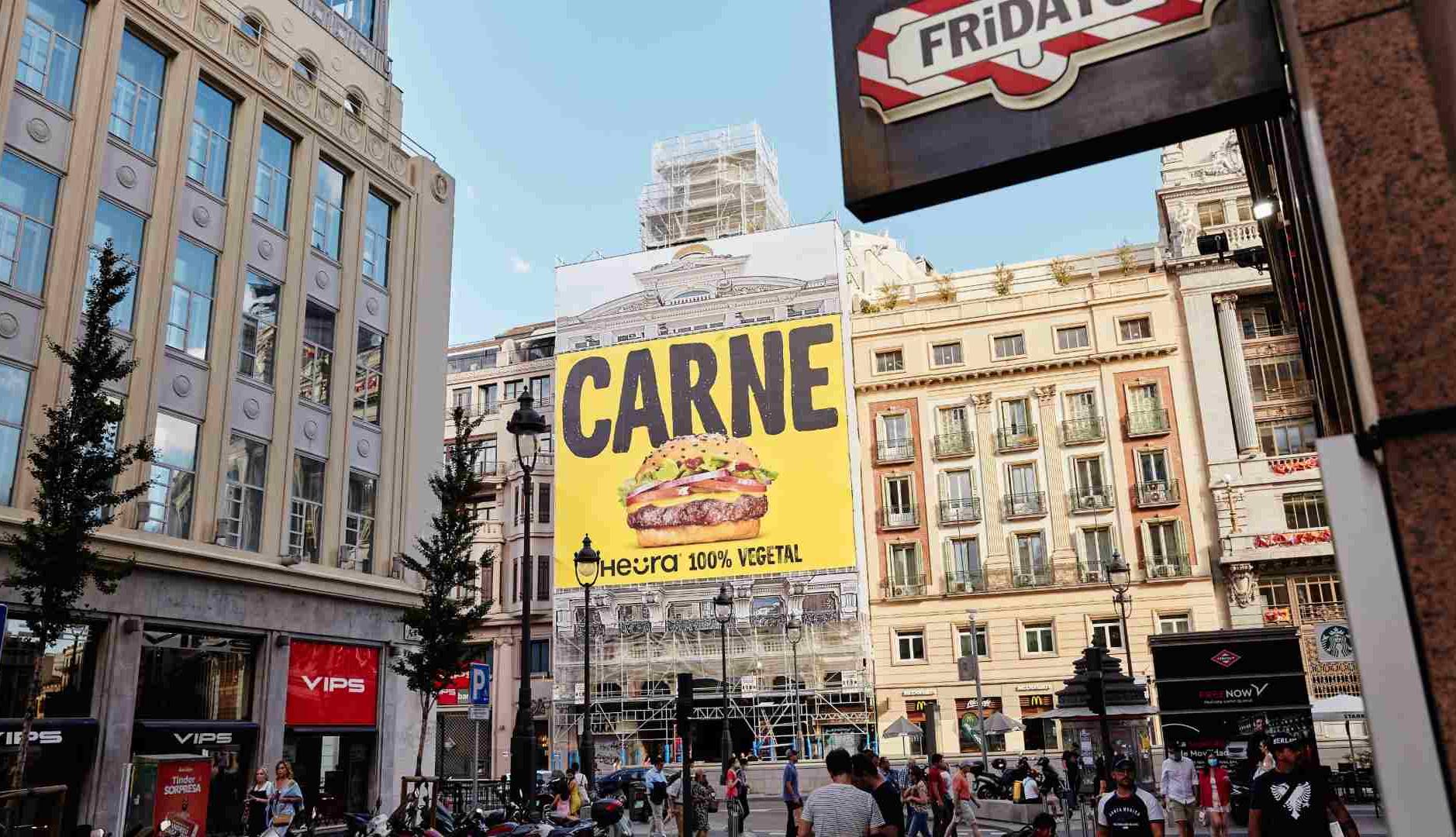
The plant-based brand Heura has taken a favorable step in its particular battle against the meat industry. And the Provincial Court of Barcelona has substantially revoked, as the brand has stated in a statement, the ruling on the complaint filed in 2022 by six interprofessional organizations in the meat sector and, therefore, would be acquitted of the acts of unfair competition that were attributed to it.
“Four years ago, we were denounced by a lobby that represents companies that have a turnover of more than 31,000 million euros. We were a company of 17 million. Four years later, justice has been clear: defending what we believe in is not illegal“, he commented in a publication in which he explains the issue. “But this victory is not just about Heura. It is about the right of any company to have a voice, innovate, raise awareness and build a better future. Today the entire agri-food sector wins and the opportunity to lead its future is protected. And you win, you deserve to be able to choose with all the information on the table”.
The case dates back to the procedure initiated four years ago by ASICI (Interprofessional Association of Iberian Pigs), INTERCUN (Interprofessional Organization to Promote the Rabbit Sector), INTEROVIC (Interprofessional Sheep and Goat Meat Organization), INTERPORC (Interprofessional Agri-Food Organization of White Coated Pigs) and PROVACUNO (Interprofessional Organization of Beef of Spain) in relation to the names of Heura’s products and the use of terms such as “meat” in its communication actions, including outdoor advertising and social networks.
The complainants pointed out that Heura’s use of commercial names commonly associated with products of animal origin to identify, promote and market its products represented an act of unfair competition. It also considered that Heüra’s advertising messages were misleading and denigratory of the livestock sector and meat products, and represented an illicit comparison, an act contrary to good faith and the obstruction of the activity of the companies that are part of the interprofessional ones.
The ruling considers that Heura’s communication does not constitute an illicit comparison
In April 2024, the Provincial Court of Barcelona partially upheld the associations’ complaint, but that resolution was appealed by Heura. Now, as the brand explained in a statement, the court has concluded that the messages spread by Heura on social networks “They cannot be considered, as a whole, either misleading, denigrating, or constituting an illicit comparison.”.
As Heura points out, the resolution recognizes that the company relies on studies and positions supported by the industry and scientific literature, with references to studies and research from the FAO (Food and Agriculture Organization of the United Nations), the WHO (World Health Organization) or AESAN (Spanish Agency for Food Safety and Nutrition).
“In the words of the ruling itself, ‘we cannot conclude that the messages are false or inaccurate’, and adds that ‘Heura usually cites the source, without there being any data that would lead us to consider that the citation is erroneous’“; expresses the company in the statement. From the brand they confirm to reason.Why that the law firm in charge of the defense will soon publish the text of the sentence, which is not yet available for public consultation.
Furthermore, Heura points out that the ruling also relies on article 20 of the Constitution to point out that “imposing the requested generic sentence would have implied an ‘unacceptable restriction’ of the right to freedom of expression“, which would be equivalent to “de facto to a censorship of Heura’s activity on social networksAs stated, the court has rejected practically the entire appeal of the
plaintiffs and has imposed on them the costs of the appeal.
The brand also points out in its statement that the audience supports its use of names such as “burger”, “sausage” or “chorizo” for vegetable products when their vegetal nature is clearly communicated. It also rules out that the use of animal pictograms that previously appeared on the packaging of Heura products is misleading.
However, the court maintains its position on a campaign launched by the brand in November 2020, in which it indicated that “A beef burger pollutes more than your car”, on a large banner located in the center of Madrid. The Barcelona Court admitted the precautionary measures requested by the interprofessionals, considering the campaign apparently illegal because it was misleading and denigrating.
The position is maintained regarding the statement “A beef burger pollutes more than your car”
The communication was withdrawn, but now the court maintains its position “considering that its formulation, aimed at the general public, required greater precision given the complexity of the matter“, according to the brand in its statement. Heura has taken advantage of the occasion to reaffirm its commitment to rigorous communication based on scientific evidence.
In its statement, the company considers the resolution as “aa victory for all companies that believe that their responsibility does not end with selling products, but also with contributing to social progress“He also understands that this is a victory for consumers, who deserve to be able to choose with truthful and transparent information.
“An attempt was made to silence a conversation that the country needs, and justice has protected the right to have it“, commented Marc Coloma, CEO and Co-Founder of Heura, in the statement. “Limiting the tools to innovate does not protect the food sector, it weakens it. “When we prevent new solutions from reaching the market, we all lose.”.
The battle has also been publicity
The truth is that the use of the term meat by the growing alternative food industry has been a point of friction with traditional meat producers. In this sense, vocabulary and nomenclature have become the communicative and advertising terrains of both parties, each of which defends its values and contributions to society.
In May 2021, Provacuno promoted the “Look for a name” campaign, in collaboration with Copiloto Estudio and the Coonic agency, with which it invited the Spanish population to propose an alternative name for hamburgers of plant origin to differentiate them from those of animal origin. “There are only two types of hamburger. Those made with meat and those born in Hamburg. The others are something else“, they pointed out in their campaign, which responded to the refusal of the European Parliament, in October 2020, to limit names such as “burger”, “sausage”, “steak” or “schnitzel” to products of meat origin.
“There are more and more products made in the laboratory and based on mixing ingredients and ingredients, in some cases more than 20, that want to imitate the shape, appearance or even the taste of hamburgers and be called the same.“, stated at the time Eliseo Isla, President of Provacuno. “It makes no sense because it is a way of confusing consumers in a market in which respect for the origin of food and its name are key.“Verduguesa” was finally the term chosen to define burgers with meat of plant origin.
From then until now, plant alternative product options have proliferated, supported by a growing concern for the health and environmental footprint of the food industry. Large companies traditionally associated with meat products, such as Óscar Mayer or prominent restaurant chains, such as McDonald’s or Burger King, have consolidated plant-based products on their menus.