Adobe held its annual Adobe Max conference in Los Angeles, where it presented its innovations and news from its ecosystem of tools. Artificial intelligence is already integrated into the vast majority of new features released. But beyond the practical application of technology, the company has made evident its vision regarding the future of creativity.
Last April, Adobe revealed some details of the work it had been doing to bring to life a generation of artificial intelligence agents to make working with its tools easier and faster. Over the last few months, it has included AI assistants in Acrobat Studio and PDF Spaces, to facilitate the summary of complex documents, the discovery of information or the validation of answers from the extract of quotes.
Adobe’s vision simplifies the creative process by moving from conversation to creation
Now it has gone a step further by deeply integrating conversational interfaces powered by so-called agentic AI into its creative applications. With this, Adobe aims to transform the way we create, since it allows you to move effortlessly from conversation to creation, simplifying the entire creative process.
As the company states, these are not simple chatbots, but assistants capable of maintaining context between tasks, understanding a creative intention and learning from the users’ instructions, adapting to their style and improving over time. “They act as competent teammates, taking on the work that distracts you from your creation, so you can achieve more while maintaining firm creative control.”Adobe describes in a statement.
AI assistants in Adobe Express and Photoshop
Thus, Adobe has presented the Adobe Express AI assistant in public beta. It ensures that the tool will empower people of all skill levels to create content that reflects their unique brand or style, simply by describing what they want. The wizard turns templates into conversational canvases to easily generate images, change backgrounds and text, or replace objects, all without needing to know which tool or model to use or what steps to follow.
Additionally, it allows users to iterate on any aspect of their content, making changes to individual elements or asset layers without losing the parts they like or having to start over.
The assistant uses a variety of proprietary and third-party models and agents to perform specific and complex tasks.
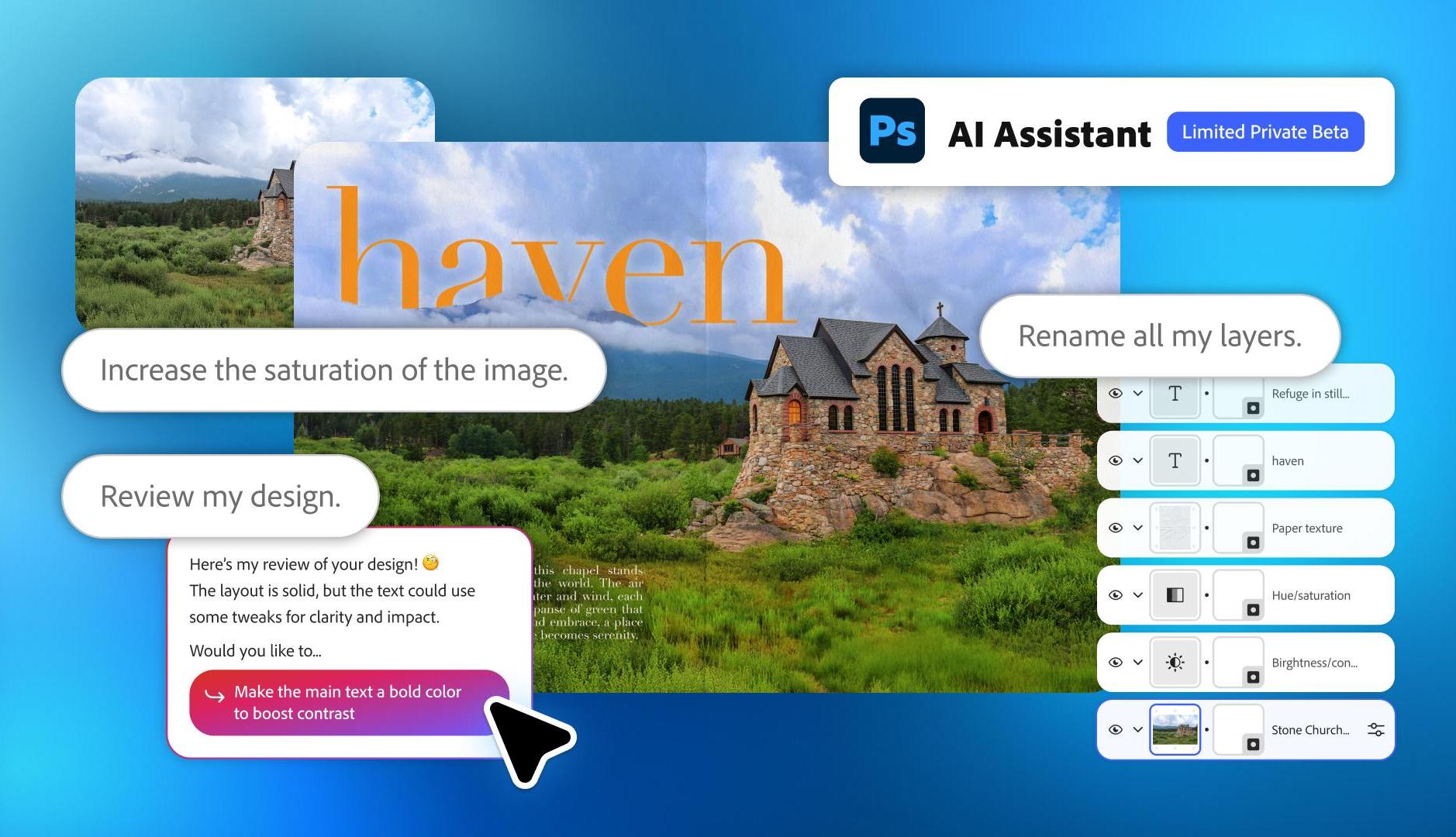
Adobe has also incorporated an AI assistant into Photoshop, in a private beta version on the web) to perform creative tasks within the tool under a conversational approach. At all times the user maintains control over the action, since he can Interact with Photoshop through conversation as well as easily move into hands-on editing.
Project Moonlight: a wizard of wizards
On the other hand, Adobe has also presented Project Moonlight, a conversational interface based on artificial intelligence capable of coordinating multiple Adobe applications. As the company describes, while each AI assistant is an expert in their field, Project Moonlight works like the conductor of an orchestra, coordinating them all in harmony. “Just tell Project Moonlight what you need and it will unite our AI assistants into a single creative team to help you make your vision a reality.”; they point out from Adobe.
Additionally, Project Moonlight pulls in information from creators’ social networks to help them generate new ideas and create content faster. It connects to Creative Cloud Libraries and social accounts to understand the user’s style and deliver personalized ideas and content that fit your personality. Through a conversational relationship, the agent moves from idea to execution, and also identifies trends and develops content strategies based on the audience and the creative brand.
It has been launched in private beta and has a waiting list.
On the other hand, Adobe claims to be working to bring its conversational experiences to the most popular chatbot platforms, so that users can access its capabilities and creative tools in other contexts. This would be possible by connecting the Adobe Express account with a chatbot platform. “It’s a preview of how we’re making sophisticated creative workflows more intuitive and accessible in all environments.”; says the company.
With all this, Adobe is outlining a new way of working on creativity driven by artificial intelligence, integration and collaboration. The company’s vision is to redefine the creative process from ideation to production and democratize creativity for all types of users. According to the initiatives promoted, the new frontier of design will not require extensive knowledge of the Adobe tools ecosystem, which will speed up and simplify the creative process.