
How many times does a person need to see an ad for it to have an effect? For years, advertising planning has used the frequency of exposure as one of its main references, under the premise that repeating a message increases the chances of it being remembered and generating results. However, not all advertising impressions receive the same attention or contribute equally to brand building.
This is the question addressed by “Cumulative Attention”, a research project developed by Lumen, Amazon Ads and Cint that proposes incorporating cumulative attention as a fundamental variable in media planning. According to their conclusions, the total time that a person pays attention to a campaign’s advertising has a predictive capacity eight times greater than the frequency of exposure when it comes to explaining improvements in brand indicators.
The study analyzes 270 multichannel advertising campaigns across 18 categories and combines exposure data with research from brand lift carried out among approximately 191,000 people. To do this, researchers have used attention models based on eye tracking developed by Lumen, together with advertising distribution data and consumer responses.
The results question the usefulness of optimizing campaigns solely based on the number of impacts and point towards planning that takes into account how much effective attention time each brand manages to accumulate.
Editorial note: It should be noted that the research analyzes declared brand results, not sales or actual purchasing behavior. Their conclusions refer to indicators such as advertising recall, notoriety, favorable perception, consideration and purchase intention.
Two consumers may have received five impacts, but they have not spent the same time observing them
The central concept of the research is cumulative attention, understood as the sum of the time of visual attention that a person dedicates to the advertisements of the same campaign through different exposures and media. The difference with respect to the traditional frequency is relevant. Two consumers may have received five advertising hits, but that does not mean that they both spent the same time observing them. Nor does it imply that the impressions were of equal value: an ad viewed for several seconds in a high-attention environment may contribute differently to the result than several barely observed exposures.
Lumen’s approach is to stop treating all impressions as equivalent units and consider the amount of attention they actually bring.
Thus, researchers have estimated the attention corresponding to each advertising exposure and have added these values to calculate the accumulated attention per consumer. Subsequently, they have related this measure to the responses obtained in studies of brand lift.
According to the research, frequency alone explains just 1% of the observed variation in brand results. Cumulative attention, on the other hand, presents a considerably stronger predictive relationship.
Furthermore, the study points out that increasing the frequency without getting enough attention can coincide with a deterioration of some indicators. Under these circumstances, decreases of 4% in brand awareness, 7% in favorable perception and 6% in consideration were observed throughout the campaigns analyzed.
These results do not mean that advertising repetition is harmful by definition. Frequency is still necessary to accumulate contact opportunities, but its contribution also depends on the attention that each exposure manages to generate. “For years, the industry has optimized its campaigns based on frequency, a metric that our research shows has a limited meaningful relationship with brand results”said Mike Follett, CEO of Lumen. “What matters is cumulative attention: generating enough attention in different environments, from streaming to open internet, to reach the necessary levels that drive better brand results”he added.
The relationship between attention and results in all indicators
The report includes a comparison of the results obtained by campaigns with different levels of accumulated attention. The data show that, as attention time increases, the five indicators analyzed also improve.
In advertising recall, for example, the increase compared to the control group goes from -0.1% among exposures with less attention to 4.7% among those with greater attention. In brand awareness, the improvement went from 4.6% to 6.5%.
The comparison is interesting because the largest increases are not limited to ad recall. They also appear in variables closer to the relationship that a person maintains with a brand, such as favorable perception or purchase intention. However, these are associations observed in the set of campaigns studied. The data does not allow us to ensure that any advertiser will achieve those same improvements simply by increasing attention time.
On the other hand, one of the most useful results for planning is the identification of different levels of accumulated attention associated with improvements in brand indicators. The study indicates that awareness requires a median of 21 seconds of accumulated attention, while purchase intention is associated with 47 seconds, more than double that.
Getting a person to recognize a brand seems to require less cumulative attention than influencing their stated willingness to buy it. This introduces an additional variable in planning and that is that not all campaigns should seek the same amount of attention, because they do not seek to cause the same effect. For advertisers, the implication is that media objectives could be adjusted based on the desired brand response, rather than applying similar frequency criteria to campaigns with very different purposes.
Combining media generates better results than focusing attention on a single environment
It also forces us to distinguish between the attention obtained by a specific piece and that which a brand manages to accumulate throughout an entire campaign. An individual ad may generate few seconds of attention, but contribute to the result when combined with other exposures. In this sense, combining media generates better results than concentrating attention on a single environment.
Thus, the research also analyzes how the combination of media influences advertising effectiveness. At this point, the report compares campaigns distributed exclusively in open internet environments with others that combine these spaces with Prime Video. Among the campaigns that accumulated at least 30 seconds of attention, the combination of open internet and Prime Video generated a brand lift average 71% higher than that obtained through campaigns focused solely on the open internet, even when comparing similar levels of accumulated attention.
The effectiveness of a campaign does not depend exclusively on how many seconds of attention it manages to gather. It also seems to be related to the environments in which that attention occurs and the way in which they are combined. The research thus points to a possible amplification effect between media. Advertising exposures in different contexts can reinforce each other, so that the same amount of accumulated attention is associated with different results depending on the combination used.
However, there is an important consideration when interpreting the results: Amazon Ads participates in the research and Prime Video is one of the advertising environments evaluated. Therefore, although the data support the convenience of studying complementarity between media, they do not automatically allow the observed advantage to be generalized to any combination of platforms.
The study goes one step further and analyzes whether the order in which a person receives advertising impacts influences the results.
According to their conclusions, campaigns in which consumers were first exposed to ads on Prime Video and later to advertising on the open internet achieved, on average, a brand lift 30% higher than those that followed the reverse sequence.
The researchers interpret this result as a possible priming effect or priming: a first exposure in an environment of high attention could facilitate subsequent contacts to reinforce the response to the brand.
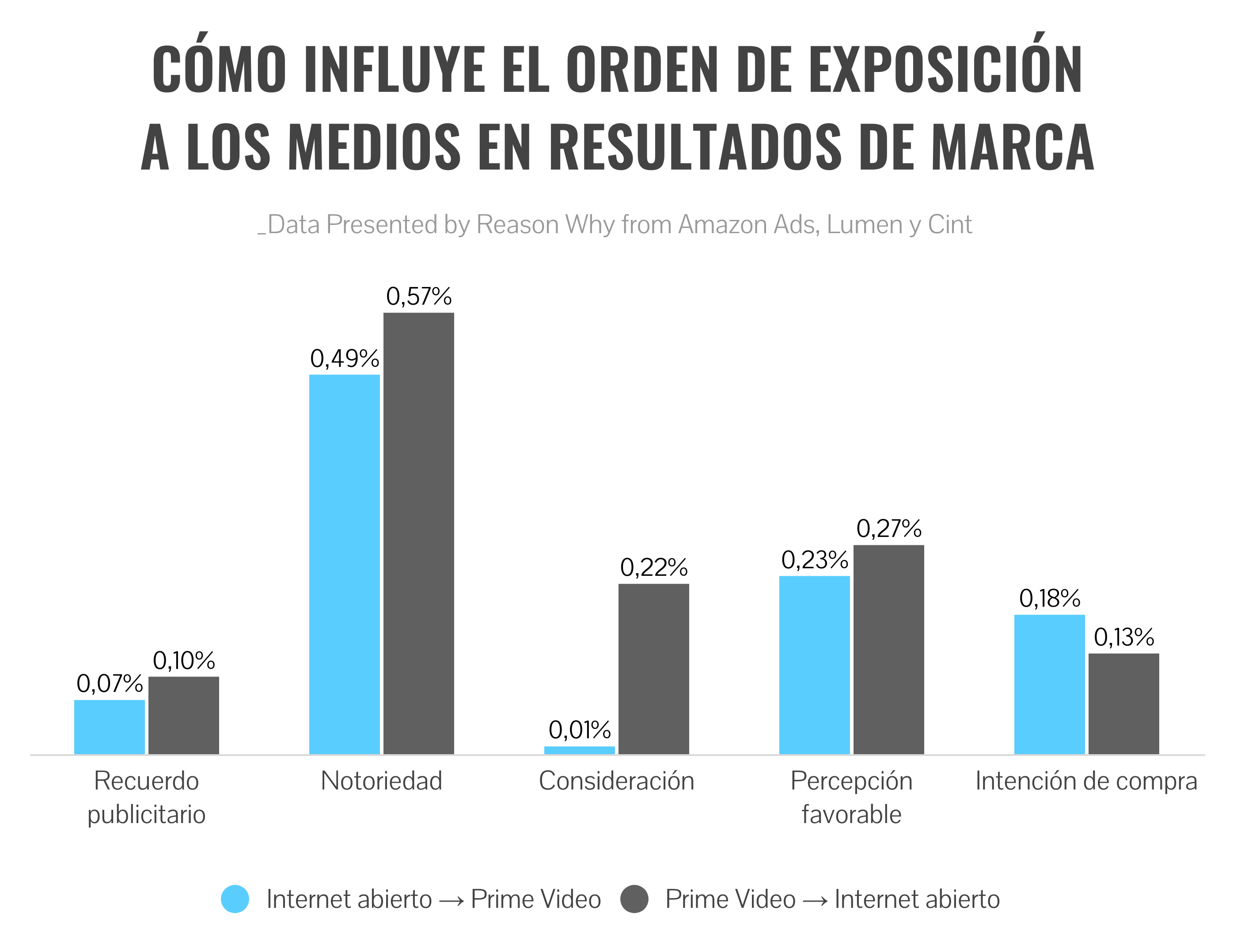
The sequence that begins on Prime Video performs better in four of the five indicators, especially in consideration. However, purchase intention presents the opposite behavior, with a higher result when the exposure begins on the open internet. This difference is relevant because it prevents extracting a single rule for all objectives. The order of the means can influence the results, but the most convenient sequence could also depend on which indicator you want to improve.
From a planning perspective, research suggests that it is not enough to decide which media to use and what percentage of the budget to allocate to each. It may also be important to determine what role each channel plays within the advertising journey and when it is most convenient to introduce it.
Towards planning that measures the quality of exhibitions
The conclusions of “Cumulative Attention” propose a review of some of the usual advertising planning and evaluation criteria.
For years, reach and frequency have allowed us to estimate how many people receive a campaign and how many times they are potentially exposed to its messages. They are useful indicators for managing the distribution of advertising, but they do not explain by themselves what happens during these exhibitions. Cumulative attention introduces an additional dimension to how much time a person actually spends looking at a brand’s ads across different contacts.
The study also provides insight into the effectiveness of repetition. Instead of assuming that each new impact adds a similar value, it proposes to consider how much it contributes to total attention and whether that contribution is sufficient to influence the pursued indicators. For advertisers, this approach can help review the distribution of investment between formats, the media mix and advertising pressure. It also invites us to question the usefulness of continuing to increase frequency when new exhibitions barely generate attention.
However, the research has limits that must be taken into account. Their results come from campaigns delivered using Amazon DSP, use attention estimates based on eye-tracking models, and analyze responses reported in brand studies. They do not establish a direct relationship between seconds of attention and sales, nor do they demonstrate that achieving a certain level of attention guarantees commercial results. In addition, the report itself warns that its conclusions come from aggregate data and may not represent the individual results of each advertiser.
However, and with these precautions, the research reinforces an idea that is gaining weight in the industry: the value of an advertising impression lies not only in whether it has been served, but in the real opportunity it has had to capture a person’s attention. And it raises a question for media planning: If two campaigns achieve the same number of impacts, but one accumulates much more attention than the other, should they be considered equally effective?