
CEOs’ confidence in the global economy has fallen to levels seen during the pandemic, but the vast majority of them are optimistic about the outlook for their businesses. They rely on a combination of artificial intelligence and talent to navigate the uncertain scenario and drive future growth in the next three years.
This is the main conclusion drawn by the 11th edition of the “CEO Outlook” report, prepared by the consulting firm KMPG. The research, carried out between August 5 and September 10, is based on the responses of 1,350 CEOs from 11 different markets, including Spain. These are responsible managers of companies with annual revenues exceeding 500 million dollars.
The study analyzes the perspectives of CEOs from four different angles: economic, technological, talent and ESG commitments. The general photo conveys a complex environment in which it is necessary to rethink strategies, functions and capabilities. However, CEOs anticipate increased revenue, a larger workforce, and a greater return on investments made in AI.
61% of CEOs expect increased profits in the next three years
This is how CEOs see the economy
According to KPMG, CEO confidence in the global economy has fallen to its lowest level (68%) in five years, compared to 72% the previous year. Despite this, they remain optimistic about their organizations’ prospects, with 61% forecasting profit increases of 2.5% or more over the next three years.
Managers are focusing their investments on people, artificial intelligence or mergers and acquisitions (M&A) to mitigate risks, address changing dynamics and ensure competitiveness. Thus, 92% plan to increase their workforce, while 69% claim to be allocating up to a fifth of their budget to AI.
The CEO’s own position is being affected by the current context of uncertainty and disruption. 80% of respondents share feeling more pressure to ensure the long-term prosperity of the company. And 59% believe the expectations and complexity of their roles have evolved significantly over the past five years, with a quarter pointing to AI and digital literacy as essential leadership skills.
Technology and artificial intelligence
Investment in technology is one of the levers that managers are activating to face market changes. 71% say artificial intelligence is a key investment priority, a figure that is growing significantly compared to 64% the previous year.
In addition, expectations regarding obtaining value from this technology are improving, with 67% indicating that they foresee a return on investment within one to three years.
KMPG data indicates increased trust in artificial intelligence. 74% believe their organization can keep pace with its rapid development and 89% say their boards are prepared to adopt advanced technologies to drive growth.
Although they consider their organizations prepared, CEOs are aware of the challenges regarding AI. Among them, ethical challenges, the availability of data, or the lack of regulation. Specifically, 69% say the pace of regulation, and their ability to keep up with technology, will be barriers to success.
Talent management in the face of AI
The “CEO Outlook” indicates that business leaders are focusing on hiring, retraining and role redesign to manage the integration of AI. 77% say preparing and training the workforce for AI will impact the prosperity of their organization over the next three years.
However, up to 41% plan to reduce the team in some areas.
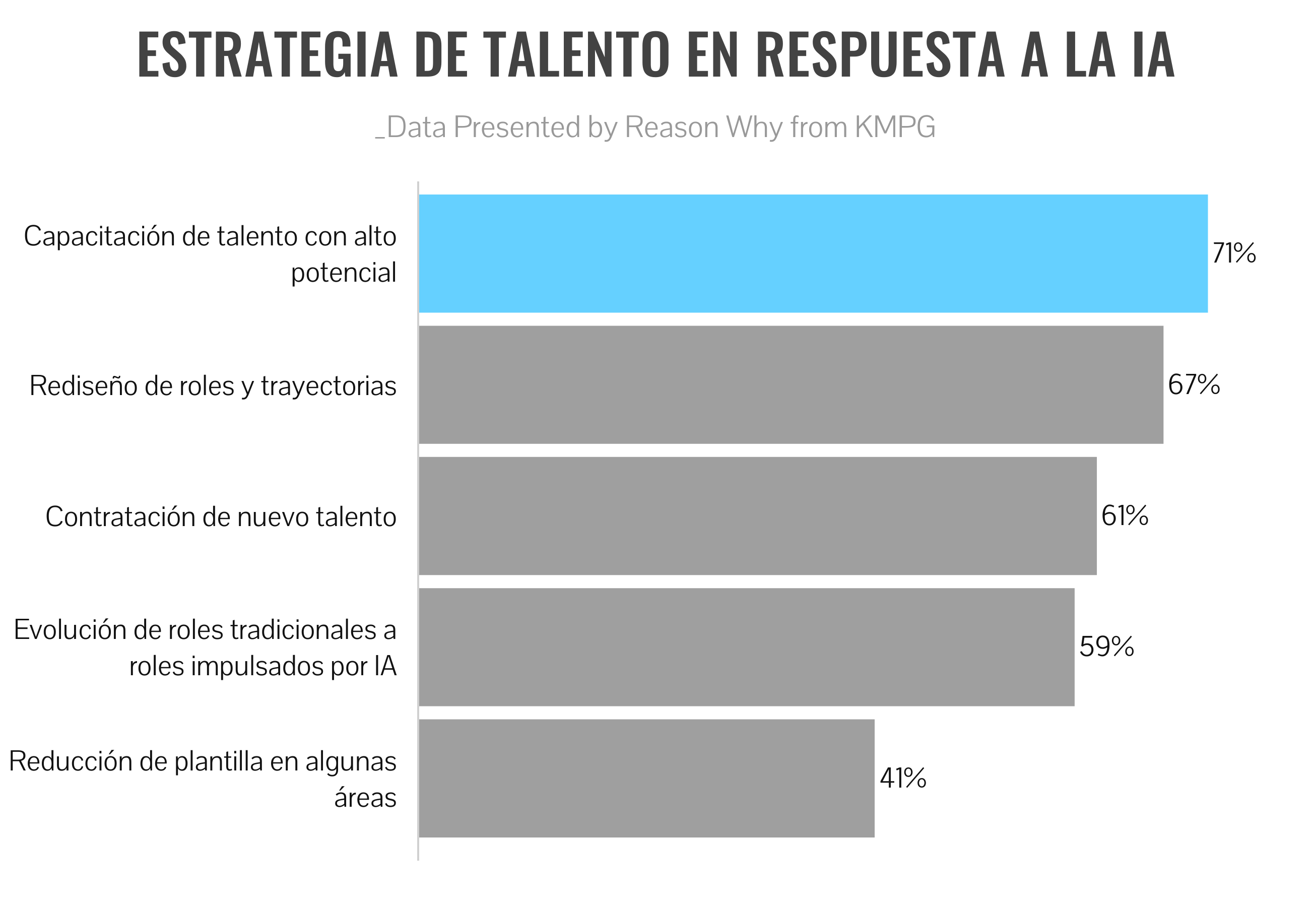
The strategies regarding talent are diverse. On the one hand, managers are betting on retaining and retraining talents with high potential; while on the other they are hiring new talent with capabilities in AI and technology.
Despite the commitment to AI, 63% of CEOs are concerned about the impact of technology on business culture and 33% recognize that the reluctance of some of their employees to adopt new technologies is a challenge.
Beyond AI, talent management by CEOs faces other challenges, such as the aging of the workforce, generational gaps or the lack of qualified professionals. “Managing the multigenerational work environment has become a new strategic point on the agenda of boards of directors“, they say from the consulting firm.
Commitment to sustainability
Although attitudes towards ESG commitments have varied in certain regions over the last few years, the KMPG report notes that CEOs maintain their sustainability goals. Furthermore, as he points out, they have more confidence in achieving them.
Specifically, 61% of the leaders surveyed claim to be on track to achieve their zero emissions goals by 2030, a figure that grows from 51% the previous year. However, the consulting firm warns that this may be due to the review that many organizations have carried out in order to set more realistic objectives.
The complexity of decarbonizing supply chains, and the lack of skills and experience to successfully implement solutions are considered the main obstacles in this matter. The cost is also mentioned, although to a lesser extent.
CEOS are confident in the potential of artificial intelligence to boost their efforts. Its application relates to data quality and reporting, identifying opportunities for efficiency or improving energy efficiency.