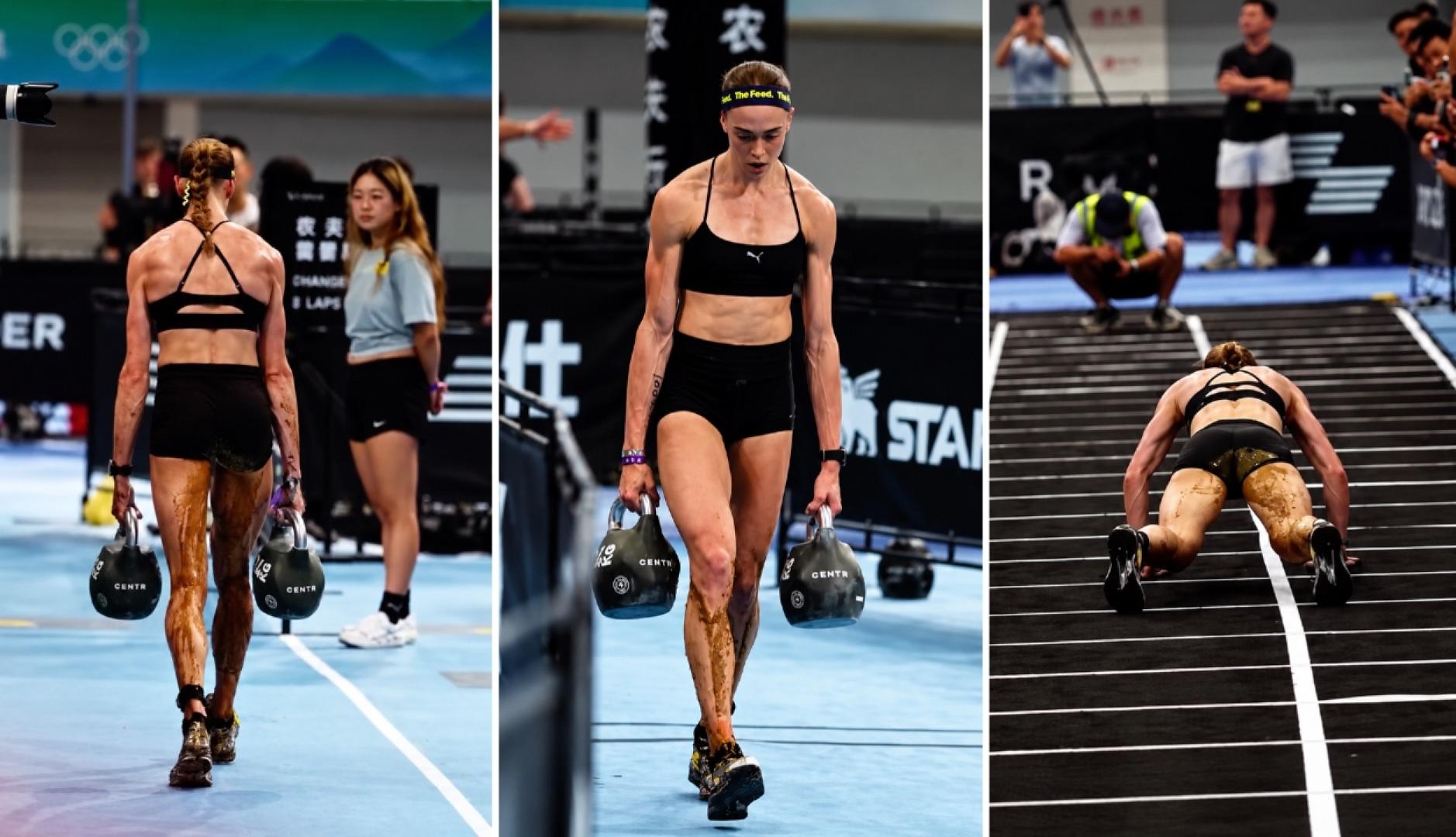
A situation that was difficult to foresee has ended up putting Hyrox’s protocols and reputation to the test. The Australian athlete Joanna Wietrzyk suffered an episode of intestinal incontinence while competing on September 12 in the Hyrox Beijing Women’s Pro category and, despite this, she was able to continue performing the different stations until crossing the finish line and winning the event.
Hyrox is a fitness competition that combines eight kilometers of running with eight functional exercise stations and has gained international popularity thanks to a standardized format, accessible to different levels and with a strong dimension of community and competition.
The incident could have been limited to the competition, but images of the athlete performing the exercises with visible fecal remains began to circulate on social networks and have sparked an international conversation. Criticism is primarily directed at Hyrox and its decision to allow Wietrzyk to continue participating in a competition in which athletes use shared spaces and equipment.
Video source: Vozpopuli on TikTok
The controversy has finally forced the organization to recognize that its actions were not appropriate and to introduce changes to its procedures. The case also shows how an operational incident can quickly escalate to become a reputational issue when it directly affects the experience that a brand offers its community.
Hyrox acknowledges that it should have intervened
Hyrox combines eight kilometers of running with eight functional exercise stations, so that numerous participants successively pass through the same spaces and equipment. This design meant that, once the images went viral, a good part of the conversation focused on the hygienic conditions and the actions of those responsible for the event.
The local organization later explained that the affected areas were isolated and disinfected and that contaminated elements were replaced. However, controversy continued to grow over the fact that the athlete had been able to complete the test.
The Co-Founder of Hyrox, Moritz Fürste, has ended up intervening publicly to apologize to the people affected and acknowledge the organization’s mistake. As explained in an Instagram post, Hyrox should have reacted immediately during the competition.
The company has since begun reviewing its procedures and introducing new rules to address similar situations in future races. The change affects precisely those cases in which continuing to compete could pose a pollution problem and force the organization to intervene. Hyrox has also sought to separate the company’s responsibility for the medical episode suffered by Wietrzyk. After the identity of the athlete was revealed and she began to receive personal attacks, the organization has condemned the threats and messages directed against her.
A crisis in full expansion of Hyrox
The episode occurs at a time of strong international growth for Hyrox. Born in Hamburg in 2017, the competition has developed a standardized format that it replicates in its international events and combines sport, spectacle and community. The Beijing event itself was extended for the first time to four days to respond to the high demand of participants.
Precisely this expansion increases the relevance of the protocols that sustain the experience. The appeal of Hyrox depends largely on thousands of people being able to compete under the same rules, using shared facilities and obtaining comparable results between events held in different countries.
What happened in Beijing has exposed a scenario that existing procedures did not resolve quickly enough. And Hyrox’s subsequent response has followed some of the usual steps in the face of a brand crisis: publicly acknowledging the mistake, apologizing, making concrete changes, and defending the person inadvertently at the center of the conversation.
The incident also shows the speed with which an issue that occurs within a sports venue can escape the control of the organization. The viralization of the images moved the debate from Beijing to an international audience and transformed an operational problem into a conversation about Hyrox standards.
The organization has recognized that its reaction was not up to the situation and has modified the rules a few days later. A particularly uncomfortable crisis that reminds us that, when a brand builds its growth around a shared experience, it must also be prepared to manage what is difficult to anticipate.