Generative artificial intelligence has evolved rapidly from its first promise – writing a prompt and obtaining an image – towards a much more ambitious model: being integrated into the entire creative process. In this context, Adobe reinforces its commitment to Firefly with an update that expands its video and image capabilities and moves towards a comprehensive creative environment powered by AI.
The company proposes a paradigm shift. The objective, in addition to generating content, is to articulate complete workflows in which creatives can ideate, iterate, edit and produce without leaving the same environment. Firefly thus positions itself as a “all-in-one creative AI studio”in which models from different providers, professional tools and new interaction interfaces converge.
This move responds to a growing need in the market to create faster and do so with consistency, control and the ability to scale.
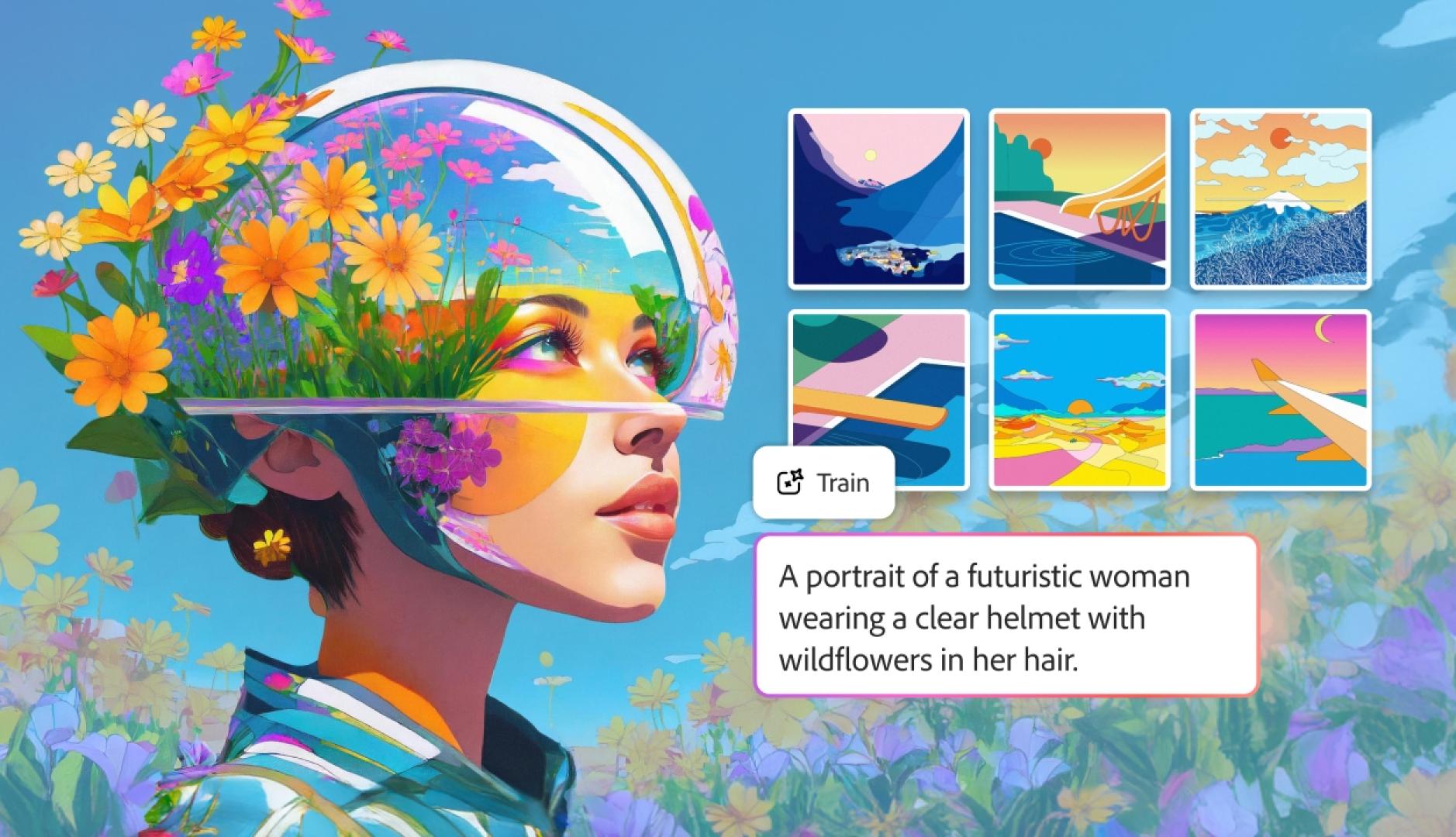
Firefly is capable of learning elements such as the stroke, color palette, lighting or features of a character
Personalized models: creative identity as an asset
The main advance of this update is the opening in public beta of Firefly’s custom models, a functionality that allows creatives and brands to train their own AI models from their images.
The logic is to transfer style – one of the most complex assets to build – to the field of automation. Through this system, Firefly is able to learn elements such as the stroke, color palette, lighting or features of a character, and reproduce them consistently in new generations.
This ability is especially relevant in three areas: illustration, where visual coherence is critical; creation of characters, which require narrative continuity; and photography, where the aesthetic finish must be maintained in different formats. So, the value is in scalability. Custom models allow you to produce large volumes of content without losing identity, something key for brands and teams that work on multiple channels and campaigns. Additionally, Adobe emphasizes that these models are private by default, reinforcing control over creative assets.
Another focus of the update is the expansion of the catalog of models available within Firefly. The platform already brings together more than 30 AI models from different providers, including developments from Adobe, Google, OpenAI or Runway, to which new additions such as Kling are added.
This approach seeks to offer the creative the possibility of choosing based on the needs of each project, without imposing a single model. Some are oriented towards cinematic movement, others towards photorealism, illustration or stylized design.
It allows you to generate with one model, refine with another and continue editing with professional tools without leaving the environment
The differential proposal is in the integration: Firefly allows you to generate with one model, perfect with another and continue editing with professional tools without leaving the environment. Additionally, Adobe introduces unlimited video and image generation on select plans, reinforcing the idea of frictionless exploration as part of the creative process.
From prompt to conversation: AI as a work interface
The evolution of the interface is the third pillar of this update. Adobe proposes a change from the prompt-based model towards a conversational system in which creation is articulated through dialogue with AI.
Within this framework is Project Moonlight, an agentic interface, currently in private beta, that connects different Adobe applications such as Photoshop, Express or Acrobat. Through it, users can describe what they want to achieve and agents execute real actions on the tools, which can subsequently be adjusted and perfected.
This approach brings interaction with technology closer to the way in which ideas are developed: iteratively, contextually and progressively. Thus, AI stops being a specific tool and becomes a system that accompanies the entire creative process.
On the other hand, Adobe has unveiled new capabilities aimed at accelerating the transition between generation and production. Among them stands out Quick Cut, a functionality that allows you to convert raw footage into a first structured montage in a matter of minutes. Added to this are improvements in image editing, which make it easier to add or remove elements, enlarge scenes or fine-tune the generated results.
With this update, Adobe expands Firefly’s capabilities, strengthening its positioning at a key time for the creative industry. Faced with a fragmented ecosystem of tools and models, the company is committed to a unified environment that combines technological power, creative control and brand coherence. And the incorporation of personalized models points directly to one of the great challenges of the sector, which is to scale production without diluting identity.