McAfee wants consumers to stop thinking of it solely as an antivirus company. After almost four decades linked to computer protection, the company has presented a comprehensive renewal that affects its product, visual identity and communication, and is based on a particularly significant decision: defining its category around security and not “cybersecurity.”
The move responds to a gap between what McAfee currently offers and what consumers recognize it for. According to the company’s own market research, 68% of consumers associate McAfee with antivirus protection, despite the fact that its catalog has expanded with solutions that include scam detection or security monitoring. dark web.
“We have been in the market for almost 40 years and trust is one of our strong points in all brand indicators”Stephanie Fried, CMO of McAfee, explained to Adweek. At the same time, he points out that this trajectory has a counterpart: the company continues to be recognized fundamentally for what it has done historically.
The renewal seeks to update that perception at a time when artificial intelligence is also transforming digital risks and multiplying the possibilities for fraudsters to act.
The brand change has been developed in parallel with a review of the product experience itself. Tavia Holmes, Executive Creative Director of McAfee – who joined the company last May – explained that the creative objective has been to address security as “something human, not technical.”
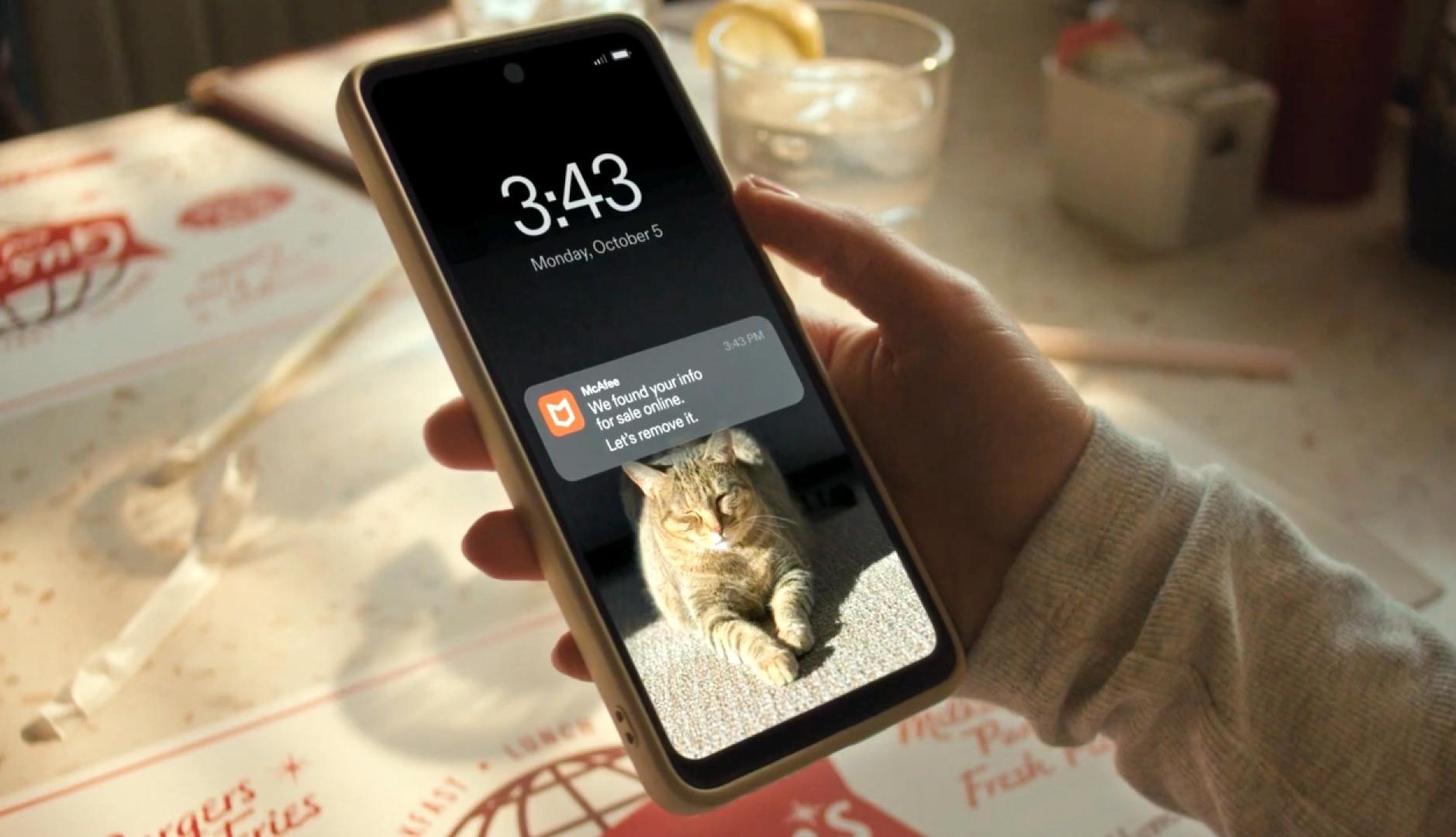
According to Holmes, the brand and product teams have worked together to simplify the way people understand, use and improve their digital security. The new experience reduces complexity, relies on notifications to guide the user and uses a visual system to indicate more clearly when intervention is necessary. It is precisely the product that has marked the development of the new brand. “The brand followed the product, and not the other way around”Holmes noted when presenting the work.
Protection is no longer associated with the device to cover digital life situations
The most relevant decision is in McAfee’s own territory. The company wants to talk about “safety” – security understood from a personal perspective – instead of “cybersecurity”, a term more linked to technology and system protection. With this, McAfee seeks to expand the framework from which it explains its services: protection is no longer associated solely with the device to encompass digital life situations related to scams, identity or exposure of personal information.
The McAfee shield changes red for orange
The renewal also materializes in a new design and visual identity system built on one of McAfee’s main historical assets: the shield.
The company maintains this element as a symbol of protection, but reinterprets it so that it also represents the people it protects. The system abandons the traditional prominence of red and adopts a warm and bright orange as its main color, called “safety orange” by the company.
Color also acquires a function within the product. In the app, green indicates that everything is properly protected, while orange indicates that the user must take action. In this way, the corporate identity and the digital experience share the same code. The update thus seeks to ensure that the brand functions as part of the security experience itself and not only as a communication layer added to the product.
“Safer than Safe”: more doors to protect
The third pillar of the renewal is “Safer than Safe”, the new creative platform that McAfee has developed together with the R/GA agency.
The concept is based on an idea linked to the evolution of digital life: there are more and more “doors” to protect, although many of them are invisible. At the same time, artificial intelligence has increased the scale and sophistication with which scammers can operate, causing consumers to question even what they see.
“Is this safe?” or “could I do something else?” These are some of the doubts that, according to Holmes, define this new scenario. McAfee’s proposal contrasts traditional protection behaviors with the promise of offering broader security in different areas of digital life.
The approach also allows the company to distance its communication from the traditionally technical codes of the category. The objective is to move the conversation from viruses, devices or computer threats to situations that directly affect people.
The work is also one of Holmes’ first major projects since joining McAfee. The creative highlights that the transformation has been developed transversally between the product and marketing teams, with R/GA as a partner in the development of the “Safer than Safe” platform.
With this renewal, McAfee tries to take advantage of the recognition built over almost four decades without being limited by it. It maintains the shield as an element of continuity, but changes the language, the color and, above all, the category from which it wants to relate to consumers.