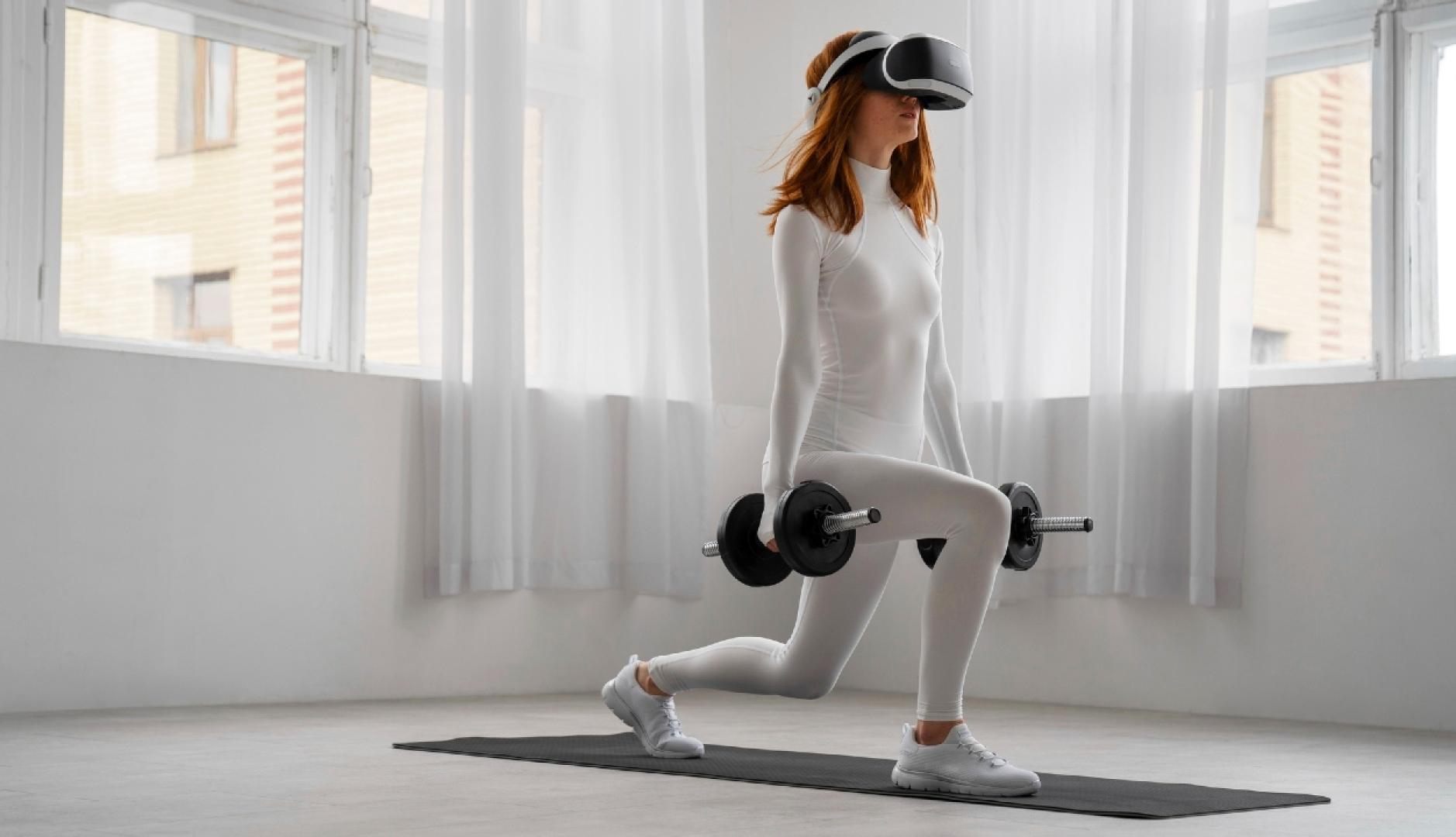
For decades, much of the fitness industry has built its proposition around relatively easy-to-visualize goals: lose weight, gain muscle, run faster or lift more weight. But the conversation is expanding. Exercise begins to relate less to achieving a certain physical result and more to how we want to live – and under what conditions we want to age – during the coming decades.
It is a transformation that is generating new products, services and consumer behaviors. Artificial intelligence begins to act as a personal trainer; wellness is incorporated into the design of residential buildings; social networks bring strength training to increasingly younger ages; and longevity is even creating new metrics by which to measure human performance. VML Intelligence brings together five trends that help understand where fitness culture is evolving.
Train to live better for more years
Longevity is changing the traditional promise of fitness. The objective is no longer exclusively to achieve visible results or surpass personal bests to focus on issues such as metabolic health, stability, cognitive capacity or the functional strength that a person can maintain as they age.
A particularly graphic manifestation of this trend will be the Super Age Games, which will be held on November 7, 2026 in New York and are presented as a fitness competition specifically designed around longevity.
Instead of just checking who runs the fastest or lifts the most weight, the tests will assess different dimensions related to aging well. “The Tightrope,” for example, will measure balance and stability, while “The Synapse” will test low-effort cognitive ability.
According to data collected by VML Intelligence, 20% of those registered are medical professionals, a sign of how longevity is transcending the purely aspirational terrain of wellness to also approach the scientific field. For David Stewart, founder of the Super Age Games, the difference is precisely in understanding well-being in a comprehensive way: preserving longevity requires that the physical, cognitive and social dimensions work together.
From the gym in the building to the building as a gym
Wellness is also changing the housing market. If for years the gym functioned as a amenity added to a residential development, some new projects are proposing practically the opposite: the home is built around a permanent ecosystem of health and exercise.
Life Time, an American fitness company, already operates four Life Time Living complexes where it combines housing and wellness
VML Intelligence highlights Life Time, an American fitness company that already operates four Life Time Living complexes, where it combines housing and wellness.
The next step will arrive at the end of 2026 with Life Time Brooklyn Tower, in New York. The project will have a athletic country club of around 7,500 square meters distributed over seven levels and will include a rooftop pool, indoor pool, contrast baths, saunas, recovery spaces and studios dedicated to disciplines such as Pilates, yoga, cardio or strength training.
The trend extends to other developments. VML points to Ace & Ivy, planned for Houston in 2028, which will integrate saunas and red light therapy in the rooms themselves, as well as an indoor pickleball club; and Akala, by Arada, whose opening in Dubai is scheduled for 2029 and which presents the residences around an environment of precision wellnesswith diagnosis, hydrotherapy and personalized wellness programs.
The evolution of the model live-work-play points like this towards a new layer: live-work-play-well. Wellbeing ceases to be a service to which one travels to become physically integrated into the place where one lives.
The personal trainer begins to be an algorithm
Artificial intelligence is also entering a traditionally very human relationship: that between coach and athlete. Beginners and experienced users are turning to tools like ChatGPT to create running plans, distribute strength training, or adapt their routines. And the phenomenon is beginning to scale. A study by ABC Fitness indicates that 61% of those who had used fitness solutions powered by AI turned to tracking applications based on this technology; 49% used tools linked to nutrition and food and 36% used virtual trainers or routine generators.
The opportunity does not lie solely in automating an exercise table. The conversation allows you to create an apparently personalized experience, enter information about objectives and progress and receive recommendations immediately. But that same ease introduces important limits. Experts cited by VML Intelligence warn that a chatbot lacks some of the context and nuance that a professional can interpret, especially when there are injuries or specific health circumstances.
AI can thus democratize a part of personalized training, but it also opens up a relevant question for the industry: what part of a trainer’s value lies in designing exercises and what part in observing, interpreting, correcting and understanding the person who performs them.
“Gymfluencers” are getting smaller
Social networks are generating another paradox. Screens are one of the great competitors for physical activity among young people, but they can also become a tool to stimulate it.
VML Intelligence identifies the emergence of “junior gymfluencers”, children and adolescents who share their training and progress on social networks and transfer the codes of adult fitness content to new generations.
One of the examples is Lucy Milgrim, a young American who practices wrestling and weightlifting and has gone viral showing her workouts. At 10 years old, he has accumulated nearly 200,000 followers and has recorded deadlifts of about 82 kilos.
Video source: @lucy.milgrim
The phenomenon is especially significant given the problem of youth sedentary lifestyle that VML points out: 81% of adolescents between 11 and 17 years old do not reach the recommended levels of physical activity.
The trend also raises a sensitive issue around boundaries, supervision and exposure to minors. But VML points to research that links following fitness creators to increased motivation to exercise among teens. Influencer culture, usually accused of keeping young people in front of a screen, could also be functioning as a gateway to physical activity.
From “lifespan” and “healthspan” to “peakspan”
The obsession with measuring longevity is also incorporating a new term into the vocabulary of well-being: peakspan.
Yeah lifespan expresses how much we live and healthspan how long we live without chronic diseases, peakspan It tries to measure how long we manage to stay close to our maximum physical and cognitive performance.
The concept has been developed by Alex Zhavoronkov, founder of the biotechnology company Insilico Medicine, together with Dominika Wilczok. Your proposal defines the peakspan as the interval during which a person retains at least 90% of their maximum functional performance in a given physical or cognitive capacity.
The conceptual difference is important. It is no longer just a matter of adding years to life or delaying the disease, but of extending the period during which a person retains abilities close to their best version. And, despite the growing market for treatments and biohacking built around longevity, VML recalls that the main recommendations to prolong it continue to be much less sophisticated: daily physical activity, balanced diet, periodic check-ups and sufficient rest.
The five trends point, ultimately, towards a change of scale. Fitness no longer ends when training ends. It is beginning to form part of how a home is designed, how artificial intelligence is used, what content is consumed on social networks and, above all, of a new aspiration: to live for more years while retaining the ability to enjoy it for longer.