Vogue has chosen one of the great international fashion showcases to reflect on the place of human creativity at a time marked by the development of artificial intelligence. And it has done so with a decision that has ended up concentrating a good part of the conversation: introducing four humanoid robots on the catwalk.
The show was structured in five acts that covered different stages of creation
The scene took place at Vogue World: Milano 2026, held on September 22 at the Vittorio Emanuele II Gallery coinciding with the start of Milan Fashion Week. The fifth edition of the traveling event of Vogue It was planned as a tribute to “Made in Italy”craftsmanship and human labor, while exploring the dialogue between tradition and technology.
The show was structured in five acts that covered different stages of fashion creation and production: “The Artisanal Revolution”, “The Industrial Revolution”, “Made in Italy”, “The Age of Intelligence” and “The Imagination Revolution”. The journey began with embroidery, lace, brocade and manual techniques and progressively moved towards new materials, technology and a speculative vision of the future.
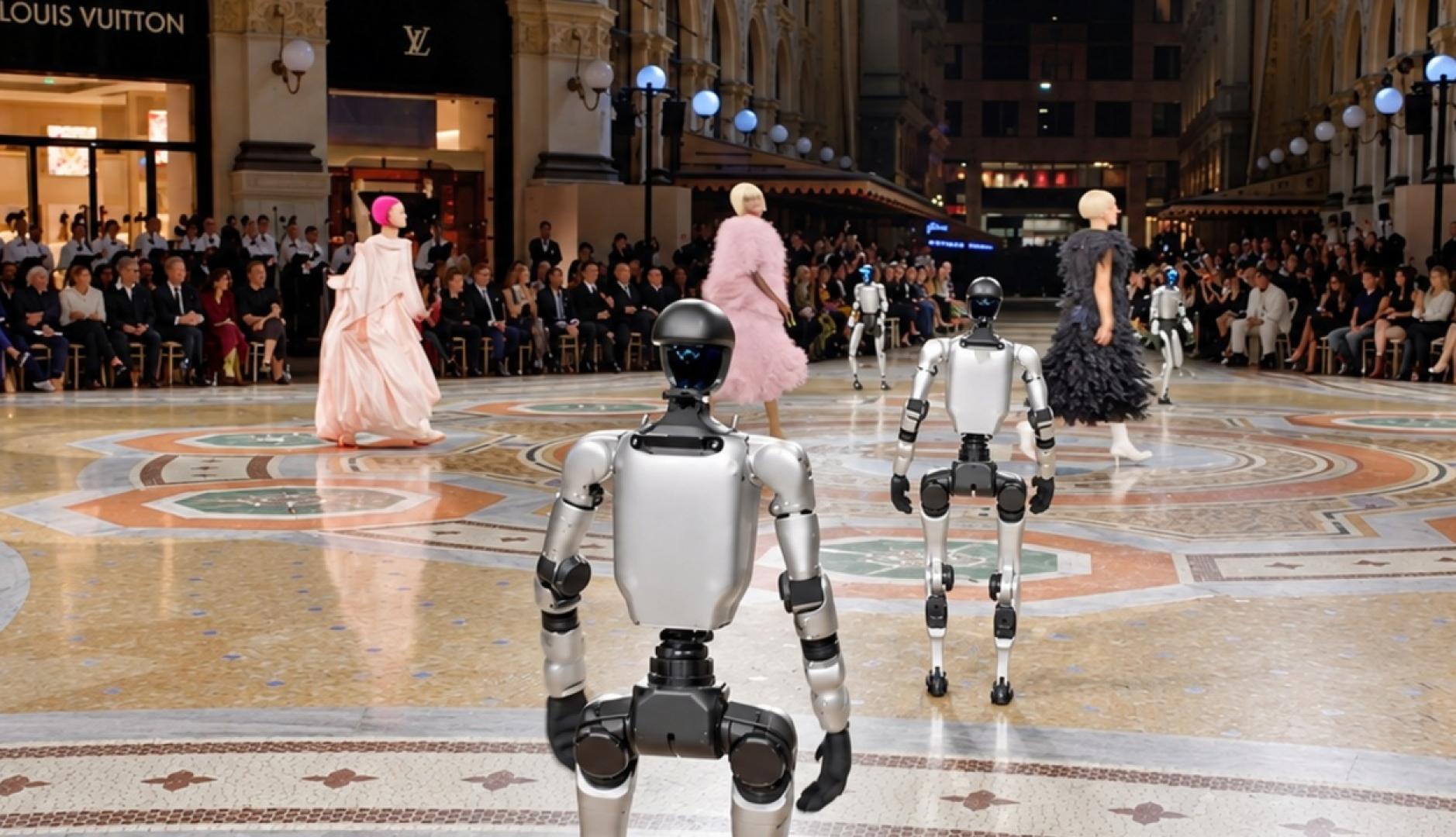
It was precisely during “The Age of Intelligence” when four humanoid robots from the Chinese company Unitree Robotics appeared among models on the catwalk of the historic Milanese gallery. The scene sought to represent the moment of technological transition that society is going through, but it also ended up opening a debate about the coherence of introducing robots in an event articulated around the value of the human hand.
Vogue World framed the evening as a celebration of Italian fashion’s ability to preserve its heritage while innovating. Historical houses such as Prada, Armani, Versace, Ferragamo and Gucci participated in a show that brought together different generations of designers, models, artists and artisans.
The location reinforced that approach. The Vittorio Emanuele II Gallery hosted a parade of these characteristics for the first time under its glass dome, between the Duomo and La Scala. own Vogue He defined the quote as a declaration of love to “Made in Italy” and to the hands that are behind the clothes.
The fourth act introduced the technological turn. Under the title “The Age of Intelligence”, the show addressed the confluence between craftsmanship and technology, with intelligent fabrics and materials capable of responding to movement, temperature or environmental conditions. In this context, the four Unitree robots appeared, walking along the catwalk and performing some movements in front of the attendees.
“Robots entered the conversation to represent this moment we are living in, which is the beginning of robotics”explained Juan Costa Paz, Creative Director of Vogue World Milano. According to the creative, their still clumsy appearance is part of the approach: he understands them as a representation of a possible historical turning point, comparable to the limitations presented by the first generations of other technologies. Costa Paz also recognizes the duality that Vogue I sought to provoke. Robotics can be fun and fascinating, but it can also cause concern. The message, as he explains, is to assume that both artificial intelligence and robots will be part of the future scenario.
The appearance did not go unnoticed. The images of the robots parading and dancing among the public quickly circulated on social networks, where some reactions from the attendees also went viral, including the expression of Alessandro Michele, Creative Director of Valentino, sitting in the front row.
The contrast was especially striking due to the argument that Vogue had used to build the event. “The Human Touch in the Age of Technology” precisely placed human work, craftsmanship and creativity in the face of technological changes at the center of Vogue World Milano.
However, the inclusion of robots was a deliberate part of that journey and was not proposed as a replacement for the creators. Vogue I had previously worked on this tension in the communication of the event through a piece directed by Bardia Zeinali and starring Vittoria Ceretti, reinterpreted as “Vittoria.ai”. The video incorporated effects generated by artificial intelligence to precisely address the limits of technology when it comes to reproducing issues such as taste, experience or emotion.
Original post on Instagram profile Vogue
“While technology can generate ideas and imitate styles, people bring their own experiences and emotions to art”Ceretti explained about the approach of the piece, defending the irreplaceable nature of that human dimension.
The presence of robots can be understood, therefore, as part of the tension that Vogue It intended to stage between hand and machine, tradition and innovation, craftsmanship and automation. But the visual impact of the intervention also caused that element to acquire its own relevance and, for part of the public conversation, overshadow other components of the parade.
The relationship between fashion and technology also extended to Vogue World’s own commercial structure. Among the main sponsors of the edition were Meta Glasses, along with ALO, eBay and Eli Lilly and Company.
The next edition of Vogue World will take place in San Francisco
The approach of Vogue The technology sector does not end in Milan either. The next edition of Vogue World will take place in San Francisco, reinforcing the meeting between one of the great editorial institutions of fashion and the epicenter of the American technology industry. A movement that can be understood within a broader approach of Vogue and Condé Nast to Silicon Valley, although there has been no official explanation of Vogue about the event in this sense.
In any case, the intervention can be read as a provocation consistent with the dialogue between the human and the technological that structured the show or as a decision that ended up subtracting prominence from the artisanal argument. But he has managed to transfer a question that was in Vogue World’s own approach off the catwalk: what space will people, machines and creativity occupy in the fashion to come.