One of the brands’ highest aspirations is to transcend traditional advertising and attract their target audience with entertainment proposals. This is why branded content has been positioned as a key piece of marketing strategies for years. The practice took off more than a decade ago with the consolidation of digital platforms and is now going through a new peak with the success of microdramas.
The rise of microdramas
Like traditional series, they are characterized by the development of a story through episodic narration. The main differences lie, on the one hand, in the duration of the chapters, which are around two minutes; and, on the other, in its vertical design and production specifically conceived for consumption on mobile phones and on social networks. They began to become popular in the Chinese market during the pandemic and have already spread and consolidated globally.
According to the “State of Short Drama Apps 2026” report by Sensor Tower, microdramas have gone from being a niche format to a fully established category, surpassing even social networks or traditional streaming. Global downloads of microdrama apps have grown rapidly, surpassing 850 million downloads in the first quarter of this year. This represents an increase of 140% year-on-year, a figure significantly higher than the 39% recorded by streaming video applications.
The average daily viewing time for microdramas is 25 minutes
Among other data that shows the evolution of the format, the research firm highlights that six microdrama applications were among the 40 most downloaded worldwide, with FreeReels leading the way at number 8. It also reveals that users spent almost six times more time on these applications than a year ago; or that the average daily viewing time reached 25 minutes worldwide in April 2026, 85% more than in January 2025, compared to 35 minutes for OTT streaming, which demonstrates the interaction and engagement generated by the format.
The interest in microdramas has been such that, in addition to causing the proliferation of platforms focused on the format, it has also captured the attention of the major players in the audiovisual industry. Earlier this year, TikTok announced the launch in the United States and Brazil of PineDrama, its own application dedicated to microdramas. In our country, for example, Atresmedia responded to the phenomenon with the launch of “A Bride for Christmas” in December 2025, which accumulated 20 million views on its streaming platform Atresplayer and on its social networks and which had a second season in the summer of 2026.
A new space for brand storytelling
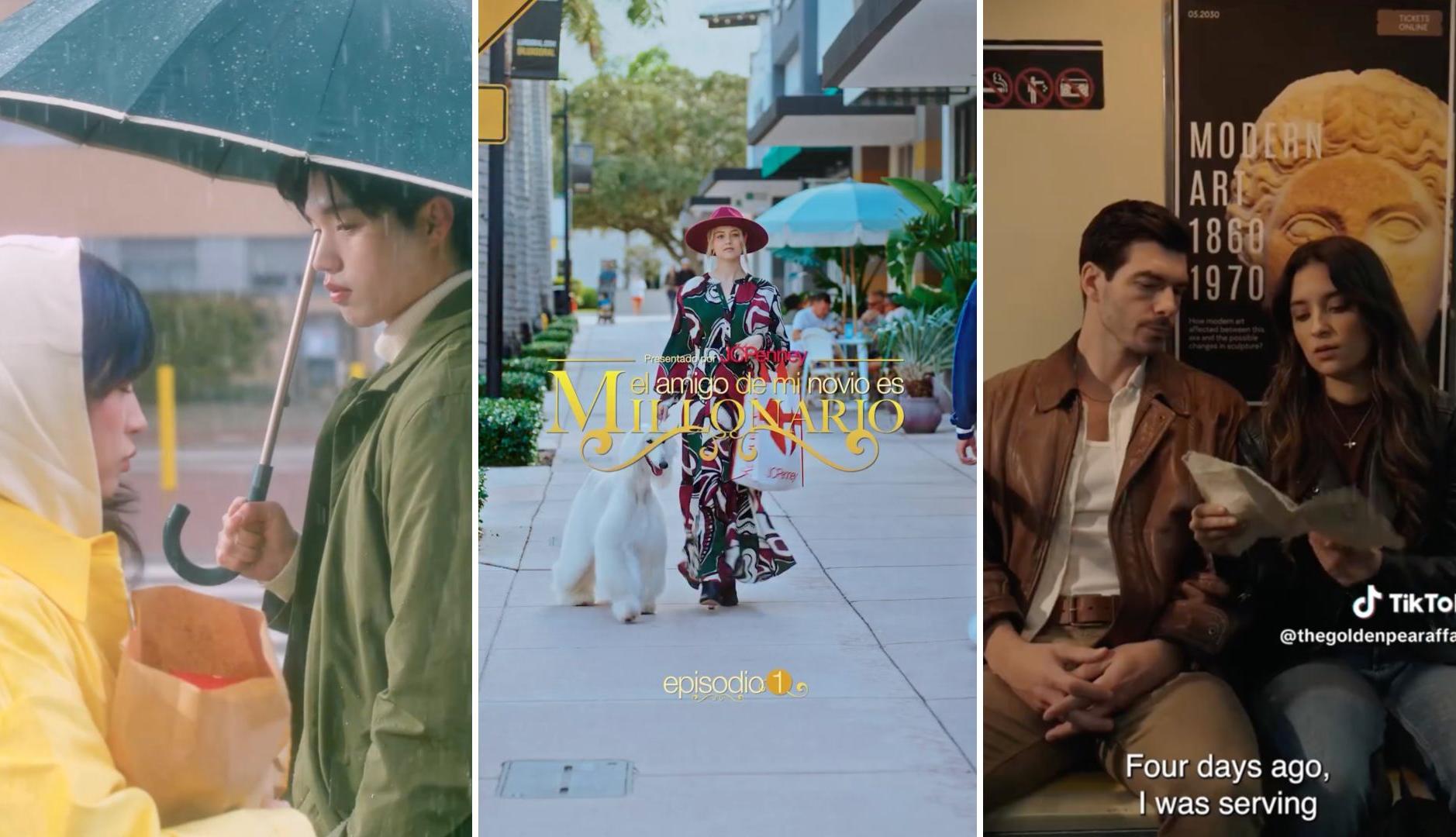
The phenomenon has also attracted brands, which in recent years have explored this short-form entertainment formula as an evolution of previous web series. Last Christmas, the department store chain JCPenney launched “My boyfriend’s friend is a millionaire,” together with TelevisaUnivision to boost its notoriety among the Latin public. Throughout five soap opera-style chapters, a story develops in which the protagonist believes that a young man is a millionaire, but he ends up being a buyer looking for affordable prices.
The microdrama generated more than 16 million impressions and 5.6 million video views, according to Marketing Dive. In addition, it also aspired to boost sales, since each delivery included QR codes on the screen with links to the marketplace to purchase all the products that appeared in the series.
Original Univision post on Instagram.
The Christmas period was also chosen by Maybelline New York to launch “Maybe This Christmas”, created together with the creative agency Maximum Effort. The microdrama consisted of five installments performed by actors Lacey Chabert and Dustin Milligan – stars of the Netflix hit “A Snowman to Melt” – and highlighted the brand’s Instant Eraser concealer.
Original Maybelline post on Instagram
For its part, Crocs launched “Charmed to meet you” on the occasion of Valentine’s Day. The microdrama, available on the ReelShort platform and told through five chapters, told the love story of two young people through the exchange of Jibbitz shoe decorations.
According to The Wall Street JournalCrocs had not previously produced scripted content of this type, but according to its Marketing Director, Carly Gomez, the brand was attracted to the format due to its low production costs and its potential to connect with Generation Z consumers. The series achieved 7.8 million views in three weeks, according to Crocs.
Original post by ReelShots on TikTok.
Marketing in microdramas
Procter & Gamble has also found in microdramas a way to enhance its notoriety and digital presence, and to expand its long-standing commitment to entertainment. It is worth remembering that the company was a precursor of the so-called “soap opera”, the soap operas that have their origin in the radio dramas of the 1930s promoted by manufacturers to promote their products for the home.
Last April, its Native deodorant brand launched “The Golden Pear Affair”, a 55-episode series created by P&G Studios, the company’s production division, and Dentsu Entertainment, which combined suspense and romantic drama. The series promoted Native’s Global Flavors range and its first five episodes can be viewed for free on the brand’s YouTube channel, as well as on TikTok, Instagram and Facebook. However, the entire series was offered for $9.99 on a dedicated website, as were the episodes individually. By visiting the page, users could access Native promotions and unlock additional episodes.
In our country, microdramas are also establishing themselves in the marketing strategies of brands. In February McDonald’s Spain launched “Amor a primer crunch”, a microdrama created together with the TBWA Spain agency that emulated the aesthetics and narrative of Korean dramas. Its objective was to promote the McCrispy Korean BBQ burger,
Original post from McDonald’s Spain on Instagram
However, the possibilities around microdramas include other options beyond the production of a complete series. As in other audiovisual formats, product placement or sponsorship are practices that are also being explored. This is what Gushers did, the fruit snack brand marketed by General Mills, which was the first to sponsor the microdrama “Screen Time”, created by screenwriter Issa Rae (HBO’s “Insecure”) and available on PineDrama. It appeared integrated into the final episode and additional content promoting the show, such as interviews with the cast.
“Screen Time” has exceeded 150 million views.
Original post by Hooramedia on TikTok
Proof of the potential and growth of microdramas is the involvement of Hollywood stars in this new format. In addition to Issa Rae, other actors and scriptwriters are also betting on it both in front of and behind the cameras. Actor James Franco, for example, stars in “Love, Lies & Frank” on the Shortical platform; while Kim Kardashian has invested in the GammaTime app.
Microdramas, which continue to be a natural evolution of certain branded content formulas towards current forms of content consumption, provide opportunities for brands in the territory of entertainment and the construction of storytelling. They allow longer and less intrusive stories to be told than the traditional advertisement, and also richer and more emotional to deepen the relationship with consumers.
In addition, they also offer commercial possibilities if the sales functionalities of social networks are used, facilitating the direct purchase of the products that appear in the different chapters. And it is not about hiding the brand presence, but about integrating it into the entertainment proposal in such a way that it accompanies the story and generates a desirable experience.
Precisely that balance between brand messages and the telling of a story that really engages the audience and keeps their attention is the main challenge of a format that still has the advantage of not being saturated or overcrowded. The key to the sustained success of microdramas will lie in adopting a change in mindset around brands as storytellers, that is, generating buzz and piquing the audience’s interest in discovering what story the brand will tell next.