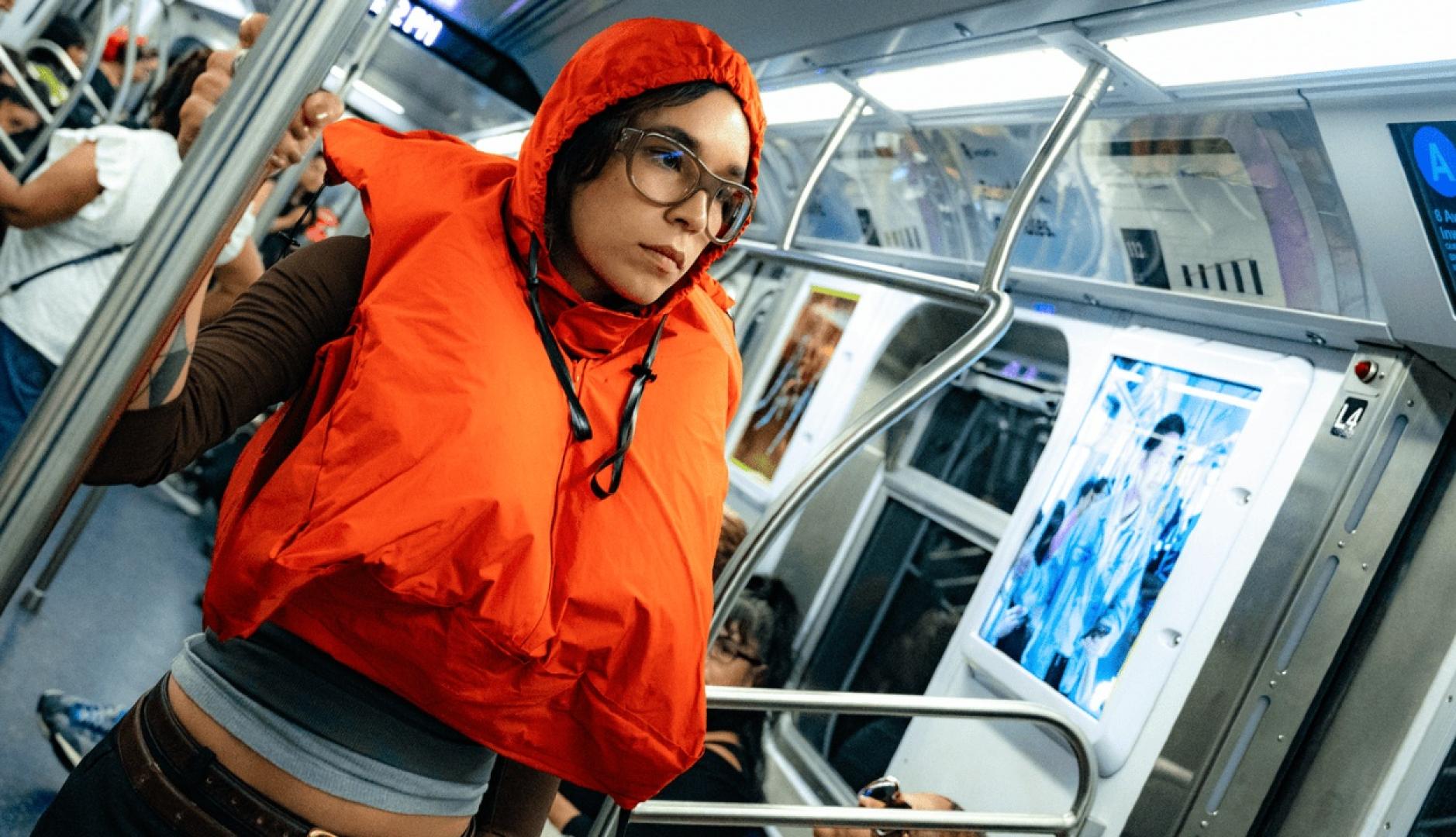
A seemingly conventional orange tote bag that can transform into a self-inflating life jacket in about 15 seconds. This is the proposal of Lifeline, an artistic and design project presented in New York to raise a question: what happens when equipment designed for an emergency begins to seem like a reasonable object for everyday life?
The piece has been created by an independent group of artists and creative professionals from New York, led by Philip Le Brun, artist and creative director, and Gabriela Mestriner, artist, designer and architect. Lifeline is not for sale nor does it intend to reach the market. Those responsible define it as an intervention located between design, protest and reflection on climate change.
The piece is situated between two universes: the fashion accessory and the emergency equipment.
The project was presented coinciding with Climate Week NYC, which takes place from September 20 to 27, and has also taken advantage of the context of New York fashion week. The choice seeks precisely to place the piece between two universes: fashion accessory and emergency equipment, consumption and survival. “We take the most everyday object, a tote bag, and we rethink it for a city that is on the front line of climate change”explains Le Brun.
Lifeline is based on one of the most common objects on the streets of New York. At first glance it works like a conventional bag, but a central zipper allows it to be opened to be inserted over the head and worn on the body. Pulling its straps activates an inflation mechanism derived from the technology used in life jackets. The result is a transformation that lasts around 15 seconds and allows the object to go from functioning as a bag to acting as a floating element.
The idea arose from images of flooding that has affected the subway and other spaces in New York during extreme weather events. Instead of proposing a real solution to this problem, the creators have taken this scenario to its ultimate consequences by designing an object that seems useful precisely because the context that would make it necessary is no longer completely implausible. “The general principle of this project is an essential object that should not exist”summarizes Le Brun.
Mestriner insists on this difference: “The project is not about designing a solution for flooding.” Its objective is to question what conditions make it possible to imagine that an object of these characteristics could become necessary.
In the conceptual text of the project, the designer delves into this contradiction and proposes Lifeline as “a speculative essay” about the cultural and environmental conditions that could give rise to an object that should never need to exist. The transformation of the stock market seeks to bring face to face concepts such as comfort and emergency, consumption and survival, privilege and vulnerability.
The first prototypes were developed using a single mass-produced waterproof jacket, taking advantage of its seams, proportions, closures and limitations as a starting point to build the new piece. A reused inflatable life jacket was later incorporated, which was modified and heat-sealed to integrate the instant inflation mechanism. The final version uses approximately three yards of nylon, two invisible polyester zippers, four yards of black cord, and four adjustable metal zippers.
The entire project has been carried out physically and locally. Those responsible also highlight that no artificial intelligence was used either to develop the object or to produce the campaign images. The process progressed through successive phases of manufacturing, testing, dismantling and adaptation.
Lifeline is a unique and non-commercial piece, developed without financing and through an artisanal process. For its creators, mass producing an object intended to criticize precisely the dynamics of consumption and its environmental impact would have introduced another contradiction in the project.
The project has been disseminated through content on social networks and billboards in areas such as Soho and Brooklyn, treating the object almost as if it were the launch of a new accessory. “Lifeline does not propose a solution, neither to the floods nor, of course, to something as complex as the climate crisis,” explains Le Brun. The creative defines the project as a speculative exercise that invites us to imagine the need to use the object and, at the same time, ask ourselves why this future is increasingly plausible.