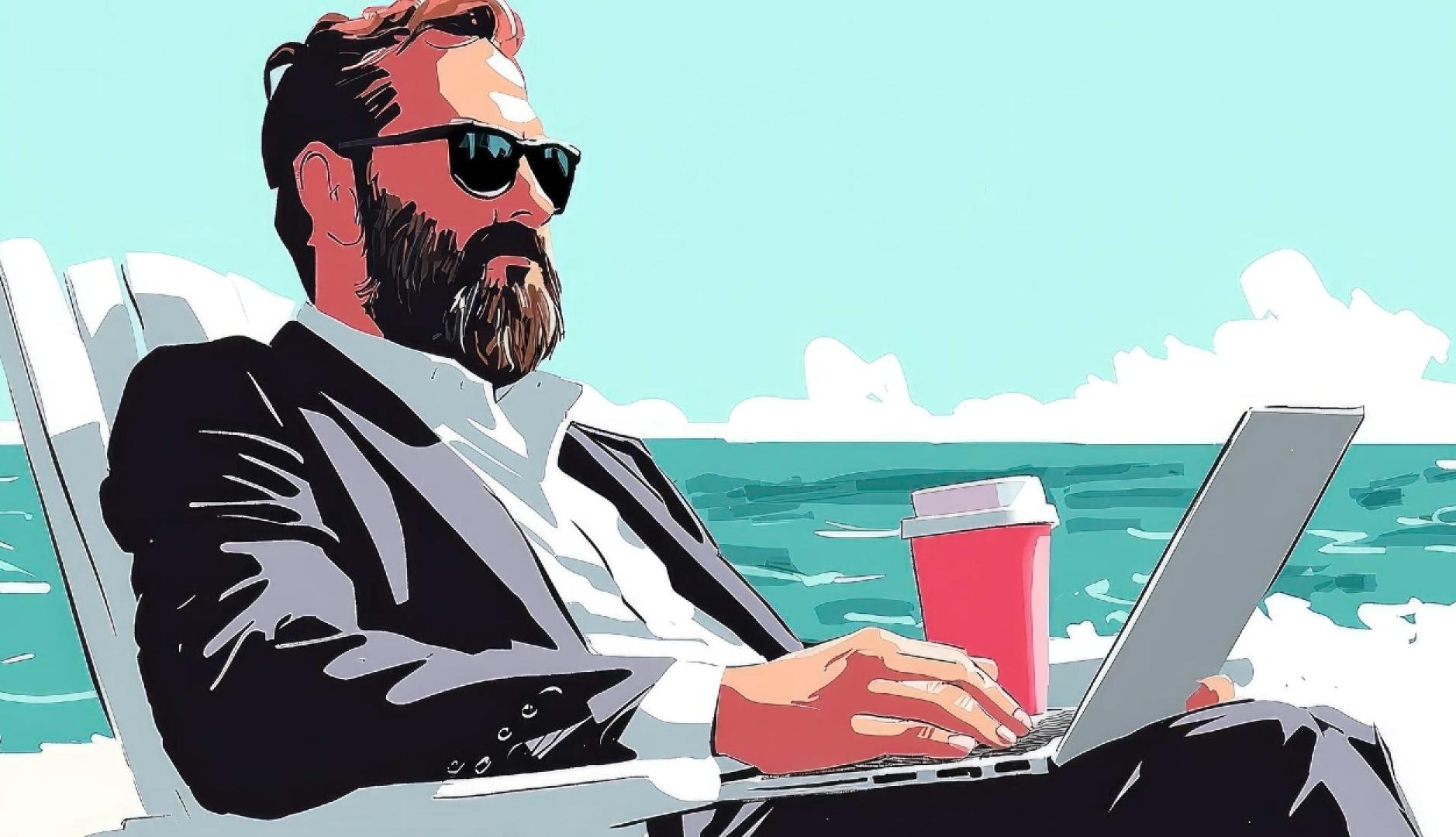
Closing the computer, activating the automatic email response and changing the office for a beach does not guarantee that the vacation has really started. The body can be hundreds of miles from the workplace while the head continues to review meetings, anticipate problems or check notifications. And when professional obligations finally disappear, another need appears: immediately fill the space they have left.
The Germans have an especially graphic word to describe part of that paradox: “Freizeitstress.” It is made up of Freizeit -free time- and Stressand the Duden dictionary defines it as “the stress that arises from excessive activities during leisure time.” The concept serves to give a name to a very contemporary contradiction: having time to rest and being unable to stop managing it as if it were work.
The issue takes on new relevance when the concept is taken to the field of leadership. And for certain professionals, permanent activity ends up being more than just a consequence of a demanding agenda: it can function as a source of structure, recognition and identity. When it disappears, the emptiness does not always bring relief.
When vacations also need to be productive
He Freizeitstress It can take seemingly innocent forms. Plan every hour of the trip, make a list of essential restaurants, chain visits, control the kilometers traveled, schedule training or feel that an afternoon without plans is a wasted opportunity.
The logic of performance thus shifts from work to leisure. It is no longer enough to have vacations: we must take advantage of them. And this use may end up subject to the same optimization, measurement and compliance criteria that organize professional life.
“Freizeitstress” appears when free time is filled with “I have to” and rest becomes another obligation
The conversations on networks around the term reflect precisely that experience. In German communities, users appear who identify the Freizeitstress with the self-imposed pressure to fit in numerous activities and events during the weekend or with the feeling that any activity accompanied by a “I have to” stops truly functioning as a break. These are personal testimonies, not scientific evidence, but they illustrate the extent to which the concept has found everyday expression in the culture of hyperactivity.
In managerial profiles there is also another layer. Work provides not only occupation, but also problems to solve, decisions to make, and the recurring feeling of being necessary. Hence, checking “just one email,” following a project remotely, or remaining available to the team may seem less like an interruption of vacation than a way to keep that identity intact.
Going on vacation is not the same as disconnecting
Organizational psychology has been studying this phenomenon for years under the concept of “psychological detachment”, or psychological detachment: the ability to stop carrying out professional activities, but also to stop thinking about them repeatedly during free time.
Research by Sabine Sonnentag and Caterina Schiffner points out that this distancing constitutes an important experience for recovery and well-being. Their work also found a particularly interesting dimension for those in positions of responsibility: the leader’s degree of disconnection was related to that of his collaborators and, indirectly, with lower levels of exhaustion and need for recovery among them. The way a boss rests can also send signals about how rest is allowed within an organization.
The latest evidence reinforces the importance of vacations. A meta-analysis published in 2025 in Journal of Applied Psychology reviewed 32 studies and 256 effect sizes and concluded that vacations produce a considerable improvement in well-being and that its benefits wear off more slowly than previous research had suggested.
The researchers also analyzed eight studies, with 69 effect sizes, to study what happens during the vacation itself. Among the experiences associated with greater benefits, psychological detachment from work and physical activity appears precisely. The length of the vacation also influences, although the research does not allow us to clearly conclude whether traveling, staying at home or combining both options is better. This clarifies a common idea: resting does not depend solely on how many days you have available or where you spend them. It matters what happens mentally during them.
In parallel, other trends are questioning the idea that a good vacation should be measured by the number of accumulated plans. The “staycation” proposes enjoying free time at home or near your place of residence, eliminating much of the logistics, travel and pressure associated with travel. The “sleepcation” takes that logic a step further and places sleep and recovery as the central purpose of the getaway, with accommodations and experiences specifically geared toward rest. Both respond, from different angles, to the same review: going from a vacation that must be taken advantage of to a vacation that really allows you to stop.
Video source: @elpaisuy
Permanent connectivity has made that border especially porous. An email can be checked from a deck chair; Slack can enter the hotel room and an incident can be resolved from an excursion. Availability no longer requires physical presence. But there is also a less visible dimension. There is no need to open the email to continue working. It is enough to anticipate the inbox, mentally rehearse a pending conversation or repeatedly ask yourself what is happening in your absence.
Hence a seemingly simple solution emerges: transform disconnection into another productivity project. A perfectly timed wellness retreat, a strict relaxation routine, or a goal-filled digital detox can reproduce precisely the control logic you’re trying to escape.
The proposal made by author and leadership coach Rob Cross in an article by Fast Company It involves using the initial discomfort generated by empty time as information. And it raises three questions:
- “Who am I?”
- “Why am I here?”
- “How am I going to live?”
The first aims to separate identity and professional position; the second, to reconsider where time and attention are really being invested; and the third, to translate that distance into some concrete change upon return: eliminate a recurring meeting, establish a night without email, reserve time to think without interruptions or delegate a responsibility that remains centralized more out of a need for control than out of business necessity.
The value of doing nothing
There is one final difficulty: true rest can be uncomfortable at first. A mind accustomed to stimuli, urgencies and objectives does not necessarily interpret the absence of activity as tranquility. You can interpret it as emptiness.
The automatic reaction is to fill it. Look at your phone, open an app, search for a plan, or make up a task. He Freizeitstress It begins precisely when free time stops being an open space and becomes another list of obligations.
The difference is between choosing leisure or feeling the obligation to take advantage of it.
This doesn’t mean that a good vacation should consist of inactivity. A 2025 research from the Institute for Public Knowledge, in fact, links physical activity during the holidays with higher levels of well-being. The difference is between doing something because you want to and doing it because even leisure has been subjected to the requirement of taking advantage of every minute.
And there the German concept acquires a reading that transcends vacations. The problem is not having plans, traveling, playing sports or wanting to know a place. It is having internalized productivity to such an extent that we also need to demonstrate that we are using our free time correctly.
Vacations can then fulfill a deeper function than recovering energy to return to production. They can reveal the extent to which work has colonized the way we organize the rest of our lives. Because perhaps the clearest sign that someone needs to rest is not being tired. It may be having forgotten what to do with your time when you have nothing to do.